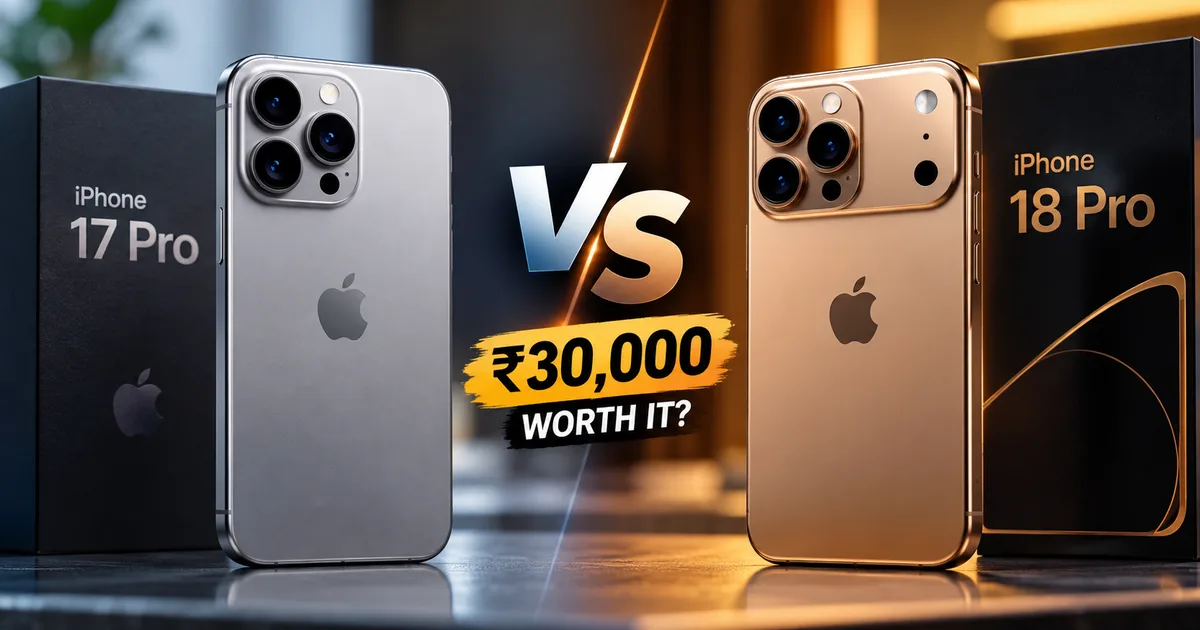
So, the Apple iPhone 17 Pro vs iPhone 18 Pro debate is officially taking over our WhatsApp tech groups and family chats. Apple just dropped the new series in India. It's a bit of a mess, honestly, and the pricing has left a lot of people scratching their heads. You walk into a Croma or an official Apple Store right now, and you face a genuinely tough choice. Do you drop a massive chunk of change on the absolute latest iPhone 18 Pro? Or do you pick up last year's iPhone 17 Pro at a solid discount?
I've been looking at the leaked specs and the early performance numbers. Honestly, this is one of the trickiest upgrade cycles we've seen in a long time. For years, the rule was simple. Just buy the newest one you can afford. But this time around, the older phone might actually be the smarter buy for most of us.
Let's break down exactly what you get for the extra money. Because when you're talking about spending upwards of a lakh and a half, you deserve to know if those new upgrades actually translate to a better experience in your day-to-day life. I think the numbers here are a bit fuzzy.
The ₹30,000 question: real prices in India
Here's the deal with the numbers. Apple has priced the new iPhone 18 Pro starting at an eye-watering ₹1,64,900 for the base 256GB variant. Yes, that's the starting price. If you want 512GB or 1TB, you're looking at numbers that could easily fund a decent second-hand hatchback (which makes sense, actually).
Meanwhile, the iPhone 17 Pro originally launched at ₹1,34,900. It is currently floating around ₹1,30,000. And that's before you apply any HDFC or ICICI bank credit card offers. During the festive sales, we'll probably see that price dip even lower. That gives us a minimum ₹30,000 to ₹35,000 price gap between the two generations.
Think about what ₹35,000 means right now. You could literally buy a very decent Android mid-ranger for a parent or just put it in a fixed deposit. And if you're eyeing the larger screen model, you'll want to check out the iPhone 18 Pro Max 2026 Leaks: Expected India Price & Specs because the premium on the Max version is even more painful.
Apple has officially delisted the iPhone 17 Pro from their online store. That is their standard practice to push people toward the newer models. But offline retailers and online platforms like Flipkart and Amazon still have plenty of stock. The choice is yours.
What actually changed in the design?
If you put the iPhone 18 Pro and the iPhone 17 Pro side by side on a cafe table, most people won't know which one you bought. They both have the same 6.3-inch screen size. They both have that familiar triple camera layout on the back.
But there are a few nerdy differences when you look closely. The iPhone 18 Pro is slightly heavier at 211 grams compared to the 17 Pro's 206 grams. You probably won't feel that difference in your pocket. Apple also bumped up the thickness to 8.75mm from 8.25mm to fit a larger battery and the new camera hardware. If you ask me, it's a fair tradeoff.
Both phones use the aluminum unibody design that Apple introduced with the 17 Pro. They ditched the titanium of older models. They both have Ceramic Shield 2 on the front for drop protection. The colors have shifted slightly. The iPhone 18 Pro comes in blue, silver, burgundy, and black. I genuinely miss some of the wilder colors from a few years ago. But Apple likes to keep the Pro models looking like expensive business suits.
If you want a truly radical design change from Apple, you're better off waiting to see what happens with the Apple iPhone Duo 2026 Foldable: Expected Price & Features. The 18 Pro just refines the existing slab phone formula.
Screen brightness and the smaller Dynamic Island
The display is where you might actually notice an upgrade. Especially if you spend a lot of time outside. The iPhone 18 Pro can hit a peak outdoor brightness of 3,000 nits. The iPhone 17 Pro was already very bright. But 3,000 nits is borderline flashlight territory.
Why does this matter in India? Imagine trying to scan a UPI QR code at a street vendor in the blazing May heat in Delhi or Chennai. With older phones, you've got to squint and shield the screen with your hand. You do it just to make sure you aren't sending ₹5,000 instead of ₹500. The iPhone 18 Pro screen fights through the glare effortlessly.
Apple also shrank the Dynamic Island at the top of the screen. It takes up less space now and can handle multiple Live Activities at once. So you can track your Swiggy order and keep an eye on the IPL score at the exact same time (annoying, I know, but sometimes you need it). I think it's a nice quality-of-life update. Though it is hardly a reason to drop ₹1.6 lakhs.
The A20 Pro chip and Apple Intelligence processing
This is the main marketing push for the new phone. The iPhone 18 Pro runs on the brand new A20 Pro chip. It is built on a 2-nanometer process by TSMC. Basically, a 2nm chip packs more computing power into a smaller space and uses less battery to do the same tasks.
But the real focus here is on Apple Intelligence. Both the iPhone 17 Pro and the iPhone 18 Pro have 12GB of RAM. That's a massive detail. It means the older iPhone 17 Pro is completely capable of running all the upcoming on-device AI features that Apple is rolling out over the next few years. You'll still get the smart notification summaries and the AI writing tools on the older phone.
The difference is the A20 Pro chip will handle complex Siri requests a fraction of a second faster because of its newer neural engine. Will you notice that fraction of a second when asking Siri to set a timer for your morning chai or add milk to your grocery list? Probably not. I'm not sure exactly why Apple makes a big deal out of it.
"I don't think the iPhone 18 Pro will offer big enough changes for most people to wait and spend an extra $200 to $300. This advice is especially applicable if you're upgrading from a phone that is more than a couple of years old."
I agree completely. Unless your daily workflow involves rendering 4K video on your phone or playing heavy games for hours on end, the processor upgrade alone doesn't justify the massive price gap.
Camera upgrades: understanding the variable aperture
If you love taking photos, the camera changes might actually tempt you. The biggest hardware addition to the iPhone 18 Pro is a variable aperture on the main camera.
What does that mean in normal terms? The aperture is the hole in the lens that lets light in. On most phones, that hole is a fixed size. A variable aperture means the phone can physically change the size of that hole. Just like a professional DSLR camera. This gives you much better control over the blur behind your subject, known as the depth of field. In my experience, this is huge.
Think about a typical Indian wedding. If you're taking a portrait of just the bride, you want the background completely blurred out so she stands out. The camera opens the aperture wide. But if you're taking a group photo of twenty family members, you want everyone's face in sharp focus, even the people standing in the back row. The camera closes the aperture slightly to increase the focus depth.
It is a fantastic tool for people who understand photography and know how to use it. You can get some incredibly professional-looking shots. But for the average point-and-shoot user who just wants to snap a picture of their dog or a sunset? The iPhone 17 Pro camera is already so good that you might not even notice the difference.
Battery life improvements and charging
Because the phone is slightly thicker and the A20 Pro chip is far more power-efficient, the iPhone 18 Pro has noticeably better battery life. Early leaks and reports point to the largest jump in battery life we've seen in several generations.
For Indian users who commute for hours and rely on their phones for literally everything, battery life is the most important spec. You use it for metro tickets, UPI payments, WhatsApp calls, and streaming music. If your current phone always dies by 5 PM and leaves you stranded without a way to pay for an auto rickshaw (we've all been there), a massive battery upgrade is a big deal.
That said, the iPhone 17 Pro is no slouch. It comfortably lasts a full day for most people. But if you're a heavy user who spends four hours a day on 5G data watching YouTube or scrolling through Instagram, the 18 Pro gives you that extra peace of mind.
So, which one should you actually buy?
It comes down to simple math and what you actually value in a phone.
Here's exactly why you might consider the iPhone 18 Pro instead of the 17 Pro:
- You want the absolute best battery life possible for long commutes on the metro.
- You understand photography and will actually use the variable aperture controls to adjust depth of field.
- You upgrade your phone every five years and want the newest A20 Pro chip for maximum future-proofing.
- You spend a lot of time outdoors and need the crazy 3,000 nits screen brightness to see your display clearly.
But you should buy the iPhone 17 Pro if you value your hard-earned money. It has the same 12GB of RAM for future AI features and an excellent camera system that takes better photos than most of us know what to do with. Saving ₹30,000 just makes total financial sense right now. You can check out more deep dives on hardware specs in our Tech Explainers section if you want to dig into the exact processor differences across older models.
Honestly, the 17 Pro is the sweet spot for 2026.
Grab one while they're still in stock at offline stores before Apple completely phases them out. Or just wait until the iPhone 19 comes out, and we can do this all over again.