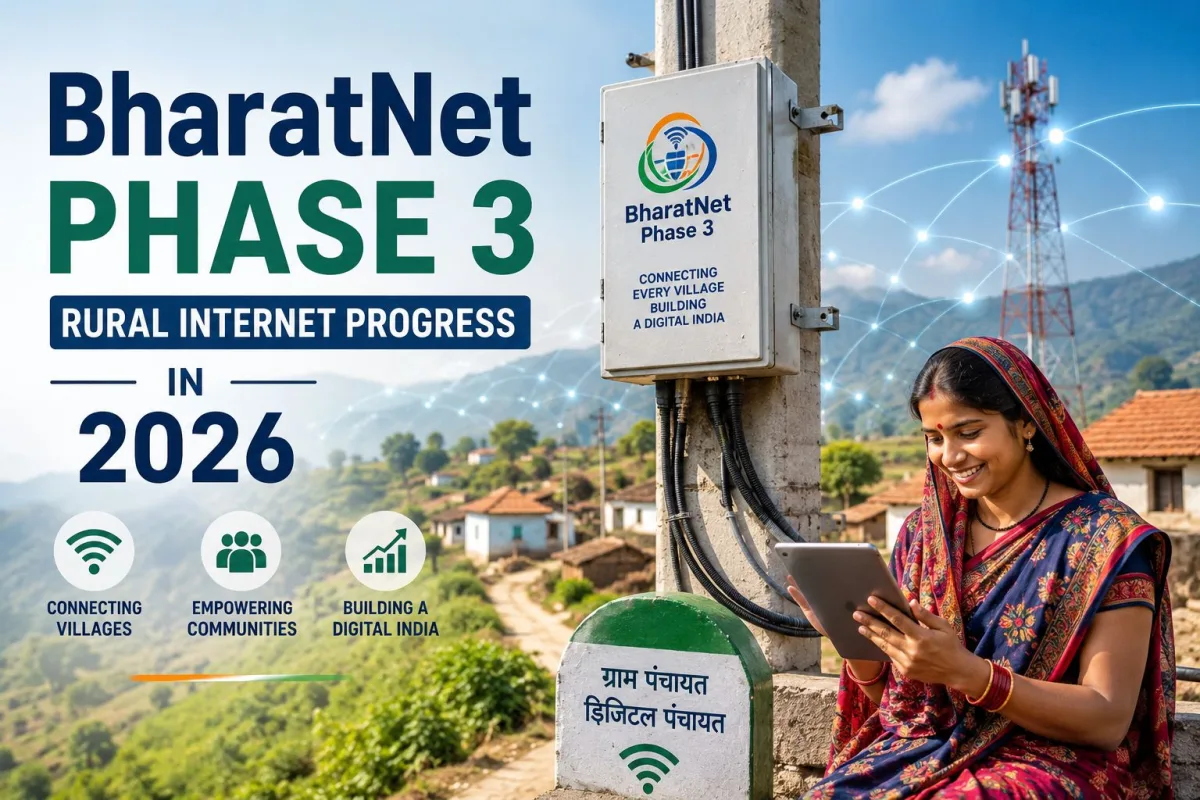
India's BharatNet Phase 3 is the government's most ambitious attempt yet to bring high-speed internet to the country's remotest villages. As of May 2026, over 2.14 lakh gram panchayats have been connected under BharatNet, according to Union Communications Minister Jyotiraditya Scindia. That sounds impressive. And it is, partly. But there's a real gap between connected panchayats and actually working broadband for ordinary villagers, and that gap is wider than government press releases tend to admit.
Here's what's actually happening with BharatNet right now, what Phase 3 looks like on paper, and what it might mean if you live or work in rural India.
What BharatNet Phase 3 actually is
BharatNet started as a project to lay optical fibre to every gram panchayat in India, roughly 2.5 lakh of them. Phase 1 and 2 focused mostly on getting fibre into the ground (or sometimes strung on poles above it). Phase 3 is supposed to go further: connecting individual households, not just the panchayat office, and bringing Wi-Fi hotspots, better last-mile access, and services people can actually use.
The project runs under the Department of Telecommunications (DoT) and is primarily executed through BSNL. Funding comes from the Universal Service Obligation Fund (USOF), a levy collected from telecom operators. Total outlay across phases has crossed ₹42,000 crore over the years, and Phase 3 adds significantly to this through state-level partnerships.
One important structural shift in Phase 3 is the "Amended BharatNet" model, where the Centre funds rollout in partnership with state governments. Andhra Pradesh recently signed a pact with the Centre for this, with ₹2,432 crore sanctioned specifically for that state's BharatNet rollout, according to The Hindu. Similar arrangements are expected with other states. This model puts more accountability at the state level, which can either speed things up or create new delays depending on local governance quality.
BSNL's contracts and the fibre being laid right now
BSNL is the backbone of BharatNet execution. The state-owned telecom has been awarding contracts steadily, and in 2025-26, BSNL awarded two more major BharatNet contracts covering thousands of kilometres of optical fibre network. This is the unglamorous but necessary work: trenching, laying cable, testing connections. It determines whether village-level internet access actually materialises or stays a line item in a budget presentation.
There's a broader technology shift happening alongside this. India is simultaneously expanding 5G coverage and doing early groundwork for 6G, and the optical fibre being laid under BharatNet will carry much of that future traffic. The cable infrastructure built today is designed to last decades, which makes the quality of execution matter considerably more than the pace of inauguration ceremonies.
The Samriddh Gram push: going beyond just laying fibre
Phase 3 is not only about fibre cables. The government introduced the Samriddh Gram Phygital Services Initiative, which combines physical and digital service delivery at the village level. Minister Scindia inaugurated a Samriddhi Kendra at Umri Village in Guna District, Madhya Pradesh — a facility where villagers can access government schemes, digital payments, telemedicine, and other services under one roof.
The reasoning is sound: internet access alone doesn't change much if people don't have a reason to use it, or don't know how. Samriddhi Kendras are meant to bridge that. Whether they work at scale, and whether they're staffed by trained people rather than whoever happened to be available, is something the government needs to track honestly. A good inauguration photo means nothing if the centre closes three months later because no one maintained the equipment.
For ordinary rural users, this kind of initiative could mean:
- Accessing government schemes and subsidies without travelling to a block office
- Using DigiLocker to store and share documents like Aadhaar cards, land records, and school certificates
- Making UPI payments and accessing basic banking services without a bank branch nearby
- Video consultations with doctors for non-emergency health issues
- Students getting consistent access to online learning platforms without relying on expensive mobile data packs
That's the optimistic picture. It only holds if the connection at the Kendra is fast and reliable — which is historically where BharatNet has fallen short. Our explainer on how rural broadband actually works in India breaks down the last-mile problem in more detail.
Where the gaps remain: Northeast India and the last-mile problem
The headline numbers look good. 2.14 lakh gram panchayats connected. Crores sanctioned. States signing pacts. But as of February 2026, 1,841 villages in Northeast India still had no mobile network coverage at all, according to The Sentinel. Not slow internet. No network. That's a clear reminder that the country's connectivity map has large blank spots, and they're concentrated in areas that are geographically difficult to serve.
The central government's response, at least partially, is to explore intra-circle roaming arrangements with private telecom operators. MoS Telecom Chandra Sekhar Pemmasani indicated in early 2026 that this mechanism, where BSNL users in unconnected areas can roam on Jio or Airtel networks, is being actively worked out. This is a pragmatic acknowledgment that BSNL alone cannot cover every corner of the country, and a public-private partnership approach may be the only practical path to reaching genuinely remote villages.
Last-mile connectivity remains the hardest execution challenge. Connecting a gram panchayat building to fibre is one thing. Getting that connection the final few hundred metres into homes, schools, and health centres, and keeping it working through monsoons, power cuts, and equipment failures, is an entirely different problem. Many panchayats that are technically "connected" have fibre that was laid but is not yet operational, or is operational but running at speeds that make practical use difficult.
As of 2026, over 2.14 lakh gram panchayats have been connected under BharatNet, and the Centre has sanctioned ₹2,432 crore for BharatNet rollout in Andhra Pradesh alone under the Amended BharatNet model — but connectivity on paper and reliable broadband in practice remain two different things for millions of rural Indians.
What BharatNet Phase 3 means for students, farmers, and small businesses
If Phase 3 executes reasonably well over the next two to three years, the practical changes for rural families could be significant. A student in Class 10 or 12 in a village in Bihar or Odisha should eventually have the same access to video lectures and NCERT resources that a student in Pune or Bengaluru already does. A farmer in Andhra Pradesh should be able to check real-time mandi prices, apply for PM-KISAN payments, and file crop insurance claims digitally without depending on a local middleman who may not always work in their interest.
Small businesses in rural areas also stand to gain. A kirana store owner accepting UPI payments, or a self-help group selling products through an ONDC-enabled platform — these are things already happening in semi-urban India, and BharatNet is meant to push that further into genuine rural areas. Our guide to digital tools for Indian small businesses covers what's available right now, even before full BharatNet coverage arrives.
But the government needs to be honest about timelines and the execution record. The ambition of BharatNet Phase 3 is real and the funding is real. The delivery history, however, has been uneven. Phase 1 ran years behind schedule. Phase 2 saw fibre laid in many places without services being activated. Phase 3 has learned from some of those mistakes — the state-partnership model under Amended BharatNet is a genuine structural improvement — but it will still take sustained independent monitoring to make sure the money translates into actual megabits reaching actual people.
How to check if your village is covered under BharatNet
If you want to know whether your gram panchayat has been connected, here's how to find out:
- Visit the BBNL (Bharat Broadband Network Limited) website at bbnl.nic.in, which has a dashboard showing state-wise and district-wise connectivity status.
- Contact your local gram panchayat pradhan or block development officer (BDO). They should know whether fibre has physically reached the panchayat and whether the connection is active.
- Check with your state's telecom department. States like Andhra Pradesh that have signed formal agreements with the Centre under Amended BharatNet often maintain their own tracking dashboards.
- Use TRAI's Sanchar Saathi portal for coverage information, though it is more useful for checking mobile network coverage than fixed broadband status.
If your area shows as connected but the service is not working, raise a complaint through the CPGRAMS portal at cpgrams.gov.in, or contact the DoT directly. It is not a fast process, but documenting these gaps creates a paper trail that forces some level of accountability over time. Follow our coverage of India's digital infrastructure and telecom policy for updates as BharatNet Phase 3 rolls out across states.
Intelligent villages or still waiting for basics?
The government's framing around BharatNet Phase 3 has shifted toward the language of "intelligent villages" — places where connected infrastructure supports digital attendance systems in schools, automated irrigation alerts for farmers, and real-time health data from primary health centres. That's not an impossible future, but it is a long way from where most of rural India sits in 2026.
A more grounded version of success looks like this: a student in a village 80 km from the nearest city can stream a video without it buffering every 30 seconds. A woman in a self-help group can transfer money to a supplier using UPI without the network dropping mid-transaction. A health worker can upload patient records from a primary health centre without driving to the nearest town that has mobile coverage.
That is a modest ambition, but it is the one that genuinely matters for the roughly 65% of Indians who still live in rural areas. BharatNet Phase 3, if it follows through on the commitments being made in 2026, has a real chance at making that version of success happen within five years. The question is always execution. In BharatNet's history, it always has been.