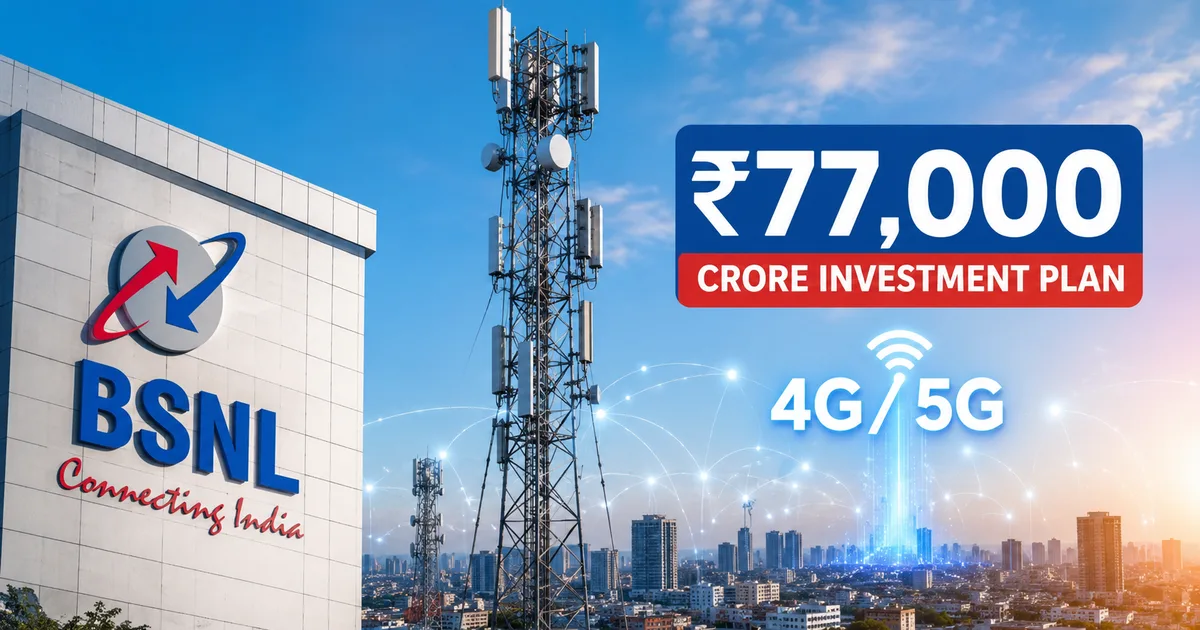
Every time your telecom operator hikes its tariffs, you probably think about porting your number to the state-run alternative. I know I do. Well, the government is finally putting serious money on the table to make that switch viable. The BSNL ₹77,000 Crore Investment Plan 2026 is now officially taking shape. And it's a massive bet on reviving a company that many had written off entirely. It's a five-year capital expenditure roadmap aimed directly at fixing the network blackspots you hate. The goal is finally delivering decent 4G speeds across India.
Honestly, BSNL has been the punchline of Indian telecom jokes for the better part of a decade. While Jio and Airtel fight over 5G download speeds in metro cities, BSNL users spent years just trying to get a basic 3G signal to load a WhatsApp image. But things are shifting. Following the steep tariff hikes by private operators last month, millions of users actually started looking at BSNL again. So this massive capex plan shows that the telecom department wants to capitalize on this exact moment. I think it's about time, honestly.
So where exactly is all this money going? And more importantly, will it actually mean you can finally scan a UPI QR code at a local chai shop without staring at a spinning loading wheel? I read through the proposals to see what this means for your daily internet use.
The math behind the ₹77,000 crore plan
A telecom network runs on hardware. And hardware is expensive. For years, BSNL was starved of the funds needed to buy modern telecom gear. This new investment plan changes that completely.
The biggest chunk of this money goes to physical infrastructure. BSNL proposed rolling out 200,000 new 4G sites across the country over the next five years. To put that in perspective, they currently have around 100,000 towers in various stages of being upgraded to 4G. Doubling that footprint is a massive job.
- Converting older 2G and 3G sites to support faster data speeds.
- Erecting completely new telecom towers in rural and semi-urban areas where coverage is currently dead.
- Upgrading the backend servers and optical fiber networks that actually carry the data from the tower to the wider internet.
- Buying equipment that can be software-upgraded to 5G later without needing a technician to physically climb the tower again.
But there's a catch here. A very Indian catch. The government mandated that BSNL has to use a completely indigenous telecom stack. They can't just go and buy ready-made gear from Nokia or Ericsson like Airtel does. They have to use technology developed by a consortium led by Tata Consultancy Services (TCS), C-DOT, Tejas Networks, and other local partners. Building a 4G network from scratch using brand new, locally developed technology takes time. You find bugs. You fix them. You find more bugs. This Aatmanirbhar approach is fantastic for India's long-term tech independence. But it's the main reason BSNL's 4G has been delayed for so long (which is pretty annoying, I know).
The homegrown technology struggle
I want to talk more about the technology itself. BSNL is doing something no other Indian telco has ever done. Private players like Jio and Airtel buy their network equipment from foreign companies. BSNL is deploying a completely homegrown 4G network. This is a massive deal for India's tech capabilities.
But it's also incredibly hard. When you buy from Ericsson, you get a product that has been tested in a hundred different countries over a decade. When you build it yourself, you have to find and fix all the bugs in real-time on live networks. That's why the BSNL 4G rollout feels so slow. They're building the plane while flying it.
If you want to look deeper into how these tech policies shape the market, we covered the history of telecom regulations in our industry analysis.
Why 4G still matters more than 5G right now
You might be reading this and thinking, "Wait, why are they spending ₹77,000 crore on 4G when everyone else is already doing 5G?" I hear you. The numbers here are a bit fuzzy sometimes, but the logic is sound.
Thing is, the hype around 5G is largely disconnected from what most Indians actually need on a Tuesday morning. Unless you're downloading heavy files on your phone every day, a solid, consistent 4G connection is more than enough for YouTube and Spotify. The real problem in India isn't that 4G is too slow. The problem is that 4G coverage is patchy.
BSNL knows this. Their management realized that chasing 5G headlines is useless if their core customer base in tier-2 cities and villages can't even load the DigiLocker app to show their driving license to a traffic cop. The 4G expansion matters way more than a token 5G launch. They need to fix the basics first.
"BSNL is currently upgrading its network with 100,000 4G towers, but the real game-changer is the proposal for 2 lakh additional sites over five years."
If BSNL can deliver a stable 4G network at ₹200 a month while private players charge ₹350 for patchy 5G, millions of price-sensitive Indian consumers will happily switch back.
Connecting the unconnected villages
Let's talk about rural India. The private operators run their networks based on profitability (which makes sense, actually). If you ask me, that's just how business works. If a village of 500 people doesn't generate enough recharge revenue, Jio and Airtel simply won't build a tower there. It makes zero business sense for them. This leaves millions of Indians in a digital dark age.
BSNL is a state-owned entity. They have a social obligation to provide connectivity everywhere, even if they lose money doing it. A large chunk of this ₹77,000 crore is going straight into connecting these remote villages. Once these areas get 4G, it changes everything. Kids can access online education. Farmers get weather updates. And local shops can finally start accepting UPI payments seamlessly.
And speaking of UPI, the digital public infrastructure in India relies entirely on connectivity. The government pushes Aadhaar and DigiLocker. But all of that breaks down if the telecom network fails. A strong BSNL network is a backup for the nation's digital economy. If a private network goes down due to a technical glitch, BSNL ensures that the country doesn't grind to a halt.
The Vi and BSNL network sharing rumors
Here's where the story gets genuinely interesting. There are heavy rumors that Vodafone Idea (Vi) and BSNL are in early talks to share their network infrastructure and spectrum.
Think about this for a second. Vi has decent 4G equipment and a lot of spectrum. But they're drowning in debt and losing subscribers every single month. BSNL has massive reach, especially in rural areas. They also have this massive ₹77,000 crore backing from the government. But they lack the slick, optimized network management of a private player.
If these two start sharing cell towers, it solves massive problems for both of them. Vi users would suddenly get coverage in remote areas where only BSNL operates. BSNL users would get access to Vi's 4G capacity in dense urban centers where BSNL towers are congested. It's the kind of pragmatic arrangement that could actually create a strong third competitor to challenge the Jio-Airtel duopoly.
Could it actually work?
I'm somewhat skeptical, to be honest. Integrating two massive telecom networks is an absolute nightmare technically. Look at how long it took Vodafone and Idea to merge their networks. And they were both private companies. Trying to merge the network operations of a private company with a state-run PSU wrapped in government bureaucracy? That is going to be slow.
But the fact that they're even talking about it shows how desperate the situation has become. India needs a third strong player to keep telecom prices in check. If BSNL and Vi have to hold hands to survive, they'll do it.
The road to FY29 breakeven
BSNL is currently bleeding money. They've been running at a loss for years. But the top brass has a clear target with this new capex plan. They want to hit financial breakeven by FY29.
That means in five years, the company needs to earn exactly as much as it spends. How on earth do they plan to pull that off?
First, they need to stop the subscriber exodus. For years, people kept their BSNL SIMs active just as a secondary number to receive bank OTPs and Aadhaar verification codes. That generates almost zero revenue. BSNL needs people to start paying for data packs again. The 2 lakh new 4G sites are the only way to make that happen. The recent tariff hikes also led to a spike in fake BSNL porting SMS alerts, which look super sketchy. So stay cautious if you are planning to switch.
Second, BSNL has a massive enterprise business. They provide the optical fiber backhaul for a lot of government departments and banks. They're heavily pushing their Bharat Fiber broadband services to counter JioFiber and Airtel Xstream. If you live in a tier-3 town, BSNL Bharat Fiber is often the only reliable wired internet available. By upgrading this infrastructure, they can lock in high-paying enterprise contracts.
Will they hit the FY29 target? I'm not sure exactly why, but I have a good feeling about this. The telecom market is brutal. But if they can execute the 4G rollout without any more hardware delays, they actually have a fighting chance. The demand for a cheaper alternative is huge right now.
What this means for your next recharge
Let's talk about you and your wallet. Why should you care about BSNL spending ₹77,000 crore?
Because BSNL is the only thing standing between you and ₹500 monthly recharges.
Look, Jio and Airtel are running businesses. They spent billions buying 5G spectrum, and their investors want a return on that money. The only way they get that return is by slowly, consistently hiking your monthly tariff. We saw it happen recently. And we will absolutely see it happen again next year.
If BSNL dies, or just remains a joke network that nobody can actually use, Jio and Airtel have total pricing power. They can charge whatever they want because you have nowhere else to go. You need your phone. You need your UPI. And ultimately, you just have to pay.
But if BSNL actually manages to deploy these 2 lakh 4G sites, and suddenly offers a reliable 4G data plan for 30% less than the private players, the dynamic changes. A strong BSNL is a natural price ceiling for the entire Indian telecom market. You don't even have to switch to BSNL to benefit from this. Just the threat of millions of users porting to BSNL is enough to keep the private operators from hiking prices too aggressively. You can check your exact current connection speeds using online network testing tools to see if switching is worth it for you right now.
I tried BSNL's 4G in a testing zone a few weeks ago. Was it the fastest thing I've ever used? No. But it was entirely fine for checking emails and watching a video. If they can deliver that experience across the country, it will shake up the market.
The next five years are critical. The ₹77,000 crore is on the table. Now BSNL just has to actually build the network. In my experience, these massive projects are a bit of a mess initially, but they usually get there eventually.