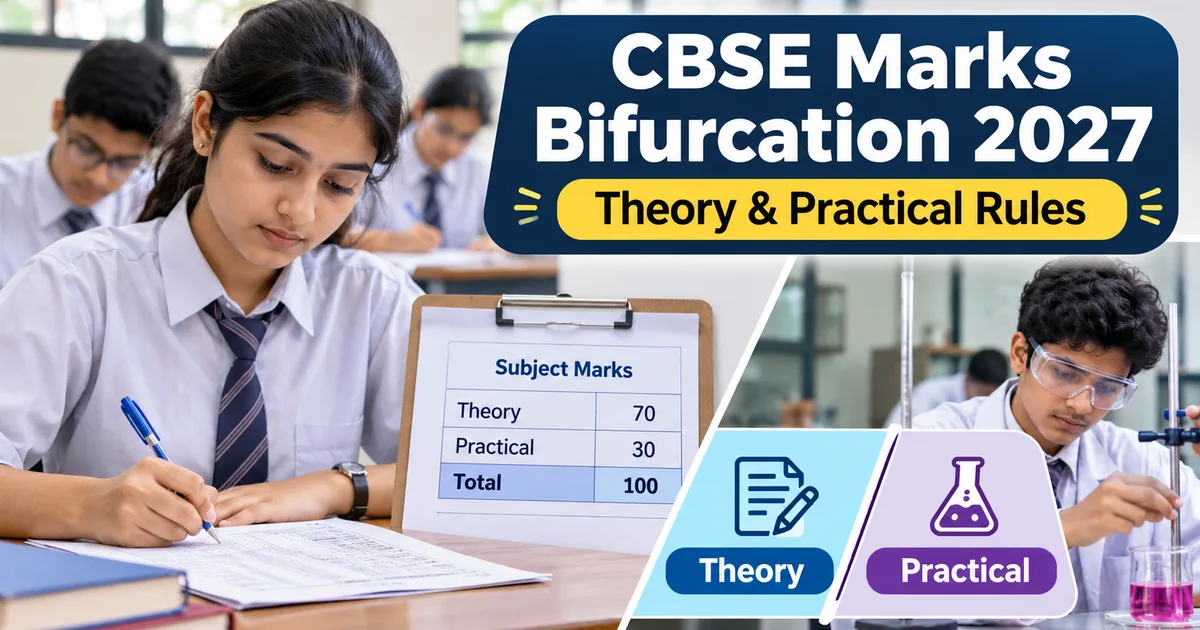
If you have a child in school or you're sitting for board exams yourself, you already know the familiar dread that arrives whenever the Central Board of Secondary Education drops a fresh PDF. My cousin in Delhi sent me a panicked voice note at seven in the morning asking if internal assessment marks had suddenly been scrapped. They haven't. But the official circular detailing the CBSE marks bifurcation 2027 is out, and it spells out exactly how every single mark gets carved up between theory papers and practical assessments.
It's a dense document. Over fifty pages of tables and subject codes that look like an income tax filing form.
Most parents just glance at the grid and spot ratios like 80:20 or 70:30. Then they assume every subject works the exact same way. If you ask me, that assumption is a total mess. And it's where students run into serious trouble once Class 12 rolls around.
Understanding the CBSE marks bifurcation 2027 circular
Look, CBSE doesn't release these marks distribution tables just to keep teachers busy in staff rooms. Every single subject carries 100 marks total. But how you get to that 100 depends completely on the syllabus. Some subjects rely almost entirely on written tests in an examination hall. Others put half their weight on lab work or portfolio submissions (which makes sense, actually, because banking everything on a single three-hour paper on an off day was always brutal).
And timing matters just as much as the marks split.
The board divides the practical exam schedule into two separate windows based on where your school is located. For winter-bound schools up in snowbound northern areas where winter shuts down roads, exams run from November 9 to December 19, 2026. Then, for regular schools across the rest of mainland India and abroad, practicals and internal assessments run from January 1 to February 13, 2027.
Missing that window is expensive. Schools can't just arrange a makeup test on a random weekend. Examiners have to upload scores directly to the CBSE digital portal on the exam day itself. Once that portal locks, getting an extension takes painful bureaucratic gymnastics that no student needs right before board season. We see the exact same strict timelines across Indian education systems, from board certifications to higher entrance tests like the NEET PG eligibility updates that demand strict adherence to cut-off schedules.
Class 10 theory weightage and practical marks breakdown
For most Class 10 students, the setup feels comfortably familiar. Standard academic subjects have a clean 80:20 formula. That means your three-hour written board exam is worth 80 marks, while 20 marks come from continuous internal assessment evaluated directly by your school teachers.
Here is how those standard subjects break down:
- Main language papers like English Language and Literature, Hindi Course A, and Hindi Course B assign 80 marks to written theory and 20 marks to school-based internal checks.
- Core academic subjects including Science, Social Science, Mathematics Standard, and Mathematics Basic all preserve the same 80-mark written and 20-mark internal ratio.
- Home Science shifts more weight toward practical tasks, allocating 70 marks for the theory paper and 30 marks for laboratory assessments.
- Painting takes an unusual three-way approach with 30 marks for written theory, 50 marks for practical portfolio work, and 20 marks for internal marks.
- Skill and vocational electives such as Computer Applications, Information Technology, and Artificial Intelligence balance things equally with 50 marks for the written test and 50 marks for practical lab assignments.
Don't write off that 20-mark internal portion as free marks. I've heard parents say, "Oh, the school gives everyone 19 or 20 anyway." That used to happen. Not anymore.
Thing is, CBSE now tracks marks inflation with statistical moderation algorithms (I'm not sure of the exact math they run, and it's a bit fuzzy to outsiders, but it definitely catches schools that hand out straight 20s). That 20-mark pool actually comes from periodic pen-and-paper tests, notebook submission quality, subject enrichment activities like speaking or listening tests, and regular lab assignments. In my experience, taking those smaller tests seriously is the easiest way to protect your overall percentage.
Exam timing changes based on marks too. If you're writing the 80-mark theory paper for Science or Social Science, you get three full hours. But if you're taking Computer Applications or certain vocational modules with a 50-mark written component, your exam lasts only two hours. That shorter clock trips up plenty of students who don't adjust their pacing. You can check out our step-by-step tech guides for simple ways to manage study timers and revision routines without burning out.
Class 12 practical exam rules and subject weightage
Class 12 is a whole different beast. If you're in the science stream, you already know the stress of the laboratory viva. For Class 12, subjects with laboratory components generally follow a 70:30 distribution rather than the 80:20 split seen in Class 10.
The board groups senior secondary subjects into clear clusters:
- Core science disciplines consisting of Physics, Chemistry, and Biology allocate 70 marks to written theory and 30 marks to laboratory practicals.
- Applied disciplines including Computer Science, Geography, and Psychology also maintain that exact 70-mark theory and 30-mark practical division.
- Commerce and humanities staples like Mathematics, Economics, Accountancy, Business Studies, History, and Political Science carry 80 marks for theory and 20 marks for project work.
- Technical skill courses such as Retail, Information Technology, and Web Application demand 60 marks for theory and 40 marks for hands-on practical assessments.
- Media streams like Multimedia split marks down the middle, requiring 50 marks for the written exam and 50 marks for practical lab production.
Here's what catches a lot of Class 12 students off guard every single year. Your practical examiners aren't your regular school teachers. Not even close.
CBSE appoints external examiners who visit your campus to inspect lab journals and watch you conduct experiments in real time, before grilling you during the viva voce. In my experience, they can spot a faked experiment in about five seconds.
I still remember sweating through my own chemistry viva years ago when the external examiner asked me why my salt analysis solution turned reddish-brown instead of yellow (annoying, I know, but external examiners live for those moments). You simply can't fake lab work on exam day. If your laboratory record book isn't signed periodically throughout the academic year, or if your project report looks like a sketchy last-minute download from the internet, external examiners will dock marks without hesitation.
The big difference in passing criteria between Class 10 and 12
This is where things get serious, and it's the part of the circular that everyone needs to read twice.
In Class 10, passing is relatively forgiving. You need an overall aggregate of 33 percent to pass a subject. That means your theory marks and your internal assessment marks get added together. If you score 20 out of 20 in your school internal assessment, you only need 13 marks out of 80 on the written theory paper to hit the 33-mark threshold. It's built to encourage students and keep failure rates low at the secondary school stage.
Class 12 has no such safety net. None at all.
In Class 12, CBSE enforces a strict separate passing rule where students must secure at least 33 percent marks in the theory paper and at least 33 percent marks in the practical or project component independently, alongside 33 percent aggregate.
Here is how the arithmetic works out in real life. Suppose you're taking Class 12 Chemistry. The theory paper is out of 70 marks. Thirty-three percent of 70 is 23.1, which rounds to 23 marks. If you score 22 marks in theory, it doesn't matter if you got a perfect 30 out of 30 in your practicals. You still fail the subject and receive an Essential Repeat or Compartment designation (harsh, but that's how the rule works).
Honestly, if you ask me, that rule catches way too many students off guard every single year. They bank heavily on scoring full marks in school practicals and neglect the written theory preparation, only to realize too late that practical marks cannot bail out a weak theory performance. For students planning higher studies or tracking academic reforms like the UGC distance PG programmes, understanding these foundational passing rules is essential for protecting your long-term academic record.
How DigiLocker and APAAR ID verify your board marks
Once your exams conclude and results drop in May, the way your marks get verified has also changed completely compared to a decade ago. You don't stand in a school queue waiting for a physical paper mark sheet stamped by the principal anymore.
Today, CBSE pushes your verified digital credentials directly into DigiLocker within hours of the official announcement. Every registered Indian student now has an Automated Permanent Academic Account Registry identifier, known as an APAAR ID or One Nation One Student ID. This unique 12-digit number links directly to your Aadhaar card and stores your academic achievements in the cloud.
Basically, your DigiLocker marksheet carries an official QR code and a cryptographic digital signature from the controller of examinations. When you apply for college admissions or state scholarship schemes, institutions verify your marks automatically through API connections rather than demanding notarized photocopies. It's fast and reliable, and it eliminates forged scorecards entirely (which makes things much easier for everyone). If you ask me, this paperless verification is one of the smoothest systems we have. You can explore our detailed academic explainers to see how Aadhaar-based digital public infrastructure is reshaping services across government departments.
Smart preparation strategies based on marks weightage
Knowing the marks bifurcation gives you a tactical advantage if you use it properly. Instead of treating every book on your desk as an equal challenge, balance your study hours against where the marks actually live.
Start by securing your practical marks right now.
Make sure your physics and biology record files are properly indexed and signed by your subject teacher before winter break (annoying, I know, but you don't want to chase teachers in January). Leaving lab records to the last week of December guarantees sloppy diagrams and stressed-out late nights. If you ask me, losing marks on incomplete journals is just throwing away free score.
For theory papers, work through the official sample question papers published on cbseacademic.nic.in. Don't skip them. Those sample papers reflect the exact question typologies, including competency-based case studies and assertion-reason questions that make up fifty percent of the question paper under National Education Policy guidelines.
And keep a close eye on the official CBSE portal at cbse.gov.in for any regional circulars. Rumors spread like wildfire on WhatsApp groups around exam time, with fake date sheets and made-up moderation formulas circulating daily. Always verify any date sheet claim against the original PDF uploaded by the board. Prepare methodically and remember that Class 12 separate passing rule. Do that, and you won't get caught off guard on result day.