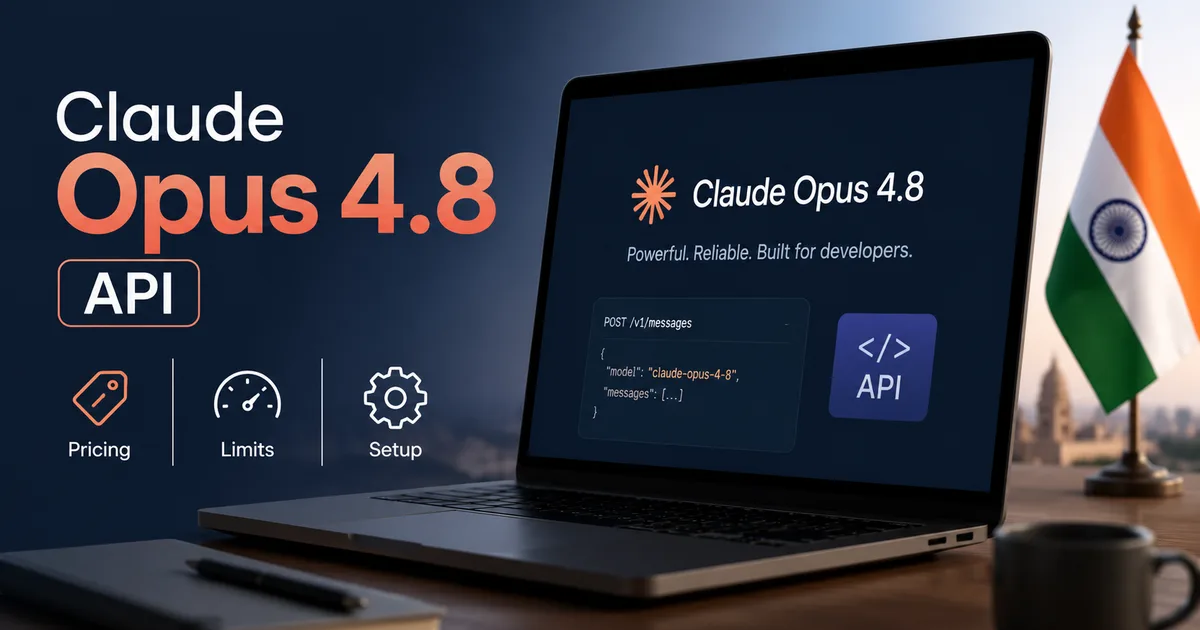
If you've been waiting for a good moment to set up Claude Opus 4.8 API access in India, that moment is now. Anthropic launched Opus 4.8 in late May 2026, just 41 days after Opus 4.7, and the improvements in coding and reasoning are real enough to matter for production applications. The company also opened a Bengaluru office this year, signalling that India is being treated as a serious developer market and not an afterthought.
This post covers the practical stuff: how to actually get API access, what it costs in rupees, what rate limits you're working with, and a few things that specifically trip up Indian developers during setup.
What Opus 4.8 actually changes for developers
Beyond the headline benchmark improvements in coding performance, there are two features that matter most for people building real applications.
The first is effort control. You can now specify how much compute effort the model applies to a given task. For quick classification jobs, you want low effort and fast responses. For complex multi-step reasoning, you increase it. This directly translates to cost control, and when you're paying per token with USD charges hitting an Indian card, that matters.
The second is more robust support for agentic workflows. Chains where the model calls tools, processes results, and loops back have historically been fragile. Opus 4.8 handles these more reliably. If you've hit reliability issues mid-chain with earlier Claude versions and worked around them with complex retry logic, this version is worth retesting.
One design decision worth flagging: Anthropic specifically built Opus 4.8 to flag uncertainty rather than project false confidence. The Indian Express reported that Anthropic described this as "prioritising honesty over overconfidence." For applications in fintech, health, or legal assistance where Indian users make real decisions based on AI output, that design choice matters more than any benchmark.
How to get Claude API access from India: the actual steps
There's no India-specific onboarding. You use the global console at console.anthropic.com. Here's the process from start to first API call:
- Create an account at console.anthropic.com with your email address
- Verify your phone number. Indian +91 numbers work without issues
- Add a payment method. Only international credit and debit cards are currently supported, both Visa and Mastercard work
- Enable pay-as-you-go billing or add prepaid credits to your account
- Generate an API key from the "API Keys" section of the console dashboard
- Install the SDK with
pip install anthropicfor Python ornpm install @anthropic-ai/sdkfor Node
The UPI situation is genuinely frustrating. There's no UPI, PhonePe, or net banking option at the direct API level. If your company's accounts team needs GST-compliant invoicing in INR, the better path is accessing Claude through Amazon Bedrock or Google Cloud Vertex AI, which have proper Indian billing infrastructure. More on that below.
Payment declines on first signup are very common for Indian users. Most Indian banks block new international SaaS charges automatically as fraud prevention. If your card gets declined, call your bank's customer care, tell them you're authorizing recurring international payments to a cloud SaaS platform, and try adding the card again. This fixes the issue almost every time.
Claude Opus 4.8 API pricing broken down in INR
Anthropic updated pricing with the Opus 4.8 launch. Based on current listed rates (verify at anthropic.com/pricing, as these change):
- Input tokens: approximately $15 per million tokens
- Output tokens: approximately $75 per million tokens
- Prompt cache reads: approximately $1.50 per million tokens for cached input
At roughly 84 rupees to the dollar in mid-2026, that's about Rs 1,260 per million input tokens and Rs 6,300 per million output tokens. A standard 500-word document is around 650 to 700 tokens, so processing one page as input costs fractions of a paisa. Costs scale fast when you're generating long outputs or running batch jobs over thousands of documents.
Prompt caching is genuinely useful and underused. If your application sends the same long system prompt or reference document with every request, caching that content cuts your input costs by roughly 90 percent. Set it up from day one rather than retrofitting it later.
Also factor in the forex markup if you're paying via an Indian credit card. HDFC, ICICI, and most other banks add a 3.5 percent markup on international transactions. Over a few months of regular API usage, that adds up. Some developers use a Wise account or a USD prepaid card to reduce this.
Rate limits and tier structure for Indian developers
New API accounts start at Tier 1, which is designed for development and testing. Anthropic raised limits alongside the Opus 4.8 launch, but you still begin with conservative throughput. The tier structure looks roughly like this:
| Tier | How you get there | Approximate limits |
|---|---|---|
| Tier 1 | New account | 5 requests/min, 10K tokens/min |
| Tier 2 | ~$40 cumulative spend | Significantly higher |
| Tier 3 | ~$200 cumulative spend | Production-grade throughput |
| Enterprise | Direct agreement with Anthropic | Custom, negotiated limits |
Tier 1 works fine while you're building and testing. The moment you're showing this to real users or running evaluations on large datasets, you'll feel the constraint. The fastest path up is spending through the threshold or contacting Anthropic's sales team, especially now that they have people on the ground in Bengaluru.
Indian companies in BFSI or healthcare with data residency requirements should go straight to enterprise. Standard API terms don't cover the data processing agreements those sectors need. The Bengaluru presence means there are actual people to call now rather than just a contact form.
Claude via Amazon Bedrock and Google Vertex AI: cleaner billing for Indian companies
If you're already on AWS or GCP infrastructure, accessing Claude through those platforms often makes more practical sense than direct API access.
Claude Opus 4.8 is available on both Amazon Bedrock and Google Cloud Vertex AI. The advantages for Indian developers:
- Billing consolidates with your existing AWS or GCP spend, which finance teams prefer
- AWS India and GCP India generate proper GST invoices for accounting and compliance purposes
- Regional endpoints may reduce latency compared to hitting US-based Anthropic servers directly
- Both platforms have enterprise data processing agreements compatible with Indian regulatory requirements
The main tradeoff is timing. New model versions sometimes arrive on cloud marketplaces a few weeks after direct API availability. If you need the absolute latest release on day one, the direct API is faster. For stable production infrastructure with clean billing, cloud-hosted Claude access is the more practical choice for most Indian companies.
A minimal Python example to test your setup
After pip install anthropic, your first call looks like this:
import anthropic

client = anthropic.Anthropic(api_key="your-api-key-here")

message = client.messages.create(
    model="claude-opus-4-8-20260529",
    max_tokens=1024,
    messages=[
        {"role": "user", "content": "Explain GST input tax credit in simple terms"}
    ]
)

print(message.content[0].text)
That's the complete basic call. The SDK handles authentication and retries on transient failures. From here, look at system prompts for consistent context, tool use for agents, and streaming if you're displaying responses in real time rather than waiting for the full output.
Anthropic's documentation and their GitHub cookbook are genuinely useful. The cookbook has working examples for RAG pipelines, multi-turn conversations, and tool-use agents that cover most common patterns Indian developers will run into.
A few things to sort out before you ship
Read Anthropic's usage policies before building anything in a regulated sector. Fintech, health, and education applications have specific content restrictions and may require safety disclosures. Finding this out after the product is built is an expensive problem.
On model selection: Opus 4.8 is the most capable and the most expensive Claude model. Honestly, most tasks don't need it. Claude Sonnet handles a large share of common workloads at significantly lower cost, and Haiku is fast and cheap for simple classification or extraction tasks. Routing requests intelligently to the right model tier based on task complexity can cut your monthly bill by 70 to 80 percent. Worth architecting for from the start rather than defaulting everything to Opus.
Anthropic's valuation crossed $965 billion in 2026, briefly surpassing OpenAI according to Analytics India Magazine. The Bengaluru office and growing enterprise partnerships here suggest the company is treating India as a long-term market. For Indian developers and startups making a platform bet on Claude, that stability is relevant context. And if you're still comparing options before committing, our guide to AI APIs available in India covers the alternatives in detail.