The EPFO interest credit 2026 is officially out, and for once, the government actually did things ahead of schedule. On July 15, the Employees' Provident Fund Organisation deposited the 8.25% interest for the financial year 2025-26 into about 34 crore accounts. The 8.25% rate for FY 2025-26 is one of the highest guaranteed returns you'll find anywhere in the market right now. When you factor in the tax benefits, it easily beats most fixed deposits and debt mutual funds. Honestly, seeing the credit arrive this early is a welcome change. Normally we wait until October or November. We're usually constantly refreshing the portal and wondering where the money is. But this time, they processed a massive Rs 1.44 lakh crore payout in one go. That's a huge payout. To put that in perspective, that is more than the GDP of several small countries. And they managed it all through a government IT portal.
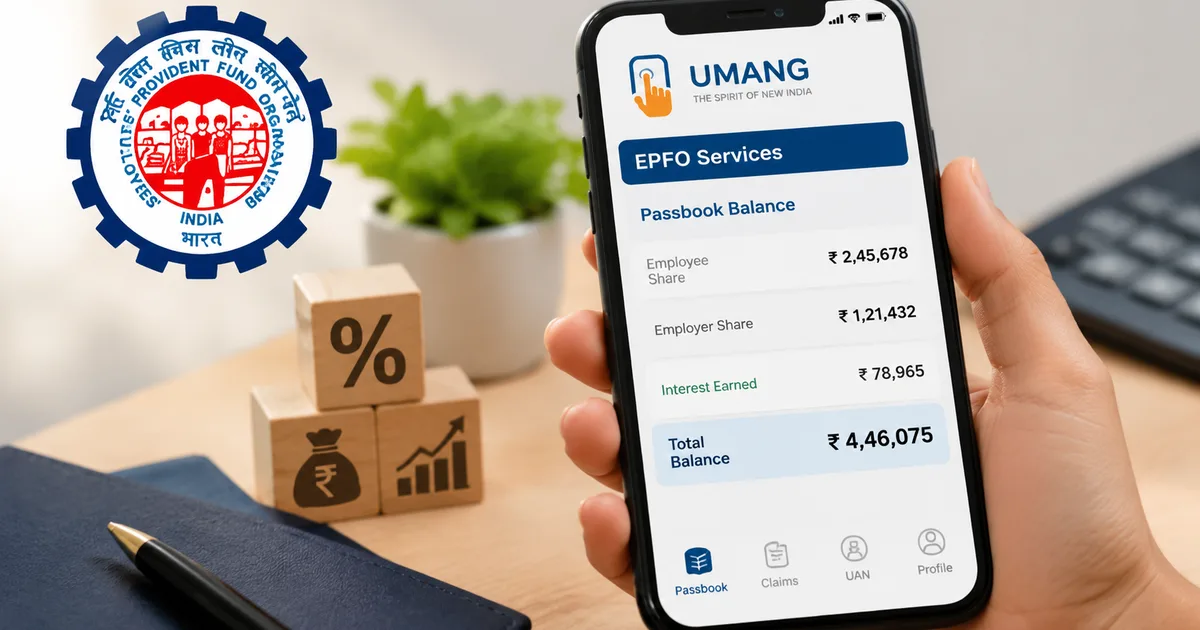
I tried checking my own balance yesterday. The servers were a bit slow. But the money is definitely there. Basically, a lot of people are asking how to verify this without dealing with the clunky main website. So, the easiest way is using the government's Umang app.
Why this year's PF interest credit is different
If you've been working in the Indian corporate sector for a few years, you know the drill. The finance ministry approves the interest rate somewhere around March or April. Then we wait. Sometimes we wait six months. Sometimes we wait eight months. Last year was a mess for many users. It caused a lot of panic.
This time, Union Labour Minister Mansukh Mandaviya announced the rollout, and they actually hit the July 15 target. They're using a new centralized IT system called CITES. I know government tech acronyms sound boring. But this one actually works (which makes sense, actually). It allowed them to push the 8.25% interest to 34 crore accounts almost simultaneously. They didn't have to go through regional offices one by one. That used to be the main bottleneck. You can read more about government tech initiatives in our explainers section.
The centralized CITES system is a big deal. In the past, the EPFO operated through multiple regional offices. Each office had its own database and processed interest locally. If you were registered in the Mumbai office, you might get your interest in August. But someone in the Delhi office had to wait until December. The new system pools everything together. This means no more regional delays. It's a single, unified database. It processes the interest for everyone across India at the exact same time.
Look, enough about backend IT systems. You just want to know if your money is there. And how to see it.
Things you need before checking your balance
Before you open the app and get frustrated, make sure you have the basics sorted out. I see people fail at this stage all the time. In my experience, they just rush it.
- Your active UAN (Universal Account Number). You can find this on your salary slip.
- The mobile number linked to your UAN. It has to be active because you'll need an OTP.
- Aadhaar linking. If your Aadhaar isn't seeded with your UAN, you'll face issues logging in.
- The Umang app downloaded on your smartphone.
If you don't have these ready, you're going to hit a wall. Stop. Find your UAN first.
Step-by-step guide to check PF balance on Umang app
The Umang app is actually one of the better digital initiatives. It brings everything from Aadhaar services to DigiLocker into one place. Here's exactly how you check your EPF passbook.
- Open the Google Play Store or Apple App Store and search for Umang. Download and install the official app. Make sure the developer is listed as National e-Governance Division. There are fake apps out there, so be careful. We cover these frauds in our scams directory.
- Launch the app. If you're a new user, you need to register using your Indian mobile number. Enter your number, wait for the OTP, and set an MPIN. If you already have an account, just log in. The app is available in multiple regional languages, which makes it accessible for non-English speakers. When you're setting it up, you can choose Hindi, Marathi, Tamil, or several other options.
- Once you're on the home screen, look at the search bar at the top. Type in "EPFO" and hit search.
- Tap on the EPFO icon that appears in the search results. This takes you to the dedicated provident fund section.
- Under the "Employee Centric Services" menu, tap on the "View Passbook" option.
- The app will now ask for your UAN. Type your 12-digit UAN carefully.
- Tap the "Get OTP" button. The OTP will go to the mobile number registered with your EPFO account. This is why having the correct number linked is so important.
- Enter the OTP you receive and tap submit.
- You'll now see a list of your member IDs. If you've worked at multiple companies and haven't transferred your PF, you'll see multiple IDs here.
- Tap on your current employer's member ID. The app will display your passbook.
- Scroll down to the bottom of the passbook entries. Look for a line item that says "Interest for FY 2025-26" or something very similar. You should see the exact amount credited to your account based on the 8.25% rate.
That's the entire process. It takes about two minutes. Well, if the servers are behaving.
What if the Umang app isn't working?
Government servers go down. It happens. Millions of people try to log in at the same time right after a massive announcement. So, if the app is throwing errors, you have other options.
The missed call method
This is old school. But it's incredibly reliable. Give a missed call to 9966044425 from your registered mobile number. The call will disconnect automatically after a couple of rings. You'll get an SMS in a few minutes. It has your latest PF balance and the details of your last contribution. It doesn't show a detailed passbook. But it confirms your total amount.
The SMS method
You can also send a text message. Type "EPFOHO UAN ENG" and send it to 7738299899. The "ENG" stands for English. You can change it to HIN for Hindi. Or MAR for Marathi. Or TAM for Tamil. Again, you'll get a reply with your balance.
The official EPFO portal
If you prefer using a computer, go to passbook.epfindia.gov.in. You'll need your UAN and your password. And you have to solve a simple math captcha. Once logged in, select your member ID and view the passbook. The web version gives you an option to download a PDF copy of your passbook. That is useful for loan applications. Check out our guides for more detailed walkthroughs on government portals.
Understanding the 8.25% math
Let's talk numbers. The 8.25% rate is pretty good compared to regular fixed deposits. Plus it's tax-free up to a certain limit. But how much money are we actually talking about?
Interest in EPF is calculated monthly. But it's deposited yearly. It's calculated on the opening balance of the year plus the monthly contributions.
If your total PF balance was Rs 10 lakh at the start of the year, the pure interest component for the year would be around Rs 82,500. If you have a larger corpus, say Rs 50 lakh, the interest alone is Rs 4,12,500. And if you're sitting on a Rs 1 crore balance, you just earned Rs 8,25,000 in interest.
The compounding effect of the EPF is massive over a 20-year career. Withdrawing it early for minor expenses is generally a terrible financial decision.
I know people who withdraw their PF every time they switch jobs. Honestly, I think that is a huge mistake. You're losing out on guaranteed, risk-free returns. They compound tax-free. Leave it alone unless it's an absolute emergency.
Why checking your PF passbook regularly is important
Thing is, a lot of people ignore their PF accounts completely. They treat it as a black box. Money goes in. Eventually, it comes out when they retire. This is a bad idea. You should check your passbook at least twice a year.
Sometimes employers delay depositing the PF money. Your salary slip might show the deduction. But the money hasn't actually reached the EPFO. If you don't check your passbook, you won't know this is happening until months or years later. By then, recovering the money becomes a massive headache (annoying, I know).
Checking your balance regularly also means your KYC details remain active. If your account stays dormant for too long, reactivating it for a withdrawal takes unnecessary paperwork.
Tax implications on your PF interest
The rules changed a few years ago. And many people still get confused by this. The interest earned on your EPF is tax-free. But there's a catch.
If your own employee contribution exceeds Rs 2.5 lakh in a single financial year, the interest earned on the excess amount is taxable. So, if you contributed Rs 3 lakh this year, the interest earned on the Rs 50,000 excess is taxable. It will be added to your taxable income. And taxed at your slab rate. I'm not sure exactly why they set the limit there, but that is the rule.
For government employees where there's no employer contribution to the EPF, this limit is Rs 5 lakh. If you're a high earner doing voluntary provident fund top-ups, you need to calculate this carefully while filing your ITR.
Troubleshooting common login issues
I get a lot of emails from people who simply can't access their accounts. Here are the most common roadblocks. And how to fix them.
UAN is inactive
Your employer generates the UAN. But you have to activate it. You can do this on the Member e-Sewa portal by clicking "Activate UAN". You just provide your Aadhaar details and mobile number. You only have to do this once.
Mobile number mismatch
If the mobile number linked to your Aadhaar is different from the one linked to your UAN, you're going to have a bad time. The EPFO relies heavily on Aadhaar authentication. You need to update your mobile number in the Aadhaar database first. That takes a few days. And then update it on the EPFO portal.
Name or DOB mismatch
This is a nightmare scenario. If your name is spelt differently in your company records versus your Aadhaar card, the system will block you. You have to submit a joint declaration form with your employer to get this fixed. It requires physical paperwork. And it can take weeks. Make sure your HR department uses your exact Aadhaar details from day one.
Password reset issues
If you've forgotten your password for the EPFO portal, resetting it used to be a coin toss. Now, it's fairly straightforward. As long as your mobile number is active. Click on "Forgot Password" on the login page. Enter your UAN and the captcha. The system will send an OTP to your Aadhaar-linked mobile number. Once you verify the OTP, you can create a new password. Make sure you use a strong password. Use a mix of letters and numbers. Don't use your name or your date of birth. Cybersecurity is no joke when it comes to your life savings.
Final thoughts on the new system
The speed at which the government processed the EPFO interest credit 2026 is genuinely impressive. If you ask me, moving 34 crore accounts to a centralized database is a massive technical undertaking. The numbers here are a bit fuzzy, but the CITES system seems to be holding up well under the load.
Go check your balance today. Seeing that interest amount credited is a nice psychological boost. Especially when the markets are volatile. Make sure your KYC details are updated. Add a nominee if you haven't already. And let your retirement corpus do its job quietly in the background.