If you own an electric scooter in India or are planning to buy one, you already know the two biggest headaches. First is the waiting time to charge. Second is the fear of replacing an expensive battery after four or five years. The EV Battery Swapping Policy 2026 changes how the industry approaches these problems. This new framework alters how two-wheelers and three-wheelers operate on our roads. I spent the last few weeks reading through the new rules and the proposed state-level changes. The shift from fixed batteries to a swappable network is highly practical for the average Indian rider.
Let us break down exactly what changes for ordinary commuters, delivery partners, and anyone looking to switch from petrol to electric this year.
How the EV battery swapping policy 2026 works
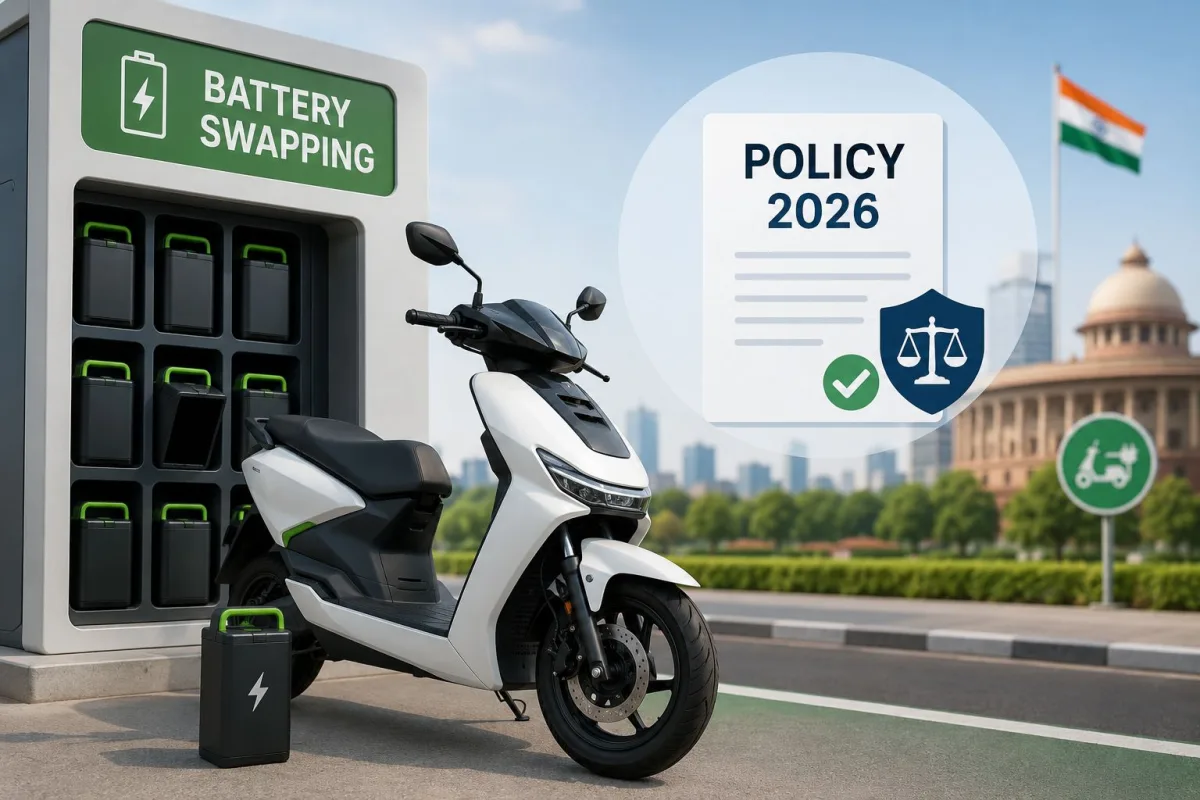
Battery swapping is a straightforward concept. Instead of plugging your scooter into a wall socket and waiting three hours, you ride into a public station. You pull out your empty battery and push in a fully charged one. You pay a small fee and drive away in two minutes. The execution has historically been a nightmare because every company uses a different battery shape and proprietary connector.
The new national policy forces standardization across the board. If a company wants to claim government subsidies, their batteries must fit into a universal swapping network. You are no longer locked into an exclusive charging grid built by one specific brand. You can swap your battery at any neutral third-party station. This decoupling of the vehicle from the battery completely lowers the upfront cost of buying an electric two-wheeler. You buy the physical scooter and rent the battery.
Delhi EV policy 2026 draft and two-wheeler impact
The Government of NCT of Delhi recently released its draft Delhi Electric Vehicle Policy 2026–2030. They laid out an aggressive roadmap to accelerate electric mobility in the capital. The draft includes a 100% road tax waiver for electric cars priced up to Rs 30 lakh. While car owners get decent benefits, the strongest incentives are aimed squarely at two-wheelers and commercial aggregator fleets.
Think about the thousands of delivery partners working for Zomato, Swiggy, and Zepto on Delhi roads. They ride 100 to 150 kilometers every single day. They cannot afford to stop and charge for hours. Right now, delivery riders lose money every minute they spend waiting at a charging plug. The draft policy offers deep financial incentives for aggregator fleets to adopt battery swapping.
"A calibrated mix of subsidies and strict timelines aims to accelerate EV adoption, but success will hinge on affordability, supply chain readiness and infrastructure scale."
The government is mandating timelines for food delivery and e-commerce companies to switch entirely to electric vehicles. Swapping stations turn mandatory charging downtime into a two-minute pit stop. This helps gig workers maintain their daily earning targets without range anxiety.
Solving app fatigue with a single UPI for EV charging
If you drive an electric vehicle today, your smartphone is likely cluttered with eight different applications just to pay for charging at different stations. It is a terrible and frustrating user experience. You have to load money into multiple digital wallets just to keep your vehicle running. The government is finally fixing this.
Heavy Industries Minister HD Kumaraswamy is pushing the rollout of 72,300 chargers across the country. India’s FAME-II scheme has already activated 6,645 EV chargers, but the expansion requires a better payment system. The government wants to implement a unified payment system across all networks.
You will soon use standard UPI for EV charging. The process becomes incredibly simple. You ride up to the swapping station and scan a single QR code on the machine. You open PhonePe, Google Pay, or whichever UPI app you prefer. You authorize the payment of fifty rupees. An empty locker pops open for your depleted battery. Another locker instantly pops open with a fully charged unit. You load it into your scooter and leave. No exclusive apps. No forced digital wallet top-ups. You use the exact same payment method you use to buy groceries at the local market.
Local manufacturing lowers your costs
None of these policies benefit the consumer if the hardware is imported and expensive. We are seeing major companies aggressively scale up local production to meet the 2026 demands. Supply chain readiness dictates how cheap these batteries will be for the end user.
Exicom recently inaugurated an integrated manufacturing facility in Hyderabad. They are building EV charging infrastructure and critical power solutions right here in India. Building components locally means a faster rollout of swapping stations and lower operational costs. When the hardware is made domestically, operators spend less money setting up a station. They pass those savings down to the rider in the form of lower swapping fees. Check our news section for updates on localized manufacturing subsidies.
Does battery swapping make financial sense for you?
Let us look closely at the math behind owning a scooter with a swappable battery versus a traditional fixed battery.
- Lower upfront price: A high-quality electric scooter with a fixed battery costs around Rs 1.3 lakh today. The battery pack is the single most expensive component. When you buy a scooter without the battery, the upfront cost drops to roughly Rs 80,000.
- Monthly subscription: You sign up for a Battery-as-a-Service (BaaS) plan. You pay a fixed monthly network fee, usually around Rs 1,000 to Rs 1,500.
- Per-swap charges: You pay a small fee of Rs 40 to Rs 50 every time you physically swap the battery at a station.
If you are a gig worker or a daily commuter who travels over 40 kilometers a day, the math works heavily in your favor. Your upfront loan is smaller and your daily running costs remain cheaper than petrol. If your commute is just five kilometers to the local train station and back, buying a scooter with a fixed battery and charging it at home remains the cheaper long-term option.
There is another massive benefit to swapping. You completely bypass battery degradation. Lithium-ion batteries lose their maximum capacity over time. After five years, your total range drops noticeably. Replacing a fixed battery out of pocket costs upwards of Rs 40,000. With a swapping network, you never own the battery. The network operator handles the maintenance, health checks, and replacement. You always ride away with a battery that functions perfectly.
Dealing with battery safety and quality control
Many buyers are nervous about putting a random, heavily used battery into their personal scooter. We have all seen the news reports of electric scooters catching fire in the extreme Indian summer heat. The EV Battery Swapping Policy 2026 includes strict safety protocols to prevent this.
Every swappable battery must feature a smart Battery Management System. When you plug an empty battery into the swap station, the machine instantly reads the health of the unit. If a battery is running dangerously hot, has degraded cells, or shows signs of internal physical damage, the station locks it down. It takes the defective battery out of circulation automatically. The Bureau of Indian Standards mandates rigorous testing for impact resistance and thermal runaway. I highly recommend reading our detailed explainer on battery safety if you are worried about summer riding conditions.
What happens to the old batteries?
A battery that degrades to 70 percent capacity is no longer useful for an electric scooter. It simply cannot provide enough range for a rider. The new swapping policy dictates a clear end-of-life process. Network operators repurpose these degraded batteries for stationary energy storage.
They are used to store solar power for street lights or provide backup power for telecom towers. When the batteries completely die after their second life, they are sent to specialized recycling plants to safely recover the lithium, cobalt, and nickel. By controlling the entire lifecycle, swapping network operators prevent toxic batteries from being dumped in local landfills.
The road ahead for Indian riders
The transition to an electric transport grid takes time. Companies like BMW Group India reported strong Q1 2026 sales, noting that fuel price volatility and changing ethanol policies are naturally pushing consumers toward electric vehicles. The consumer demand is loud and clear. The physical execution is what matters now.
The central government has built a solid framework. The rollout of 72,300 chargers and thousands of new swapping stations will take a few years to become highly visible in Tier 2 and Tier 3 cities. The integration of standard UPI payments will make the entire system actually usable for the average person. If you are buying a two-wheeler this year, check the swapping network density in your specific neighborhood before you make a decision. If there is an active swap station within three kilometers of your home, going electric under these new rules is a smart financial move.