The fake electricity bill QR code scam has quietly become one of the most effective frauds running across India right now. It's not dramatic. No fake police officer on a video call, no elaborate stock trading group. It's just a WhatsApp message, a printed QR sticker, and a UPI payment that goes to a fraudster instead of your discom. Simple. And it's working at scale.
Telangana's power distribution company actually suspended its own QR code payment option after fraudsters started running this scam systematically. Delhi's power department issued orders to discoms to take additional security measures. A 19-year-old was arrested in a QR code tampering case reported by Times of India. This is not a theoretical threat.
What this scam actually is
There are two versions, and knowing both matters.
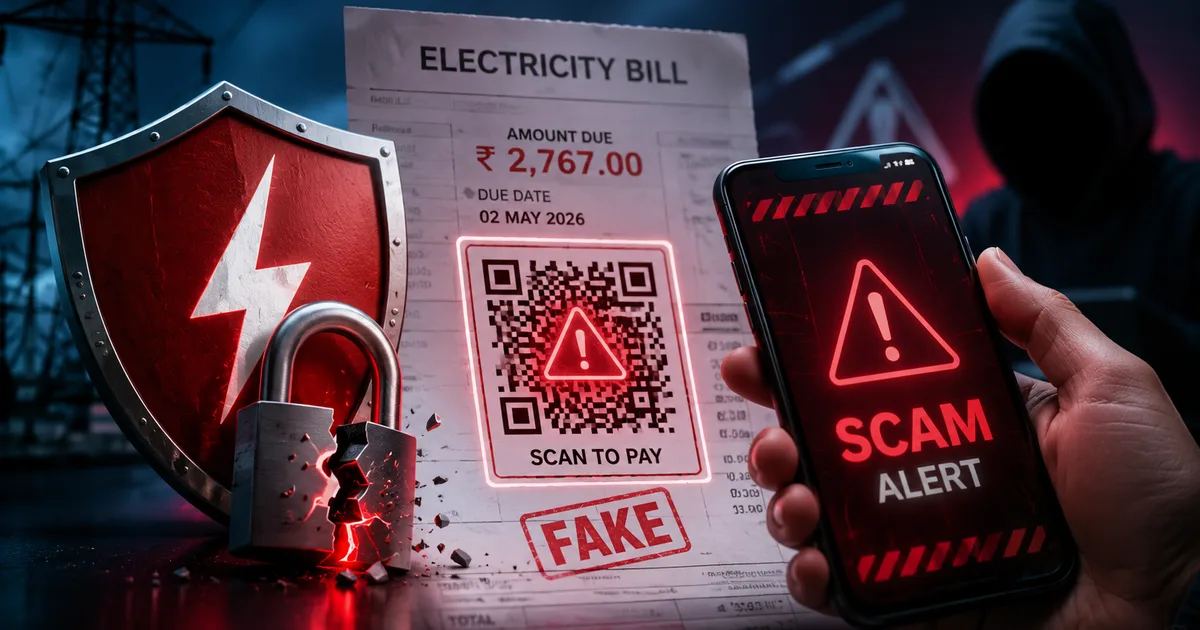
The first is the WhatsApp and SMS version. You get a message claiming to be from your state electricity board — BESCOM in Karnataka, MSEDCL in Maharashtra, BSES or TPDDL in Delhi, TNEB in Tamil Nadu, wherever you are. The message says your bill is overdue. Pay within a few hours or your connection gets cut. Scan the QR code to pay immediately. The QR code looks real. It might even show your approximate bill amount. But it links to a scammer's UPI ID, not your discom's account. You pay. The money is gone.
The second version is more brazen: physical QR code tampering. Fraudsters print fake QR stickers and paste them over legitimate ones at electricity board offices, on printed bills left at your door, or on pamphlets. You walk up, scan what looks like the official payment QR, and your money lands in someone else's account. The 19-year-old arrested recently was running exactly this kind of operation.
How the WhatsApp electricity bill scam works, step by step
- Your phone number gets into scammer hands through data leaks, telemarketing lists, or random targeting of numbers in a locality with heavy discom customers.
- You receive a WhatsApp message or SMS with a fake electricity board logo. The message looks official: proper letterhead, your approximate area mentioned, sometimes even a partial account number.
- The message warns of immediate disconnection unless you pay. The deadline is short. "Within 2 hours" or "before midnight today." This urgency is deliberate.
- A QR code is included or sent as an image. You're told to scan it on PhonePe, Google Pay, Paytm, or any UPI app.
- When you scan, a UPI payment screen opens. The recipient name might say something like "BESCOM PAYMENT" or "MSEDCL BILL SERVICE," not obviously fake.
- You enter the amount and your UPI PIN. Done. The money transfers instantly, with no reversal possible once confirmed.
- Some scammers send a fake receipt after payment to delay suspicion. You find out the truth when your actual discom sends a disconnection notice days later.
The scam works because electricity disconnection is a genuine, immediate threat. People don't pause to verify when they're scared of losing power, especially if they have a home office, elderly parents, or young children at home.
Warning signs that tell you it's a UPI payment scam
Honestly, some of these messages are well-crafted. But there are tells.
- The message arrives on WhatsApp or SMS, not through your discom's official app or website. Discoms do not send payment QR codes via WhatsApp. Full stop.
- There's a short, artificial deadline: "pay in 2 hours," "last chance before midnight."
- The QR code, when scanned, shows a personal or generic UPI ID rather than an official verified corporate account. Look at the UPI ID carefully before paying anything.
- The sender's WhatsApp number has no business verification tick. It's a regular mobile number pretending to be an official channel.
- When you call the "helpline" number in the message, the person pressures you to pay immediately without answering basic questions about your account.
- For physical QR stickers at offices: the sticker looks slightly off — different paper quality, edges that don't align with the printed material underneath, or a laminate that doesn't match the rest of the document.
And here's something worth knowing: if a QR code leads to a payment screen where you can type in the amount yourself, that's almost certainly a scam QR or a collect request. Legitimate bill payments through BBPS pre-fill the exact bill amount. You shouldn't be entering a number manually (annoying that this even needs saying, but here we are).
Why Telangana's discom had to suspend QR code payments entirely
This detail shows the real scale of the problem. Telangana Today reported that cyber fraudsters were running this scam so aggressively that TSSPDCL (Telangana Southern Power Distribution Company) decided to pause its QR code payment feature while security measures were reviewed. A state-level power utility basically said: the fake QRs are convincing enough that we can't trust customers to tell ours from a fraudster's right now.
The Indian Express reported that Delhi discoms — BSES Rajdhani, BSES Yamuna, and Tata Power Delhi Distribution — were told by Delhi's power department to take additional security steps and actively educate customers. Multiple discoms issued public advisories telling people to pay only through official apps and the BBPS system.
So official payment infrastructure had to be partially pulled back because fraud had gotten this bad. If that doesn't make the case for never paying a utility bill through a WhatsApp QR code, I'm not sure what will.
How to protect yourself from electricity bill QR code fraud
None of this is complicated. The precautions are real and they work.
- Pay only through your discom's official app or website. BESCOM has the BESCOM app. MSEDCL has the MahaVitaran app. BSES and Tata Power Delhi each have their own verified apps. Download from the Play Store or App Store directly — never from a link in any message. You can find verified utility payment resources in our tools section.
- Use BBPS (Bharat Bill Payment System) through your bank app or through the "Pay Bills" section in PhonePe, Google Pay, or Paytm. When you pay electricity via BBPS, the payment routes through a regulated channel to the correct registered biller. Far safer than scanning an unknown QR.
- If you must scan a physical QR at an office, check the edges of the sticker. Fake QR stickers are layered over real ones. If anything lifts or the paper quality looks different, don't scan it and alert the office staff immediately.
- Before confirming any UPI payment, read the recipient name carefully. If it shows something generic like "Merchant" or an individual's name instead of a registered official entity, stop and don't proceed.
- If you're worried your actual bill is genuinely overdue, call your discom's helpline number printed on your last paper bill — not any number found in a WhatsApp message.
CERT-In guidance: India's national cybersecurity agency has consistently flagged QR code fraud as a growing threat alongside rising UPI adoption. Their advice: always verify the recipient's UPI ID before confirming payment, and never scan QR codes received through unsolicited messages or from unknown sources. Full advisories are at cert-in.org.in.
One practical thing worth remembering: electricity bills in India typically run from around ₹150 for a basic single-room household to ₹8,000–15,000 for air-conditioned apartments and small offices. If a scam message quotes a suspiciously round number like "₹2,000 overdue" without matching your actual usage pattern, that's a flag. Your real current bill is visible in your discom's official app at any time. Check it before paying anything from any external source.
What to do if you already paid a fake electricity QR code
Don't wait. Move fast.
Call your bank immediately. If the transaction is recent, some banks can flag it for review before settlement completes. The 1930 cybercrime helpline is specifically designed for financial fraud and can sometimes help coordinate action faster. Save your transaction ID, the UPI ID you paid, and screenshots of the scam message and any fake receipt.
- File a complaint at cybercrime.gov.in, India's National Cyber Crime Reporting Portal. Do this as soon as possible. Speed genuinely matters here.
- Call 1930, the National Cybercrime Helpline, available across all states. They guide next steps and can sometimes coordinate with banks to freeze fraudulent accounts before the funds are withdrawn.
- File an FIR at your nearest police station with cybercrime cell support. Bring transaction screenshots, the fraudulent message, and a written note of the UPI ID you paid to.
Recovery isn't guaranteed. UPI transactions are instant and generally irreversible once confirmed. But reporting quickly does improve the odds. And it helps build cases against these networks — the 19-year-old arrested for QR code tampering was caught partly because enough victims reported consistently. Your complaint matters even when the money seems lost.
For related fraud patterns, see our scam alerts section covering fake UPI collect requests and phishing attacks on Indian payment users. And if you want a broader look at safe digital payment habits in India, our payment safety guides cover everything from UPI basics to net banking.
The wider QR code fraud problem in India
QR codes went everywhere fast. Tea stalls, parking lots, temples, electricity counters, auto-rickshaws. Most people trust them because they look technical and official. Fraudsters noticed this.
The electricity bill angle works particularly well because it combines two real pressures: fear of losing power and the guilt of owing money. Both make you want to resolve things fast, without questioning. Scammers have been running WhatsApp payment scripts for years, but adding a QR code shifts the scam from "sketchy link" territory into "normal payment" territory. People who've learned not to click links will still scan a QR code without pausing to check who's actually receiving the money.
RBI and NPCI have pushed digital payments hard, and broadly that's been good for India. More people are now comfortable doing large transactions via QR code. But that comfort is also a gap — paying significant amounts without verifying who is actually getting the money. That gap is exactly what this scam runs on.
In my experience, the fix comes down to three habits. Know your discom's official app. Use BBPS for bill payments. Ignore every WhatsApp payment request without exception. Those three close the gap almost entirely. You can learn more about how India's bill payment infrastructure works in our digital payments explainers.