I get these messages on WhatsApp almost every single week. You probably do too. A random number sends you a friendly, urgent text about government money. Right now, it's the fake Mukhyamantri Ladli Behna Yojana 2026 registration WhatsApp APK scam. And honestly, it makes my blood boil.
Here's the deal. Scammers know people need this money.
Government schemes like Madhya Pradesh's Ladli Behna and Maharashtra's new Ladki Bahin are huge right now. Millions of women are getting monthly cash transfers. Criminals just look at those headlines and see an easy payday.
They aren't hacking into government servers. Basically, they're tricking you into handing over the keys to your own bank account. I want to break down exactly how this specific fraud works, step by step, so you can warn your family before someone loses their savings.
What the fake registration scam actually is
Let's get one thing straight. The government doesn't send mobile apps over WhatsApp. They just don't.
If you're reading this, tell your parents and grandparents today. If you ask me, older folks are usually the main targets here.
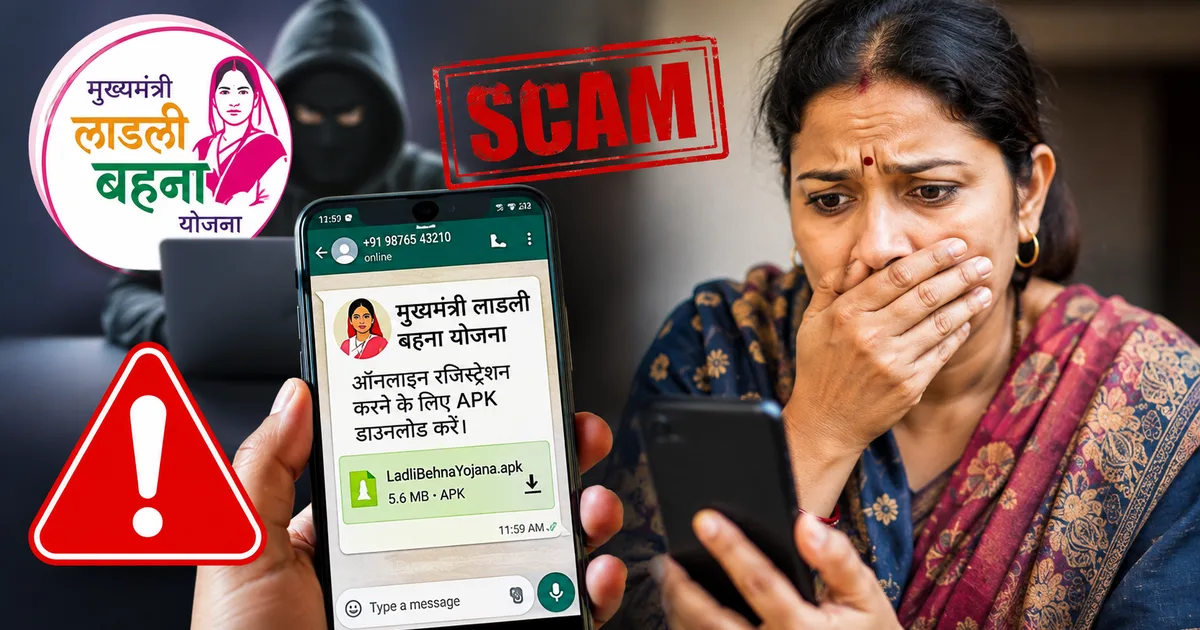
This scam starts with a forward. Usually, it comes from someone you know who fell for the trick and forwarded it without thinking. The message claims you need to complete your registration right now to get your Rs 1500 or Rs 3000 installment. Some messages even claim you missed a deadline and have to act fast.
Attached to the message is a file ending in .apk. This is an Android Package Kit. It's basically the raw file used to install an app on your phone, bypassing the Google Play Store entirely (which makes sense, actually, since Google would block it).
When you download and tap that file, you aren't installing a government app. You're installing a remote control for a criminal sitting in Jamtara or somewhere else.
According to advisories from CERT-In, side-loading malicious APK files is currently one of the leading causes of financial fraud in India.
Why this specific scheme is targeted
Look, state governments are genuinely distributing thousands of crores right now. In Maharashtra, the Ladki Bahin scheme is rolling out to over a crore women. In Madhya Pradesh, the Ladli Behna Yojana has been a massive political success. People know the money is real.
They see their neighbors getting SMS alerts from the bank showing deposits. So they want in.
Scammers exploit this fear of missing out. I'm not sure exactly why it works so well, but when someone reads that they might get Rs 3000 every single month just for filling out a form, their critical thinking just shuts down. The desperation for financial support overrides basic digital safety rules.
And let's be honest, government websites are often confusing. They crash. The servers go down under heavy load. The forms are a mess. So when a helpful-looking message arrives on WhatsApp promising an easy, one-click registration process through a simple app, people take the bait.
How the WhatsApp APK fraud empties your bank account
The technical side of this is scary because it's so incredibly simple. Here's exactly what happens when someone falls for this scam.
Step 1: The lure
You get the WhatsApp message. It looks official. It might have the Chief Minister's photo on it. It might use the state emblem. The text is written in Hindi or Marathi, offering immediate financial relief.
Step 2: The installation
You tap the APK file to download it. Your Android phone will likely show a warning. It'll say something like "Install unknown apps" or tell you this file could harm your device. The scam message usually includes instructions telling you to ignore this warning and go to Settings to allow installation from unknown sources. Sadly, people follow these instructions because they want the scheme money.
Step 3: Handing over permissions
Once the fake app opens, it looks like a cheap registration form. It asks for your Aadhaar number and PAN details. Oh, and your bank account number. But that's just a distraction. Behind the scenes, the app asks for permissions on your phone.
Specifically, it asks for permission to read and send SMS messages. Once you click "Allow," the trap snaps shut.
Step 4: The silent robbery
You submit your details on the fake form. It probably shows a fake loading screen and says your application is pending. Meanwhile, the scammers now have your bank account number. They go to their own device and initiate a money transfer using your bank details.
Your bank sends an OTP via SMS to verify the transaction. Normally, you'd see this, realize you didn't authorize a transfer, and ignore it. But the malicious app you installed intercepts that SMS.
It hides the message from you and silently forwards the OTP directly to the scammers.
They enter the OTP. The money leaves your account. You don't even know it happened until you check your balance days later. We saw a 70-year-old CA in Madhya Pradesh lose Rs 21 crore to online fraud recently (the exact numbers here are a bit fuzzy, but the loss was massive). If a chartered accountant can get fooled by sketchy online schemes, anyone can fall for a fake government app.
Major warning signs you cannot ignore
You have to stay alert. The tactics change. But the red flags remain the same.
- The app is sent directly on WhatsApp or Telegram instead of asking you to go to the Google Play Store.
- The message creates a false sense of extreme urgency, claiming you will lose benefits if you don't install the app within 24 hours.
- The application asks for SMS reading permissions. A legitimate scheme status checker has absolutely zero need to read your private text messages.
- The spelling and grammar in the message are slightly off. Many of these gangs operate quickly and make basic language errors.
- The sender is a random 10-digit number, not an official verified WhatsApp business account with a green tick.
If you see even one of these signs, stop. Delete the message. Tell the person who sent it to you that their phone might be compromised.
How to protect yourself and your money
You're the first and best line of defense against UPI and banking fraud. Your bank can't stop you from handing over your OTP voluntarily through malware.
First, never install an APK file sent to you in a chat. I don't care if it comes from your own mother. Never side-load apps from unknown sources. Go to your Android settings right now, search for "Install unknown apps," and make sure this permission is turned off for WhatsApp and Chrome.
Second, only use official websites. If you want to register for a government scheme or check your status, open a web browser and type in the official state government URL. Look for websites ending in .gov.in or .nic.in. If you're unsure, visit your local e-Seva kendra or official government office. It's better to stand in line for an hour than to lose your life savings in five minutes.
Third, read more about how these frauds operate. Check out our explainers on Android malware. Educate yourself by reading our guides on securing your digital life.
Fourth, keep a separate phone number for your bank accounts if you can afford to (it's a bit of a hassle, I know). Don't use your primary WhatsApp number for your sensitive banking OTPs.
Where to report the fraud immediately
Time is your worst enemy if you accidentally installed the fake app. You have minutes. Not hours.
If you installed the fake Mukhyamantri Ladli Behna Yojana 2026 APK, do this right now. Put your phone in airplane mode. This cuts off the internet connection so the scammers can't receive your OTPs anymore.
Grab another phone. Call your bank immediately and tell them to freeze your accounts and block your UPI IDs. Tell them your phone is compromised.
Then, report the crime. Call the National Cyber Crime Reporting Portal helpline at 1930 immediately. They have a mechanism to freeze fraudulent transactions if reported quickly enough. You must also register a formal complaint on the official website at cybercrime.gov.in.
Finally, factory reset your infected phone. Don't just uninstall the app. The malware often hides deep in the system.
Scams like this thrive on desperation and lack of awareness. Government schemes are real, and they are helping people. But criminals are using that hope as a weapon. You can check our other scam alerts to see how widespread this is. Stay skeptical.