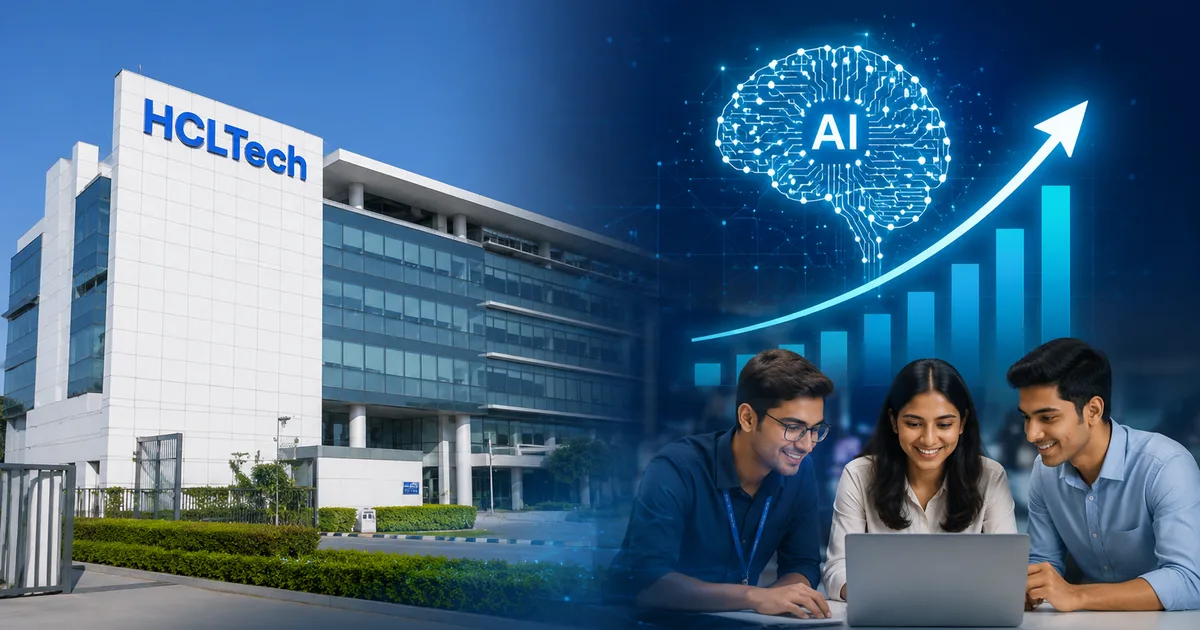
The numbers are finally out. HCLTech just released its financial report for the first quarter of the financial year. The HCLTech Q1 2026 results show a net profit of Rs 4,624 crore. That's a solid 20% jump compared to the same time last year.
Revenue also went up by 14%. And for the investors out there, the company announced an interim dividend of Rs 12 per share. On paper, these are very good numbers. But honestly, the real story goes way beyond profit margins (which makes sense, actually, given the market). People just want to know about jobs. Specifically, what this means for engineering students sitting on campuses right now, waiting for offer letters.
I've spoken to dozens of final year students over the past few months. The anxiety is real. You spend four years studying. Your parents spend a large chunk of their savings. And then you hear that IT companies are freezing hiring. So when a massive player like HCLTech posts a 20% profit jump, the immediate question is whether that money will translate into jobs.
What the results mean for fresher hiring
Some context helps here. Just a few days ago, TCS reported its own numbers. They added over 9,000 employees in their first quarter. That was a huge relief. For a long time, the headcount at major Indian IT firms had actually been shrinking. People were leaving, and companies just weren't replacing them.
HCLTech has maintained its growth. That suggests we might be seeing a slow thaw in the job market. They retained their FY27 guidance. This means they're confident about their business for the rest of the year. In my experience, companies that feel secure usually hire people.
But don't expect a return to the crazy hiring days of 2021. The reality is just different now. The skills they want have changed. If you check out our guides on career transitions, you'll see a massive shift in what recruiters want to see.
Companies no longer hire people to do basic coding. Automation handles a lot of that now. Recruiters want people who understand cloud architecture and data engineering. The bar for freshers is definitely higher.
The real story behind AI revenue growth
You can't talk about tech earnings in 2026 without talking about AI. Every company mentions it. Usually, it's just noise. But these earnings actually show strong bookings backed by real client demand.
Clients in the US and Europe aren't just experimenting with AI anymore. They are paying actual money to get it implemented. HCLTech is building large scale data systems for these clients. Because you can't run generative AI if your basic data is a complete mess.
"Clients are moving from proof-of-concept AI projects to enterprise-wide implementation, driving a new cycle of tech spending."
This is where the AI revenue is coming from. Indian IT is shifting from a low-cost maintenance hub to an implementation partner for complex new tech. I'm not sure exactly why the transition took so long, but this is exactly what the industry needed to do to survive.
If you're an experienced IT professional in India right now, this is your signal. Basic Java will keep you employed for a while. But the premium salaries are in the AI and data analytics projects. HCLTech's management noted strong demand in these areas during their earnings call.
The company is getting big deals. Analysts at major brokerage firms are positive about HCLTech because they keep winning these large contracts. It proves they can compete with global consulting firms. Not just other Indian IT companies.
Data privacy laws and domestic IT growth
Basically, there's another angle to this revenue growth that people often miss. American and European clients are important, but the domestic market in India is expanding. Fast. With the enforcement of the Digital Personal Data Protection (DPDP) Act, Indian companies have to completely overhaul how they handle customer data.
Banks and healthcare providers in India can't store data casually anymore. They need secure infrastructure. This is a massive opportunity for companies like HCLTech. They're helping domestic firms build data systems that follow the new Indian regulations.
Think about the sheer scale of data from systems like UPI and Aadhaar. Millions of transactions happen every single day. Securing this data and making sure it meets DPDP Act standards takes serious technical muscle. Indian IT firms are perfectly positioned to grab this domestic spending.
I was reading through the earnings call transcript recently. The global deals get all the headlines. But the domestic market provides a really nice cushion. When the government pushes digital public infrastructure, the tech ecosystem benefits. Somebody has to build the backend systems for these massive national projects, right?
Navigating AI regulations globally and locally
The other big factor driving consulting revenue is AI regulation. The European Union has its AI Act. India is working on its own AI framework. Companies are terrified of deploying AI tools and getting hit with massive fines for compliance failures (and honestly, the numbers here are a bit fuzzy, but the fines are huge).
So they turn to IT service providers to build AI systems that are safe. And legally compliant. HCLTech writes code and also provides advisory services on how to use AI without breaking the law. This consulting work brings in high profit margins.
This explains why revenue grew by 14%. When a client wants to implement an AI chatbot, they also pay for security audits and data masking tools. The initial AI project just snowballs into a massive IT contract.
This is exactly why the skill requirements for freshers have changed. You need developers who understand data privacy. Writing efficient code is good. But writing secure code that complies with the DPDP Act is what gets you a premium salary.
The shift to Tier-2 and Tier-3 cities
We also need to look at where these jobs are going. In the past, getting an IT job meant moving to Bengaluru or Hyderabad. You paid crazy rent. You spent three hours a day in traffic. But companies like HCLTech have been actively expanding into smaller Indian cities.
They're setting up centers in places like Lucknow and Nagpur. This completely changes the math for freshers. A starting salary of Rs 3.5 to 4 lakh per year is almost impossible to survive on in Bengaluru today. But in a tier-2 city, living at home or renting a cheaper apartment, that same salary goes much further.
This geographic shift is how companies maintain their profit margins. That's how they managed to hit that Rs 4,624 crore net profit number. By hiring talent in smaller cities, they control their real estate and wage costs. It's a smart business move.
IT hiring in 2026 has expanded beyond the big metro cities. The growth is decentralizing. For a lot of middle-class families in smaller towns, this means their kids don't have to move a thousand kilometers away to start a corporate career.
Understanding the stock market reaction
The stock market is always a bit weird with IT results. Before the announcement, HCLTech shares actually jumped over 6%. People were expecting good things. Then the results came out. They beat profit estimates. They announced a Rs 12 dividend, and the stock just fell 3% the next day.
Why does this happen? It's all about expectations. Sometimes investors price in perfection. When a company delivers something that's just "very good" instead of "perfect", short-term traders sell their shares to lock in profits.
If you're a retail investor holding HCLTech for the long term, daily price movements don't matter much. Look at the fundamentals. A 20% profit jump to Rs 4,624 crore is a massive number. The Rs 12 dividend is real cash hitting shareholder bank accounts. That's what actually pays the bills.
For more details on how these tech stocks are performing, you can read our latest market updates.
How Indian IT is changing in 2026
We need to look at the bigger picture here. The Indian IT services industry employs over five million people directly. It supports millions more indirectly. Thing is, when companies like HCLTech and Infosys do well, it impacts real estate in Bengaluru. It affects car sales in Pune.
The past two years were rough. Inflation was high in the US, so western companies cut their IT budgets. That pain rolled downhill directly to Indian tech parks. Promotions were delayed. Variable pay was slashed. Freshers even had their joining dates pushed back by six to twelve months (annoying, I know).
These Q1 2026 results from HCLTech, combined with the recent TCS numbers, indicate that the worst of that cycle might be over. Western clients are spending again. They have to. You can't delay upgrading your tech infrastructure forever.
But the jobs returning are different from the jobs that were lost. I really can't stress this enough.
The skills required for the new IT jobs
Imagine sitting in a tier-2 engineering college right now. Your seniors struggled to get placed last year. You're worried. What should you do?
- Stop relying on your college syllabus. It's probably outdated.
- Learn how to work with cloud platforms like AWS or Azure.
- Understand the basics of machine learning pipelines.
- Get very good at problem-solving, not just syntax memorization.
HCLTech is looking for problem solvers. When they win a multi-million dollar contract from a European bank, that bank expects modern solutions. They don't want legacy code. The freshers who get hired this year will be the ones who can prove they can learn new technologies quickly.
I know this sounds exhausting. You study for four years and then realize you have to learn everything over again. But that's the reality of the tech industry. It just never stops moving.
The impact of the Rs 12 dividend
We should talk about that dividend for a second. Rs 12 per share might not sound like much if you only own ten shares. But for large institutional investors and mutual funds, it's millions of rupees. Many ordinary Indians hold HCLTech indirectly through their SIPs and mutual funds.
When these IT companies pay out consistent dividends, it stabilizes the returns on those mutual funds. It is a sign of financial health. A company only pays a cash dividend when it has actual cash in the bank. Not just accounting profit.
In a world where many startups are burning through cash and laying people off, the boring reliability of traditional IT companies is quite refreshing. They make money. They pay their employees. And they return cash to shareholders.
You can read more about how to evaluate tech company fundamentals in our detailed financial explainers.
Final thoughts on the quarter
The numbers from HCLTech are a solid win for the company. Hitting Rs 4,624 crore in net profit while managing the shift toward AI isn't easy. Retaining their FY27 guidance shows they have a clear view of their pipeline for the next nine months.
For the workers, the signs are cautiously optimistic. The heavy layoffs and hiring freezes seem to be in the rearview mirror. The deals are flowing again. But the pressure to upskill has never been higher.
If you're in the industry, take this quarter as a warning sign. The companies are surviving by adapting to AI and cloud. If you want to survive and grow your salary, you have to do the same thing. The jobs are out there. But they require a completely different mindset now.