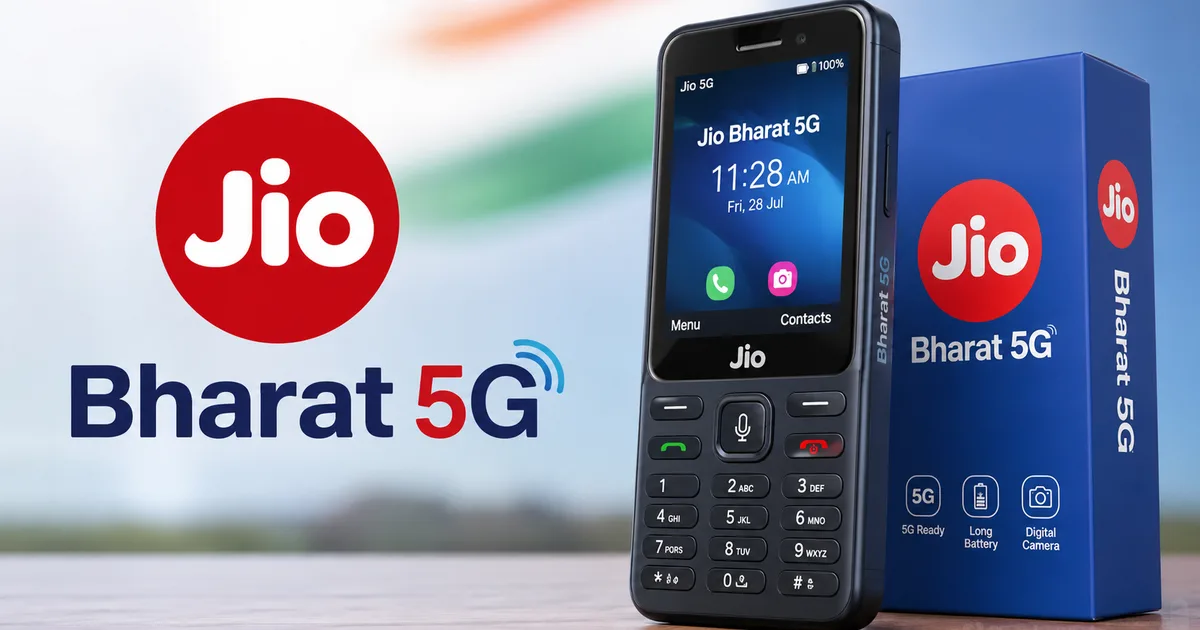
The Jio Bharat 5G Phone Launch in India is happening, and Mukesh Ambani is about to disrupt the market again. You probably remember when Jio first launched. Free data. Cheap SIM cards. Long queues outside stores. Now they want to get everyone left behind on 2G or basic 4G onto a 5G network. And they plan to do it with a phone priced at just ₹1,999.
Look, a 5G phone for under two thousand rupees sounds almost impossible. But Reliance Jio has a history of heavily subsidising hardware to lock you into their ecosystem (which makes sense, actually). I spent the last few days digging through the leaks and official announcements. I want to break down exactly what you're getting, how to book it this July, and whether it makes sense to buy one.
The reality of the ₹1,999 price tag
There's been a lot of confusion about the pricing. Some leaks mentioned ₹2,499, and others threw around wild claims about 108MP cameras or massive 7000mAh batteries. Honestly, you should ignore the clickbait. A ₹1,999 phone won't have a 108MP camera. That's just basic math.
What you're actually getting for ₹1,999 is a heavily subsidised entry-level 5G device. The business model here is simple. Jio sells you the phone at a loss. You buy it. Then you're locked into a Jio 5G plan for a year or two. In my experience, it's the exact same strategy they used with the original JioPhone and the more recent JioBharat 4G devices.
If you look at the buying guides for budget phones, even a basic 4G smartphone costs around ₹6,000 these days. Offering a 5G device at a third of that price is aggressive. But it's necessary for Jio. They've spent billions rolling out a true 5G standalone network across India. Now they need people to use it. And millions of Indians are still using basic 2G feature phones because they can't afford a smartphone upgrade.
Will there be hidden costs?
Yes, absolutely. The ₹1,999 is just the upfront cost of the hardware. You'll have to recharge it. The fine print usually requires an active plan to keep the phone functioning properly. We expect Jio to launch specific tariff plans for these devices. They'll likely be slightly more expensive than the old 4G JioBharat plans that started at ₹123.
But even with the recharge costs, the barrier to entry is insanely low. For a daily wage worker or a student, paying ₹1,999 upfront is manageable. Paying ₹8,000 for a standard Android phone isn't.
Specs that actually matter (no marketing fluff)
So what's inside this cheap plastic shell? Don't expect an iPhone killer. Expect a utility device.
According to the most reliable supply chain leaks, the JioPhone 5G has the Qualcomm Snapdragon 480 chipset. This is an older, very basic 5G processor. It's not going to run heavy games smoothly. But that's not the point. The Snapdragon 480 is perfectly fine for basic tasks. It'll run WhatsApp and YouTube. It'll also manage UPI payments without stuttering.
- A 6.5-inch HD+ LCD screen. It won't be very bright in direct sunlight, but it gets the job done.
- 4GB of RAM and maybe 32GB or 64GB of internal storage. You will probably need a microSD card if you take a lot of photos.
- A basic 13MP rear camera and an 8MP front camera for video calls. Good enough for scanning QR codes at the local kirana store, but you won't be winning any photography awards.
- A 5000mAh battery. Combined with the low-resolution screen and basic processor, this thing should easily last a full day on a single charge.
- Pragati OS, co-developed with Google, which is basically a stripped-down version of Android optimized for low-end hardware.
That's the main appeal of this device. It's designed for utility. It has the Jio AI Classroom Programme integrated, which is a massive deal for students in rural areas. It supports all the major Indian digital public goods. You can access DigiLocker or download your Aadhaar. You can use BHIM UPI natively. In many ways, this is a government service delivery device disguised as a budget phone.
Why this changes things for ordinary Indians
It's easy to sit in an air-conditioned office in Bangalore or Mumbai and dismiss a ₹1,999 phone as e-waste. But for millions of Indians, this is their first real on-ramp to the modern internet.
Think about the digital divide right now. If you have a decent smartphone, you have access to online education and telemedicine. You get cheap entertainment. If you're stuck on a 2G feature phone, you're excluded from all of that. You can't even scan a QR code to pay for vegetables. The Jio Bharat 5G phone closes that gap.
With 5G speeds, a student in a tier-3 town can stream educational videos without buffering. A farmer can get real-time weather and mandi prices via video. And a small business owner can accept digital payments faster.
There's also a huge safety aspect. Upgrading people to smartphones allows them to use better communication tools. But it exposes them to new risks too. That's why the JioBharat phones reportedly come with built-in safety features. They're meant to help users avoid the massive wave of digital frauds we see right now. Speaking of which, if you're new to the digital world, you really should check out our scam alerts. You'll learn how to spot fake apps and phishing links.
Your July 2026 booking guide
Okay, so you want one. Or maybe you want to buy one for your parents. How do you actually get your hands on it? Because whenever Jio launches something this cheap, the demand is ridiculous. The supply is usually a mess.
Here's the exact process you need to follow for the July 2026 bookings.
Step 1: Get the MyJio app ready
Don't bother trying to book it through a third-party website. The initial batch will almost certainly be sold exclusively through the MyJio app or Reliance Digital stores. Download the MyJio app now. Log in with an existing Jio number. Make sure your payment details are updated.
Step 2: Watch for the beta trials
Reliance loves doing beta trials before a full commercial launch. They did it with the ₹999 4G phones, starting trials around July 7th. I think we can expect a similar rollout strategy here. They'll likely open up bookings in specific cities first. Keep an eye on the banner inside the MyJio app. If you see a registration link, click it immediately.
Step 3: Offline Reliance Digital stores
If you miss the online booking window, your next best bet is a physical Reliance Digital or Jio Store. But go early. These stores get crowded fast. You'll need your Aadhaar card for KYC to get the new 5G SIM that comes bundled with the phone.
Warning: Beware of fake booking links
This happens every single time. Scammers set up fake websites that look exactly like the Jio portal. They send WhatsApp messages claiming you've been selected for a VIP early access booking. They ask you to pay ₹500 as an advance booking fee.
Scam Alert: Jio will never ask you to pay an advance booking fee via a random UPI link on WhatsApp. Always use the official MyJio app or a physical Reliance Digital store for any transactions.
If you get a message like that, report it immediately on the national cybercrime portal at cybercrime.gov.in. Or call the 1930 helpline. If you want to know more about how these frauds operate, read our detailed explainers on WhatsApp scams.
Made in India, for India
There's another angle to this launch that we need to talk about. The manufacturing. In the past, ultra-cheap phones sold in India were mostly imported white-label devices from Shenzhen, China. A company would slap their logo on a generic phone and sell it cheap.
But the supply chain has shifted. To hit a ₹1,999 price point and avoid massive import duties, these phones have to be assembled locally. Reliance has been partnering with local contract manufacturers. This ties directly into the government's PLI schemes. By assembling these devices in places like Noida or Sriperumbudur, Jio gets tax breaks. That helps them keep the retail price artificially low.
It's a smart strategy. The government gets to talk about local manufacturing numbers. Jio gets to expand its user base. And the consumer gets a cheap phone. I'm not saying these phones are entirely sourced from India (the numbers here are a bit fuzzy). The processor and memory chips are still imported. But the final assembly is happening here. That creates local jobs.
The app ecosystem and pre-loaded software
When you buy a phone this cheap, you aren't just buying hardware. You're buying into a walled garden. And Jio's garden is heavily curated. Out of the box, you'll find the phone pre-loaded with the entire suite of Jio applications. We're talking about JioCinema for entertainment and JioTV for live news. They also throw in JioSaavn for music.
But it goes beyond entertainment. As I mentioned earlier, the integration of the Jio AI Classroom Programme is huge. Education in rural India often suffers from a lack of quality teachers. Giving students access to AI-driven educational content directly on a cheap mobile device could actually help with that problem.
You'll also find JioPay heavily pushed as the default UPI app. Yes, you can probably install Google Pay or PhonePe. But Jio wants you using their financial services. They want to be the platform where you watch a cricket match and pay your electricity bill. If you want to explore other utility apps, you can always check out our app reviews section.
The storage space on a ₹1,999 phone is going to be extremely limited. Out of the 32GB of advertised storage, the operating system and pre-installed apps will likely eat up at least half of it. I'm not sure exactly why it takes so much space. But you'll have to be ruthless about uninstalling apps you don't use and clearing your WhatsApp media cache regularly.
The competition is sweating
This launch puts immense pressure on Airtel and Vodafone Idea. Neither of them has the financial muscle to subsidise hardware at this scale. Airtel has tried offering cashback schemes if you buy specific budget smartphones. But a cashback after 36 months isn't the same as a ₹1,999 upfront price.
Even the government-owned telecom operator is struggling to keep up. Everyone is wondering what BSNL 5G will look like. But until they actually roll out a widespread network, Jio basically has a monopoly on the ultra-budget 5G segment.
Is this good for the market in the long run? Probably not. Less competition usually means higher prices down the line. We've seen Jio slowly raise their tariff plans over the years once they captured the market. But in the short term, a ₹1,999 5G phone is a massive win for the Indian consumer.
Final verdict: should you buy it?
If you already own a decent 4G or 5G smartphone that costs over ₹10,000, this phone isn't for you. You'll find it slow. The screen will look washed out. The cameras will disappoint you.
Thing is, that's missing the entire point of the device. This is a phone for the next hundred million internet users. It's for the person who wants to upgrade from a keypad phone. It's an excellent secondary backup device. And for ₹1,999, it is frankly one of the most important pieces of consumer tech launching in India this year.
Just make sure you book it through official channels and read the fine print on the mandatory recharge plans. You should also set it up properly for whoever is going to use it. The internet is sketchy sometimes. But having access to it shouldn't be a luxury.