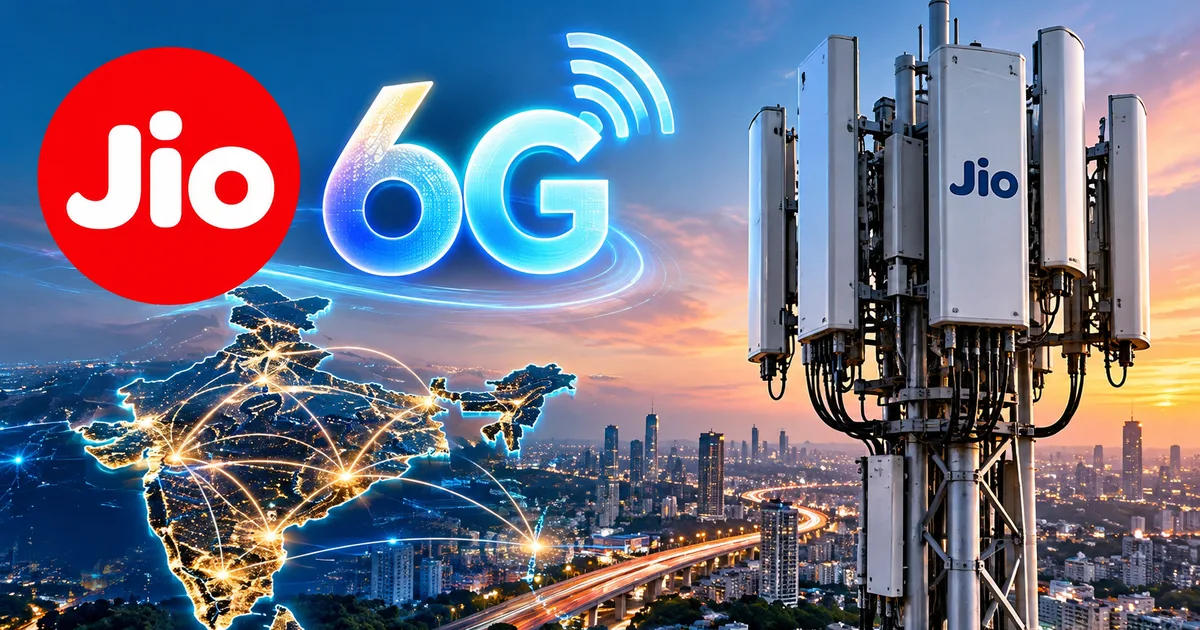
If you walked through Bharat Mandapam during IMC 2026, you probably saw crowds huddled around Reliance Jio's pavilion. Jio took the stage to unveil its homegrown Jio pre-6G stack and a colossal Giga MIMO radio unit. The company declared that India won't be playing catch-up this time around. For decades, our country waited years after the West before getting modern telecom standards. With 6G, Jio insists India will be right in the opening wave by 2030.
Look, telecom marketing teams love throwing big acronyms around. When 5G rolled out across Mumbai and Delhi back in late 2022, we heard wild promises about remote robotic surgery and automated flying cabs. Most of us just wanted our YouTube shorts to load on the local train without buffering. Or our UPI payments at the sabzi mandi to go through on the first tap instead of timing out (annoying, I know). So when an operator starts talking about 6G while many Indian villages still struggle with spotty 4G reception, if you ask me, it's healthy to raise an eyebrow.
I spent hours checking the technical sheets and talking to network engineers at the venue. Jio brought real silicon and genuine radio engineering to the table, backed by an aggressive patent push. But whether this hardware actually changes your monthly mobile recharge bill anytime soon? Honestly, that's a very different story.
What the Jio pre-6G stack actually is
Here's the deal. Telecom generations don't just land out of thin air.
You don't flip a switch on New Year's Eve in 2030 and magically find 6G running on your phone. Engineers always build stepping-stone tech years ahead of time. That's exactly what this Jio pre-6G stack is. It's a full package of cloud-native network software, baseband controllers, routing protocols, and custom server code built entirely in-house by Jio Platforms engineers over in Navi Mumbai. Instead of buying locked-down hardware boxes from foreign vendors, Jio runs its core network on regular commercial servers using its own code.
And that software setup lets them test next-gen transmission tricks right now on their live 5G standalone grid. Right now, they're testing ultra-low latency scheduling along with sub-terahertz radio frequencies at the network edge. The goal is simple. They want to iron out the nasty bugs before the International Telecommunication Union puts its official stamp on global standards (which makes sense, actually).
Why the Giga MIMO radio hardware matters for your phone
Software is only half the battle. Radio waves still have to blast through concrete walls or heavy monsoon rain to reach your pocket.
That's where the new Giga MIMO radio comes into play. If you've glanced up at mobile towers around your neighborhood recently, you've probably noticed big rectangular antennas. Those are Massive MIMO antennas, and they usually pack 32 or 64 small antenna elements inside. Jio's prototype Giga MIMO unit pushes that idea much further by stuffing hundreds of individual transmitters into one single housing.
Why does stuffing more antennas together help? It comes down to beamforming.
Old towers broadcast radio waves in wide circles like a bare ceiling bulb. Everyone nearby shares that weak signal, and radio noise ruins your download speed. Giga MIMO is much more like a laser pointer. The base station tracks your phone in real time, then aims a tight cone of radio energy right at your hand.
Jio's engineering slides from the summit claim this setup delivers five times more network capacity and cuts latency by up to ten times compared to current 5G gear. To be fair, the lab numbers here might be a bit fuzzy compared to messy street conditions. But think about Rajiv Chowk metro station at 6:30 PM on a weekday. It's packed. Thousands of commuters try to book cabs or stream video at the same time, and data speeds grind to a halt. A radio unit that fires hundreds of narrow beams keeps those individual signals from crashing into each other.
The patent race and why 8,000 filings change India's standing
Honestly, if you ask me, this patent angle is where things get genuinely interesting for anyone tracking Indian telecom industry reports.
Historically, Indian telecom providers operated purely as buyers. Foreign corporations spent billions researching wireless patents and ran international standards bodies to decide the specifications. Then Indian telcos spent billions of dollars importing all that equipment. Every single time an Indian subscriber recharged their phone, a royalty check flew right out of the country to patent holders abroad.
Jio's trying to flip that equation on its head.
At IMC 2026, Akash Ambani revealed that Jio's filed more than 8,000 patents spanning telecommunications, artificial intelligence, cloud infrastructure, and network software. Hundreds of those filings directly cover pre-6G and 6G technologies. On top of that, Jio engineers submitted over 934 technical contributions to global standards groups like 3GPP and the ITU.
"India was a consumer of telecom technology during 2G and 3G. With 5G we became an adopter, and with 6G we will be an originator and global exporter." - Akash Ambani, Reliance Jio Chairman at IMC 2026
Holding standard-essential patents is a massive financial advantage. When a company owns standard-essential patents, other countries have to pay licensing fees whenever they roll out networks built on those specifications. And it puts Indian engineers right at the drafting table where global wireless spectrum gets carved up.
Realistic India rollout timeline: when can you actually use it?
Don't rush out to trade in your smartphone just yet.
Thing is, marketing hype always outpaces reality. The global roadmap is coordinated by the ITU under its IMT-2030 framework. Official 6G technical specs won't be locked until late 2029 or early 2030. And chipmakers like Qualcomm and MediaTek can't build commercial modem silicon until those rules are final.
So what does Jio actually mean with this 2030 target?
Here's the realistic progression:
- Between 2026 and 2028, Jio plans to use its pre-6G stack for private lab trials and limited campus field tests in select tech parks.
- From 2028 to 2029, pilot deployments will expand across dense commercial clusters like Bandra-Kurla Complex in Mumbai and Cyber City in Gurugram.
- The Department of Telecommunications plans 6G spectrum auctions around 2029 or early 2030, allocating frequencies in the terahertz spectrum alongside centimetric bands.
- Commercial subscriber access will kick off in late 2030, rolling out first to flagship enterprise devices and fixed wireless access modems in tier-1 cities.
If you recently bought a mid-range 5G handset for Rs 15,000 or Rs 20,000, relax. You can easily use it through its natural lifespan without missing out on anything. Your current phone won't ever connect to a native 6G band. But in my view, you really don't need it to. Today's 5G networks still have plenty of room left to grow.
Satellite connectivity and the rural broadband puzzle
One surprising part of the presentation focused on space.
Jio revealed its architecture for what it calls Sovereign Satellite Connectivity. Basically, the plan hooks low Earth orbit satellite links directly into the terrestrial cellular core. If you go trekking in Ladakh or take a road trip through remote forest stretches in Bastar, your phone currently loses signal the second you drive past the last roadside tower.
Direct-to-cell satellite tech is designed to fix that dead zone.
Instead of forcing you to carry a bulky satellite phone with a massive whip antenna, future pre-6G and 6G radios can communicate directly with low-orbiting satellites using standard cellular protocols. The Government of India has been pushing for this through its official Bharat 6G Vision document, which specifically mandates seamless coverage across remote villages and border highways. It's a huge technical hurdle. But tying satellites into the same core network that handles regular city towers makes total sense to me.
What this means for your daily data bills and recharge plans
All this new hardware costs serious money.
In the end, subscribers always pay for network buildouts. We've already seen telecom tariffs creep upward across 2024 and 2025 as operators tried to recoup their multi-billion rupee 5G investments. Basic monthly recharge packs that used to cost Rs 239 have steadily climbed toward Rs 300 and beyond.
Jio's strategy focuses on broadening its digital ecosystem far beyond basic mobile data. By weaving connectivity with services like Jio financial services lending products and enterprise cloud solutions, they're spreading their income across multiple revenue streams.
For mobile gamers jumping into intense BGMI battle royale matches, near-zero ping sounds like a dream. But for regular folks checking WhatsApp or scanning UPI QR codes, today's 5G speeds are already more than enough.
Honestly, the practical benefit of this pre-6G gear will show up quietly in network reliability rather than crazy speed test screenshots. If Jio can deploy Giga MIMO radios to absorb massive crowd surges during Diwali shopping or Kumbh Mela gatherings without towers choking, that's a massive win. You won't care whether the icon on your screen says 5G or 6G. You'll just be glad your payment went through.
Final thoughts on India's 6G ambitions
Watching an Indian telecom operator present proprietary radio designs and thousands of international patent filings feels like a real shift. For decades, our domestic tech conversation was limited to importing hardware and offering the cheapest voice minutes on the planet.
Building domestic intellectual property is tough work. There'll be standardisation battles with international consortiums and complex spectrum allocation debates with the DoT.
Still, having a homegrown roadmap backed by working prototypes changes how global telecom leaders view India. In my book, Indian engineers are now actively shaping international wireless specifications. If you want to dive deeper into how our domestic wireless networks are transforming, check out our detailed telecom technology breakdowns.