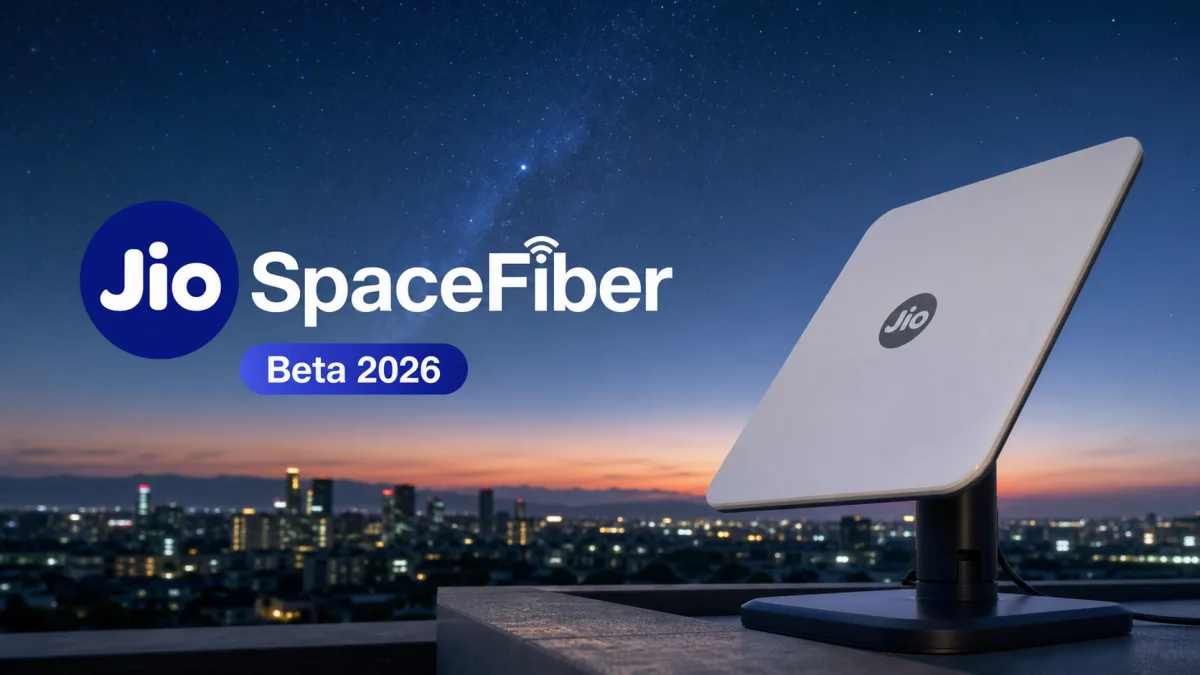
I remember when getting a new internet connection meant waiting weeks for a guy to show up and run a cable over your roof. Things changed fast. Now, the sky is literally the limit. We are talking about satellite internet, and specifically, the much-anticipated JioSpaceFiber Beta 2026 rollout. If you live outside a major city, you probably know the pain of spotty mobile data and broadband cables that never quite reach your street. Reliance Jio is trying to fix that by beaming internet straight down from space.
You have probably heard the noise about Elon Musk's Starlink trying to enter India. They even listed prices recently — around ₹8,600 a month — before claiming it was a technical glitch and taking them down. That price point is steep for the average Indian household. This is exactly where Jio smells an opportunity. They want to do to satellite internet what they did to 4G mobile data back in 2016: make it so cheap and accessible that everyone gets on board.
So, how do you actually get your hands on this? The service isn't officially fully commercial yet, but Jio is quietly running trials and you can express your interest to be part of the early rollout. I'll walk you through exactly how to apply for the beta program, what documents you need, and what to expect when the dish finally arrives.
Why satellite internet matters for India
Look, 40% of India is still offline. That is a massive chunk of people. Laying fiber optic cables across mountains, through forests, and into remote villages is a logistical nightmare. It costs too much money and takes too much time. Satellite internet skips all of that ground work.
Instead of cables, companies launch a constellation of Low Earth Orbit (LEO) satellites. You put a small dish on your roof, point it at the sky, and you get a high-speed gigabit connection. Jio actually demonstrated this technology at the India Mobile Congress last year, claiming it's India's first satellite-based giga fiber. They have partnered with SES, a Luxembourgish satellite telecommunications network provider, to make this happen.
The government is currently drafting the spectrum allocation rules. There is a bit of a fight happening right now between Jio and Amazon's Project Kuiper over how this spectrum should be given out. Jio wants an auction, while Amazon and Starlink prefer an administrative allocation. Until the Department of Telecommunications (DoT) and TRAI sort this out, full commercial launches are stuck in a holding pattern. But that doesn't mean you can't get in line.
"The regulatory framework for satellite spectrum allocation will determine the pricing and accessibility of space internet for Indian consumers over the next decade." - TRAI Consultation Paper
The delay actually gives Indian consumers a bit of breathing room to understand the technology. Unlike traditional broadband where you pay a small installation fee, satellite internet usually requires buying the dish outright. This hardware cost can be a barrier, which is why beta programs are so attractive right now.
What you need before applying
Before you jump into the application process, get your paperwork sorted. This isn't like buying a prepaid SIM card at the corner shop. Satellite communication equipment is heavily regulated in India for security reasons. You will need standard KYC documents, and they must be verified.
Grab your Aadhaar card. Make sure the phone number linked to your Aadhaar is active because you will need the OTP for eKYC verification. If your Aadhaar is linked to a number you no longer use, go fix that at a local Aadhaar Seva Kendra first. You can also use DigiLocker to fetch your documents during the digital onboarding phase, which speeds up the process considerably.
You should also have the MyJio app installed on your phone. Jio pushes almost all of its new service registrations through the app ecosystem. It's much faster than navigating their website on a slow mobile connection. Keep your UPI app ready as well, just in case Jio introduces a small refundable token amount to secure your beta booking.
How to register for the JioSpaceFiber beta
The process is straightforward but buried in the menus. Follow these exact steps to register your location for the initial rollout.
- Open the MyJio app on your smartphone and log in with your existing Jio number. If you don't have a Jio number, you can create a login using an email address.
- Tap on the search bar at the top of the home screen and type "SpaceFiber". Do not search for regular JioFiber, as that will take you to the wired broadband section.
- Select the banner that says "JioSpaceFiber Beta Registration". If you don't see the banner, the beta might not be open for your specific telecom circle yet, but keep checking every few days.
- Enter your exact installation address. Use the GPS pin drop feature on the map. This is critical. Satellite internet depends entirely on having a clear line of sight to the sky from your specific coordinates.
- Fill in your contact details and hit submit. You will receive an OTP on your registered mobile number.
- Enter the OTP to confirm your registration. The app will generate a service request number. Save this number by taking a screenshot.
Once you submit the form, you enter the waiting list. Jio prioritizes areas with poor or zero existing fiber connectivity. If you live in central Delhi, you probably won't get a beta dish anytime soon. If you live in a remote village in Meghalaya or a mountainous region in Uttarakhand, your chances are significantly higher.
The installation process
I haven't had one installed myself yet, but based on the demos from IMC and early reports, the setup is different from a standard DTH dish. You will get a box containing a satellite dish (often called a user terminal) and a Wi-Fi router. The dish itself looks quite futuristic, a flat square or circular panel rather than a deep parabolic curve.
A Jio technician has to do the initial installation. They mount the dish on your roof and align it perfectly to track the LEO satellites moving across the sky. The dish is motorized and will adjust its position slightly to maintain the best connection as different satellites pass overhead.
After the physical installation, you use the MyJio app to complete the digital onboarding. This involves a quick Aadhaar eKYC scan and agreeing to the terms of service. You can then connect your devices to the router just like any standard Wi-Fi network. The whole process takes about an hour if the mounting location is easy to access.
Expected pricing and speeds
Pricing is the big unknown. Jio has kept its cards close to its chest. Starlink's leaked ₹8,600 per month price tag is way out of reach for the Indian mass market. We know Jio's strategy is always volume over margins. They disrupted the 4G market with dirt-cheap data, and they are fully capable of doing the same with space internet.
Industry analysts expect JioSpaceFiber to be priced competitively with premium wired broadband plans, perhaps sitting in the ₹1,500 to ₹2,500 per month range for the entry-level tier. They might also offer subsidized hardware costs for rural customers or bundle it with government connectivity schemes like BharatNet. The hardware cost is the real wildcard — satellite dishes are expensive to manufacture.
As for speeds, the technology is capable of delivering gigabit connections. During the beta phase, you should expect realistic speeds of anywhere from 100 Mbps to 300 Mbps, depending on network load and weather conditions. Heavy rain can sometimes interfere with satellite signals, a phenomenon known as rain fade. You might notice a slight drop in speed during monsoon season, but the connection shouldn't drop completely.
Comparing JioSpaceFiber to the competition
Jio isn't the only player in this game. The Indian satellite internet market is shaping up to be a massive battleground over the next few years. Everyone wants a piece of the rural and enterprise pie.
Starlink has a massive head start globally with thousands of satellites already in orbit. They have partnered with the Meghalaya government for some pilot projects, but they are still waiting for full regulatory clearance from the Indian government to operate commercially. Elon Musk's company prefers a direct-to-consumer model and usually avoids partnering with local telecom operators.
Bharti Airtel has backed OneWeb, another major satellite constellation. OneWeb focuses more on enterprise customers and government contracts rather than direct consumer retail. They already have the necessary GMPCS (Global Mobile Personal Communication by Satellite) license from the DoT, giving them a slight regulatory edge. Airtel plans to use OneWeb to provide backhaul for their rural 5G cell towers.
Jio is uniquely positioned because they already have a massive retail distribution network across India. If they crack the pricing, they can bundle satellite internet with their existing mobile and digital services. Imagine getting a JioCinema premium subscription and 5G mobile data included with your home satellite connection. That makes it a very tough package to beat.
Security and privacy concerns
When your data beams to space and back, security is a valid concern. The Indian government is very strict about where this data goes. This is why foreign companies like Starlink face regulatory hurdles. The DoT mandates that all satellite internet traffic originating in India must be routed through local earth stations and gateways.
This means your data cannot just bounce from a satellite straight to a server in the US. It has to come back down to an earth station in India first, making it subject to Indian data interception and monitoring laws. Jio, being an Indian company, already complies with all these local routing requirements. They have built earth stations across the country to handle the traffic.
Make sure you secure your local Wi-Fi network. Change the default password on the router immediately after the technician leaves. A fast satellite connection is useless if your neighbors are piggybacking on it and draining your bandwidth. Read our basic guide on router security if you aren't sure how to do this. You should also be careful about phishing attempts. Scammers are already sending fake WhatsApp messages offering early access to satellite internet. Never pay money to a third party claiming they can fast-track your installation.
What happens next?
The satellite internet race in India is just getting started. The DoT and TRAI need to finalize the spectrum allocation rules. Once that happens, expect a flood of commercial launches and aggressive marketing campaigns from Jio, Airtel, and eventually Starlink.
Registering for the JioSpaceFiber Beta 2026 is a good move if you struggle with terrible internet at home. There is no financial commitment to join the waitlist, and it puts you in line for the hardware when it finally rolls out in your area. Keep an eye on the MyJio app and your SMS inbox for updates on your application status. Be patient, as these rollouts take time, especially in remote terrain.
We will update this guide as soon as Jio announces official pricing and commercial availability dates. Until then, get your KYC documents ready and claim your spot in line.