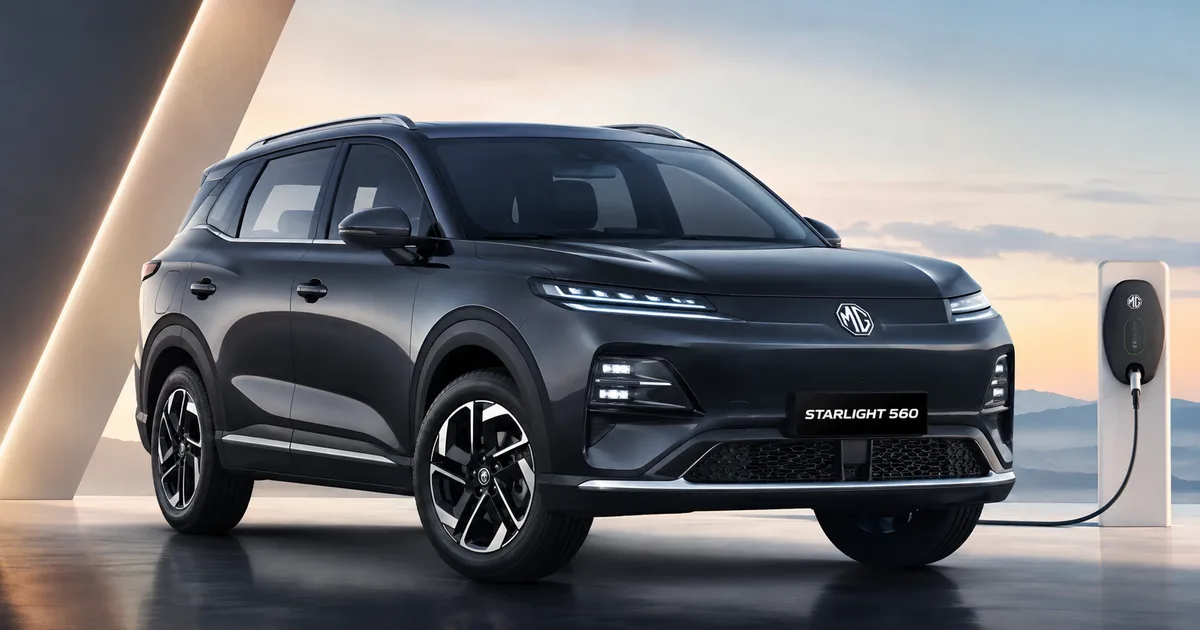
So the wait is finally over. We've heard rumors for months but the JSW MG Starlight 560 SUV 2026 India launch is officially happening. JSW MG Motor India has confirmed they're bringing this new 7-seater SUV to our shores between August 26 and August 28.
You might've heard people calling it the Hector Hawk. That makes sense, actually, since MG is just bringing the Wuling Starlight 560 from global markets and slapping a Hector badge on it for India. Honestly, this is a pretty wild move for the Indian auto market right now. We aren't getting some standard petrol guzzler. The car is arriving in both pure electric (EV) and plug-in hybrid (PHEV) versions. That changes the whole conversation.
The big shift in JSW and MG's new strategy
Look, you have to understand the money behind this launch. JSW Group bought a major stake in MG Motor India, and things have sped up crazy fast since then. The conglomerate has massive pockets. And they have huge ambitions, too. I think they really want to tear up the electric and hybrid space in India completely.
The Hector Hawk is the first big product from this joint venture. It's built on the new ADAPT architecture. This isn't just an old petrol car chassis with a battery stuffed inside (which is a mess, honestly). The ADAPT platform is made specifically for electric and plug-in hybrid powertrains from day one. You get better weight distribution. You get more interior space. The batteries are integrated straight into the floor structure, so the center of gravity is lower. Hopefully that translates to better handling on our terrible Indian roads.
The global version of this car is the Wuling Starlight 560. It has done really well in overseas markets. People know it for packing premium features at a super aggressive price. JSW MG has a winner if they can copy that exact formula here. And if you're curious about how tech and traditional industries are merging in India, we talk about that in our business explainers.
Why the plug-in hybrid option actually matters
The Indian SUV market is completely packed. Everyone wants a big, imposing car these days. But finding a real 3-row, 7-seater SUV that doesn't cost ₹50 lakhs is incredibly tough. Finding one that doesn't also drain your wallet at the petrol pump is even harder.
The premium family SUV segment in India is a bloodbath right now. If you're shopping in the ₹20 Lakh to ₹30 Lakh price bracket, your main options include:
- Mahindra XUV700
- Tata Safari
- Toyota Innova Hycross
- Hyundai Alcazar
MG is hitting this from a totally different angle. They have the PHEV option.
I honestly think the plug-in hybrid tech is the biggest deal here. Charging infrastructure in India is way better than it was three years ago. You can easily drive from Delhi to Chandigarh in an EV now. Or Mumbai to Pune. But range anxiety is still a massive headache for most regular buyers.
Relying purely on fast chargers can be stressful if you're taking your family from Delhi to Manali. What if the charger is dead? What if there's a power cut? Or what if there's just a massive queue of Tata Nexons parked ahead of you?
A plug-in hybrid gives you both options. You charge the battery at home overnight for your daily 40 to 60 kilometer office run. The car runs purely on electric power. You don't burn a drop of petrol. Then the petrol engine kicks in when you hit the highway for a weekend trip. You get normal petrol car range, and you can fill up at any regular fuel station in five minutes. The electric motor gives you instant torque for overtakes. The engine handles the high-speed cruising.
It's just more practical for a one-car family in India today. You don't need to buy a small electric car for the city and a big diesel SUV for your road trips.
Expected range and performance specs
The pure EV variant of the JSW MG Starlight 560 is supposed to deliver up to 530km of range on a single charge. But ARAI figures and real-world figures are always completely different. You can safely expect about 400km to 430km in actual Indian traffic. Especially with the AC blasting in our 45-degree summers.
That is still more than enough for 95% of buyers.
"The Hector Hawk arrives in August 2026, and it won't come in just one flavour. Buyers get to pick between a full electric setup and a plug-in hybrid, making it a serious challenger in the premium family SUV space."
I'm not exactly sure what the battery size for the PHEV version is yet. The numbers are a bit fuzzy right now. But cars in this segment typically offer around 80km to 100km of pure electric range before the petrol engine takes over. The combined range could easily cross 800km on a full tank and a full charge. Just imagine doing a Delhi to Udaipur run without stopping for fuel even once.
Charging infrastructure in India today
You'll have to rely on the public charging network for long trips if you buy the pure EV variant. The Indian government and private players have thrown a lot of money at this network lately. Apps like Tata Power, Zeon Charging, and Jio-bp make finding a charger pretty easy.
Most of these chargers have fast charging. You can top up from 10% to 80% in about 45 minutes and pay right through UPI. Highway charging during holiday weekends like Diwali is getting super crowded, though. You might end up waiting an hour just to get a plug.
And that is exactly why the PHEV version of the Hector Hawk makes so much sense for Indian roads.
Interior tech and features
MG has always sold cars based on their interior features and tech. The Starlight 560 is going to be packed to the roof. We expect massive dual screens for the infotainment and the driver display. It'll have Level 2 ADAS for highway cruising. You'll also get a massive panoramic sunroof and ventilated seats. Because ventilated seats are an absolute necessity in India.
I expect to see a ton of localized tech in this car. The current MGs already have voice assistants that understand Indian accents and regional languages. You can probably pay for parking or tolls directly through the car's screen using UPI. We might even get native apps that let you pull up your RC and driving license directly from DigiLocker.
You really need to secure your accounts if you're worried about the safety of connected car features. Check out our cybersecurity section for tips on protecting your digital life.
Pricing expectations and tax benefits
JSW MG has to price this aggressively. They have to do it if they want to pull buyers away from the big players.
I expect the pricing to start somewhere around ₹22 Lakhs for the base models. The top-end EV and PHEV variants will probably go up to ₹30 Lakhs to ₹32 Lakhs. That puts it right in the crosshairs of the XUV700 and the Tata Safari. It'll compete directly with the Toyota Innova Hycross, too.
The Innova Hycross is a strong hybrid. It charges its own battery while you drive. But you can't plug it in. It has a very small electric-only range. A true PHEV like the Hector Hawk could offer much lower running costs for people driving in the city.
The electric version might actually make a lot of financial sense. Many Indian states still have road tax exemptions for pure EVs. Saving 10% to 15% on road tax on a ₹30 Lakh car is a huge amount of money. Buying the EV version could save you upwards of ₹3 Lakhs right off the bat in states like UP or Maharashtra. Delhi has similar savings.
The Indian government doesn't offer those same tax benefits for plug-in hybrids yet. Strong hybrids and PHEVs still get hit with high GST rates. Automakers are lobbying hard to change this rule. It could completely change the pricing game if the government decides to lower the GST on hybrids before this launch.
The competition and market impact
JSW MG is walking into an absolute battlefield. The 3-row SUV segment is where Indian carmakers make their best margins. They fight aggressively for every single customer.
Mahindra is completely dominating with the XUV700 right now. They have their own electric SUVs lined up for next year, too. Tata is pushing the Safari hard, and the Harrier EV is coming soon. But none of them currently offer a plug-in hybrid.
So this gives MG a massive selling point. They can target the customer who wants the tech and green credentials of an EV. But that same customer has the range anxiety of a traditional car buyer.
I do have a few concerns, to be honest. MG's after-sales service network is good in major cities. It still doesn't match the massive reach of Maruti or Hyundai in tier-2 and tier-3 cities, though. Mahindra is way ahead there, too. Maintaining a complex plug-in hybrid might be a headache if you live in a smaller town like Meerut or Hubli. You need highly trained technicians. They have to know how to handle high-voltage battery systems and petrol engines in the exact same car.
Just make sure to do your research on your local service center before booking. Read our car ownership tools for more details on what to look out for.
Should you wait for it?
I suggest holding off for a few more weeks if you plan to spend over ₹20 lakhs on a family SUV right now. The JSW MG Starlight 560 is a really solid package on paper.
You can probably just book it using your phone in a few weeks. You'll pay the booking amount via UPI like every other car launch today. There are still things we don't know, though. We need to see the exact battery sizes. We need to know the real-world mileage of the hybrid engine. And we really need to see how the suspension handles our broken Indian roads.
We absolutely need to see the final price. It'll be a very tough sell if JSW MG prices this at ₹35 Lakhs. The Indian buyer is incredibly price-sensitive. It doesn't matter how much tech you throw at them. The premium 7-seater market is definitely growing. But there is a clear ceiling on what people will actually pay for a new entrant in the space.
We will know everything by August 26. I'll be watching the launch closely to see if they can actually deliver on these promises. Just hold on to your money for now.