Remember when ChatGPT first came out and everyone in India was suddenly using it to write emails or debug code, maybe even finish their homework? That felt like a massive leap. But if you talk to the people actually building these AI models in San Francisco right now, they think we haven't seen anything yet.
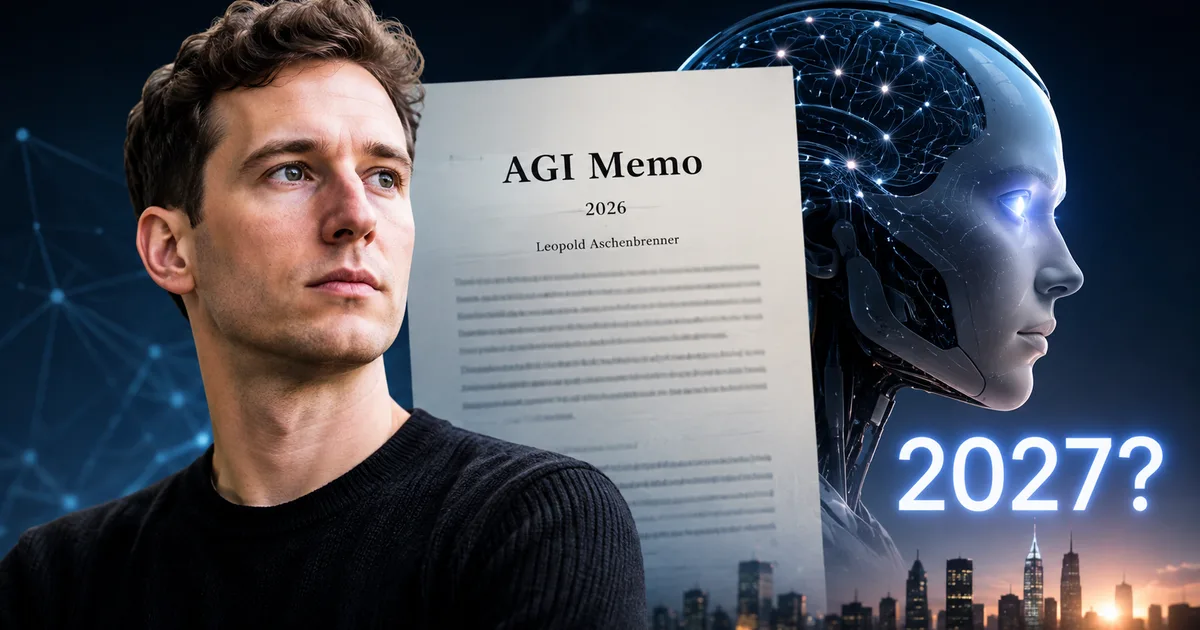
Honestly, I read a lot of AI predictions, and most of them are just hype from startup founders trying to raise money. But recently, a 165-page document called the "Situational Awareness" memo has been making the rounds. It's genuinely shaking up the tech world. Leopold Aschenbrenner wrote it. He's a 23-year-old former researcher at OpenAI (the company behind ChatGPT). And his main argument? Artificial General Intelligence, an AI that is smarter than human experts at basically everything, is coming by 2027. Yes, next year.
So, who is this guy and why did OpenAI fire him? Let's break it down in this explainer. Because if even half of what he's saying is true, it's going to change how we work and live in India very quickly.
Who is Leopold Aschenbrenner?
Before we look at the memo, you need to understand who wrote it. Leopold Aschenbrenner isn't your average tech bro. He's a 23-year-old prodigy who went to Columbia University at age 15. Until recently, he worked on the "Superalignment" team at OpenAI. That's the specific group of engineers whose entire job is figuring out how to stop super-smart AI from going rogue. Sounds like a sci-fi movie, I know, but it's a real job title. I think working there must be super stressful.
But here's the twist. Aschenbrenner got fired from OpenAI. Why? According to news reports, he ruffled some feathers because he raised serious security concerns to the company's board of directors. He essentially told them that OpenAI's security wasn't strong enough to protect their most advanced AI secrets from foreign hackers, specifically Chinese intelligence. Shortly after raising these alarms, he was shown the door.
Since then, he hasn't exactly been sitting quietly. He launched an AI hedge fund based on his "Situational Awareness" thesis. And the financial side of his story is wild. News reports from 2026 show he grew an investment fund from $225 million to $45 billion, betting heavily on the hardware and power infrastructure needed for AI. Then he lost most of it in days due to a brutal margin call. The guy is clearly brilliant and completely convinced that we are on a runaway train toward superintelligence.
The Core Prediction: AGI by 2027
The heart of Aschenbrenner's memo is a timeline that most people find terrifyingly fast. He predicts we will hit AGI, Artificial General Intelligence, by 2027.
What exactly is AGI? Right now, AI like Claude or Gemini is like a really smart intern. It can write a decent draft or fix some Python code. But you still have to check its work. AGI, in Aschenbrenner's definition, is a drop-in remote worker. Imagine an AI that can do the job of a senior software engineer or a data analyst, maybe even a lawyer, completely autonomously. Without making stupid mistakes.
Basically, he argues that we are scaling up AI compute power so rapidly that this jump is inevitable. The computing power being thrown at AI training is growing exponentially. We aren't just building faster computers. We are building huge data centers, a $13.7 billion infrastructure boom, just to train the next generation of models.
The Trillion-Dollar Cluster
One of the most interesting parts of the 2026 AGI memo is his focus on infrastructure. Aschenbrenner argues that the bottleneck for AI isn't the software. It's the physical hardware, specifically electricity and chips.
He predicts that tech giants will soon build trillion-dollar clusters. These are huge data centers requiring gigawatts of electricity. To put that in perspective, that's more power than a large Indian city consumes. He even joked about betting on power companies and Bitcoin, because whoever controls the electricity controls the AI revolution. I'm not sure exactly why Bitcoin fits in, but the power part makes sense. If you look at India, companies like Reliance and Adani are already heavily investing in green energy and data centers. The AGI race isn't just about code. It is really about real estate and power grids.
From AGI to Superintelligence
Thing is, here is where the memo goes from an interesting tech prediction to completely mind-bending. Aschenbrenner says AGI in 2027 is just the start. Once we have an AI that is as smart as a human researcher, what do you think we will ask it to do? We will ask it to build a better AI.
He predicts a rapid intelligence explosion. This is when AGI systems start automating AI research. Imagine millions of AI engineers working 24/7 without sleeping or taking chai breaks. They write code to make themselves smarter. Aschenbrenner believes that within a short time after hitting AGI, we will reach Artificial Superintelligence (ASI).
ASI is an intellect much smarter than the best human brains in practically every field. It's an AI that can solve complex physics problems or cure diseases (which makes sense, actually). It could even invent new technologies that we can't even comprehend right now.
The National Security Problem
Remember why Aschenbrenner got fired? Security. A big chunk of his memo is dedicated to what he calls The Project. He argues that once the US government realizes how powerful AGI is, they will step in and take over the leading AI labs. You just can't leave the most powerful weapon in history in the hands of a few tech CEOs in California.
He warns that authoritarian regimes will try everything to steal the weights, the core brain, of these AI models. His biggest fear isn't the AI turning evil like Terminator. His biggest fear is that OpenAI or Google, along with Anthropic, will build superintelligence, and then a foreign intelligence agency will just hack their servers and steal it. It's a mess.
What Does This Mean for India?
So, how does a 23-year-old's memo in Silicon Valley affect you sitting in Bengaluru or Delhi? A lot, actually.
Think about the Indian IT services sector. Companies like TCS employ millions of Indians alongside Infosys and Wipro to do software development and customer support. If AGI is an autonomous software engineer by 2027, the traditional outsourcing model faces a big shock. We are already seeing hiring slow down for entry-level coders. If Aschenbrenner's timeline is right, upskilling is a survival requirement. You absolutely need to learn how to manage and direct AI. Competing with it on basic code won't work anymore.
And think about India's digital infrastructure. We have built systems like UPI and Aadhaar, as well as DigiLocker. An AGI system could easily integrate with these platforms to offer personalized services. Imagine an AI financial advisor that perfectly understands RBI regulations and optimizes your taxes in real-time. That's the upside.
The downside? Scams. We already have major issues with fake SMS alerts and WhatsApp APK scams targeting Indian bank accounts. If criminals get access to near-AGI capabilities, the phishing attacks will become perfectly personalized. They will be almost impossible to detect. The Fake PM Internship Scheme WhatsApp messages we see today will look like child's play compared to what super-smart AI could generate. It's sketchy.
Is He Right or Just Crazy?
Look, making predictions in tech is a dangerous game. A lot of engineers think Aschenbrenner is way too optimistic about the timeline. Scaling up data centers takes time. Getting enough electricity is hard. The AI models might hit a wall where simply adding more data doesn't make them much smarter.
But the money backs him up. We are seeing hedge funds pouring billions into AI infrastructure. OpenAI is reportedly building data centers that cost more than entire space programs. People in the industry are betting their careers and billions of dollars on a 2027 timeline.
I don't know if we will have superintelligence next year. But the trajectory is clear. The AI tools you are using today are the worst they will ever be. They are only going to get faster and more autonomous. Aschenbrenner's memo might sound like science fiction. But honestly, so did a talking chatbot just five years ago.