The job market in India right now is a complete mess. You apply to fifty roles on a Tuesday. And you hear back from exactly zero by Friday, which is honestly exhausting. If you're actively looking for a change in 2026, you already know the drill. When Microsoft decided to push a bunch of new updates, I was skeptical. Are the new LinkedIn Premium AI tools 2026 actually going to get you hired? Or is this just another corporate attempt to justify a monthly subscription fee?
I spent the last two weeks testing these features. I completely tore down my profile and generated a new resume. Then I applied to jobs I'm vastly unqualified for just to see how the system handles it. Some of it is surprisingly good. But some of it is just fancy autocomplete. Let's get into the details.
Why LinkedIn added more AI for job seekers
Look, the truth is finding a job has become a game of beating algorithms. Companies use Applicant Tracking Systems (ATS) to filter out most resumes before a human ever sees them. And candidates use AI to write cover letters. It's just machines talking to machines (annoying, I know).
LinkedIn knows this. Their own recent research found that nearly 80% of people feel unprepared to find a job in 2026. At the same time, recruiters complain they can't find good talent. That's a massive disconnect. And to fix it, LinkedIn's strategy is simple. They put AI directly into the platform so you don't have to bounce between ChatGPT and their site.
Aneesh Raman is an executive at LinkedIn. He recently said something interesting about this shift in a Livemint interview.
"AI is actually more aligned with the builder mentality that has always existed in India."
He's right. Indian professionals are incredibly fast at adapting to new tech when it solves a real problem. But the question is whether these specific tools solve the right problems for you. I think they do, for the most part. If you want more background on AI basics, check out our guides section.
Testing the new AI resume builder
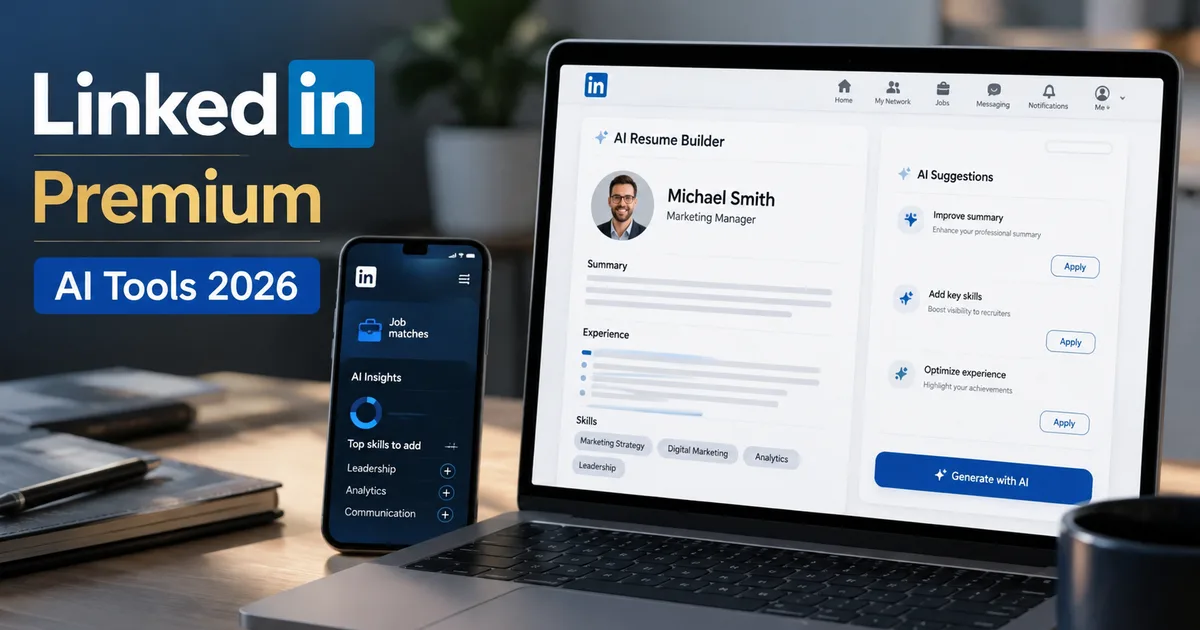
This is the feature everyone cares about. The new AI resume builder is available right on your profile page. You click a button. Then it reads your entire work history and skills before formatting it into a PDF.
It sounds simple. But anyone who's formatted a resume in Word knows the pain of moving an image and destroying the entire layout. This tool completely eliminates that problem.
Here's what I noticed during my test. The AI is sketchy and aggressive about rewriting your bullet points. If you say "managed a team of five", it'll suggest changing it to "directed a five-person team to increase operational efficiency". Sometimes this is great. Other times it sounds like you swallowed a corporate dictionary. You have to edit the output. Never just accept the first draft.
I compared it against a few other popular tools available in India right now.
| Feature | LinkedIn AI Builder | Standard Free Builders |
|---|---|---|
| ATS Compatibility | Excellent. Formatted specifically for standard parsers. | Hit or miss depending on the template. |
| Writing Assistance | Very aggressive. Sometimes too corporate. | Usually just basic spell check. |
| Data Entry | Zero. Pulls everything from your profile instantly. | Manual entry required for everything. |
The biggest advantage is simply the time saved. You don't have to type anything out if your profile is already up to date. But that's also the catch. If your profile is a mess, your generated resume will also be a mess. It can't invent good experience out of thin air.
How it handles Indian context
One thing I specifically checked was how it handles Indian universities and local companies. Older tools used to flag non-US universities or get confused by Indian degree formats like B.Com or PGDM. The 2026 version of LinkedIn's tool has this sorted out. It correctly parsed my old project experience without throwing weird formatting errors. It even understands common Indian corporate structures and designations.
How the AI job search features actually work
The resume builder is cool. But the job search features are where things get interesting. Searching for jobs used to mean typing "Frontend Developer Bangalore" and scrolling for hours. Now, you can literally type "Find me remote frontend roles in India that pay over 12 LPA and use React".
The system understands natural language. And more importantly, it reads the job descriptions and compares them to your profile.
The good parts of AI search
When you look at a job posting now, there's a small AI summary box. It tells you exactly why you're a good fit and what you're missing. For example, it told me I was a strong candidate for a product management role because of my past writing experience. But it noted I lacked SQL skills.
This is incredibly useful. It stops you from applying to jobs where you have zero chance. It saves time. And time is exactly what you don't have when you're job hunting after a long day at the office (which makes sense, actually).
Another feature I liked is the automated outreach drafting. If you want to message the hiring manager, the AI drafts a quick note for you. I strongly suggest you rewrite at least half of it. Recruiters can spot an AI-generated message instantly. But having a starting point is better than staring at a blank screen wondering how to say "please hire me" professionally.
The not so good parts
It isn't perfect. Sometimes the AI completely misses the context of a job. It recommended a senior director role to a junior developer account I created for testing. This happened simply because both profiles had the word "Python" in them. You still have to use your brain. Don't blindly apply to everything the system recommends.
Also, the salary estimates for Indian roles are still occasionally wildly off. The numbers here are a bit fuzzy. It might estimate a role pays 25 Lakhs when the industry standard is 10 Lakhs. Always do your own research on platforms like Glassdoor or ask around in your network. If you need a break from the job hunt, you can always read up on the latest news in the tech world.
The hidden gem: AI interview preparation
Most people focus entirely on the resume. But the interview is where you actually win the offer. LinkedIn quietly added an AI interview prep feature that simulates a real conversation. You turn on your camera and microphone. Then the AI asks you common behavioral questions. "Tell me about a time you failed." "How do you handle conflict in a team?"
I was ready to hate this. But it's actually decent. It gives you immediate feedback on your pacing and your filler words. It also tells you if you actually answered the prompt. Indian professionals often struggle with speaking too fast during high-stress situations like interviews. The AI catches this instantly. It flags if you're rushing through your points or failing to use the STAR method.
Is it as good as doing a mock interview with a senior colleague? No. But a senior colleague isn't available at 11 PM on a Sunday when you're panic-prepping for a Monday morning interview. For that alone, it is a solid addition.
If you're applying for remote jobs with foreign companies, this feature helps you get comfortable speaking to a screen. And if you're struggling with basic technical concepts, don't forget to review our explainers before you log onto your call.
Is the Premium subscription worth the INR price tag?
Let's talk about money. LinkedIn Premium isn't cheap. In my experience, for a lot of Indian professionals, spending anywhere from INR 1,200 to 1,600 a month on a social network feels ridiculous. And for a long time, I agreed. Paying for InMail credits you never use just isn't worth it.
But the 2026 updates change the math slightly.
Here's exactly what you get for your money:
- Full access to the new AI resume builder with unlimited PDF exports
- Advanced natural language job search filters
- Automated AI summaries on all job descriptions
- Unlimited sessions with the interactive AI interview prep tool
- The standard InMail credits and profile view analytics
If you're actively looking for a job and applying every day, then yes. It's worth it for one or two months. The time you save on tailoring your resume for different ATS systems pays for the subscription alone.
Think about it like this. If the AI resume builder helps you get past the automated filters and lands you just one extra interview, that's a massive return on investment. The cost is roughly equivalent to a decent dinner out in Mumbai or Bangalore. If that investment cuts your job hunt short by even a week, you get your money back many times over.
But if you're just casually browsing? Don't buy it. Stick to the free version. The free search features are perfectly fine if you're not in a rush. Just make sure you're aware of common employment frauds. Check our section on scams if you want to know what to watch out for, especially the fake work-from-home offers spreading on WhatsApp lately.
Final thoughts for Indian professionals
The tech industry in India is shifting rapidly. We've gone from massive hiring sprees to cautious recruitment cycles. I'm not sure exactly why it flipped so fast, but here we are. With all the noise about AI replacing jobs, it's easy to get cynical. But the reality is that tools like these are just utilities. They're digital hammers.
LinkedIn's new features won't get you a job if you don't have the skills. But if you have the skills, these tools make it much easier to prove it to a hiring manager. The resume builder is solid. It outputs clean PDFs. The natural language search is genuinely helpful for filtering out noise. And the automated summaries save a ton of reading when you're scanning through fifty job descriptions.
My advice? Sign up for the one-month free trial if you haven't used it already. Update your entire profile with your latest experience. Generate a few different versions of your resume tailored to specific roles you want. Run a bunch of highly specific job searches. Practice with the interview bot until you stop saying "um" every five seconds. Then cancel the subscription before they charge your credit card.
You get all the benefits of the new 2026 AI tools without spending a single rupee. That's how you actually beat the system. Try it out. Take what's useful. And ignore the rest.