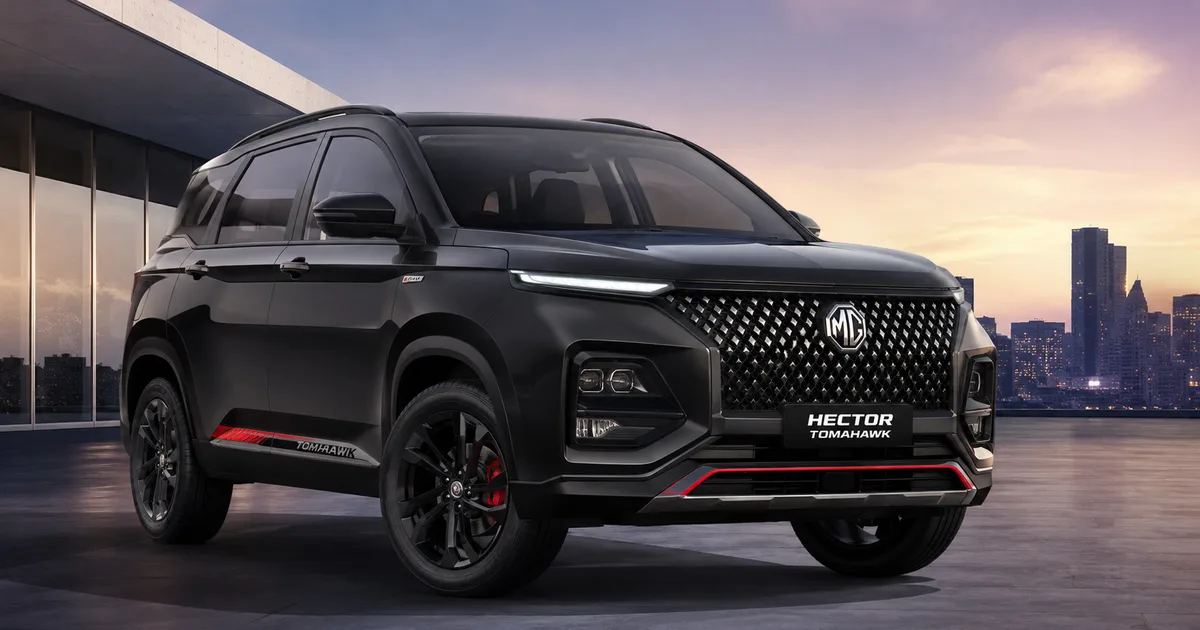
If you've been waiting for a family-sized electric SUV that doesn't cost a fortune, the MG Hector Tomahawk Edition 2026 India launch is finally here. I've been watching this one closely. Honestly, the 7-seater EV space in India has been mostly empty or ridiculously overpriced. Now, JSW MG Motor India has dropped both an EV and a PHEV (Plug-in Hybrid) version of the Tomahawk, and they've actually priced it aggressively. Prices for the EV start at ₹13.99 lakh. That's not a typo. Here's exactly what you get, what this Battery-as-a-Service (BaaS) thing means for your wallet, and whether the hybrid is worth the premium.
MG Hector Tomahawk Edition 2026 India launch: Aggressive pricing
The pure electric version of the Hector Tomahawk starts at a shockingly low ₹13.99 lakh. The fully loaded, top-spec EV is ₹19.49 lakh. When you compare this to what else is out there, it's wild. You're getting a huge 7-seater SUV for the price of a compact 5-seater EV like the Tata Nexon EV or the Mahindra XUV400. And I think that's going to shake things up.
MG is clearly trying to grab market share. They want to undercut the competition before the Tata Harrier EV and Mahindra XEV 9e hit the streets. Basically, they're forcing Indian buyers to ask a serious question. Why pay ₹20 lakh for a sub-4-meter crossover when you can get a full-size three-row SUV for the same money?
But here's the catch. The plug-in hybrid (PHEV) version is priced significantly higher, starting at ₹25.69 lakh. That's a massive ₹6 lakh premium over the fully loaded EV. Why would anyone pay that much more for the hybrid? Range anxiety. Our public charging infrastructure is growing fast in India. But it's still patchy on major highways once you leave the big metros (which makes sense, actually). A lot of buyers just don't trust a pure EV for a 600-kilometer family road trip yet.
The MG Hector Tomahawk PHEV option and BaaS explained
MG knows that the ₹25.69 lakh sticker price for the PHEV is steep. So they brought in the BaaS (Battery as a Service) model for it. Under this scheme, the upfront cost of the PHEV drops to ₹21.49 lakh. You then pay a battery rental fee of ₹3.20 per kilometer driven.
It's a clever way to reduce the initial financial hit. But you really need to do some math to figure out if ₹3.20 per km makes sense for your daily running.
If you drive 50 km a day, that's around 1,500 km a month. Under the BaaS model, your battery rental is ₹4,800 every month. On top of that, you have to pay for the electricity to charge it. And you pay for the petrol you burn when the battery runs out and the engine kicks in.
Compare that to paying the extra ₹4.2 lakh upfront. That is the difference between ₹21.49 lakh and ₹25.69 lakh. If you plan to keep the car for five years and drive heavily, buying it outright might actually save you money in the long run. The BaaS model is great if you want to lower your EMI burden right now. But always calculate your expected annual running before committing to a per-kilometer rental. Honestly, the numbers here are a bit fuzzy for average users.
For more updates on how the EV and auto market is shifting, keep an eye on our Latest Tech News section.
Battery specs and the claimed 517 km range
The pure electric Tomahawk has a 69.2 kWh battery pack. MG claims an ARAI-certified range of 517 km on a single charge.
Look, we all know ARAI numbers are tested in ideal conditions inside a lab. In the real world, driving in Delhi summer with the AC running at 18 degrees, or navigating Mumbai's bumper-to-bumper traffic, you should expect somewhere around 380 to 420 km.
I think that is still enough for almost everyone. If your daily commute is 40 km, you'll only need to charge it once a week.
Speaking of charging, the SUV is built on JSW MG Motor India's new ADAPT platform, which supports fast DC charging. You should be able to top up from 10% to 80% in under an hour during a highway chai break. That is assuming you find a working 50kW or faster charger.
The ADAPT platform is specifically designed to handle heavier electric vehicles. It also maximizes cabin space. The batteries are pushed flat into the floorboard, which gives the vehicle a lower center of gravity. This helps a lot with handling. That matters because a 7-seater SUV with a giant battery pack is a very heavy machine.
Design upgrades: What's new inside the 7-seater EV?
MG has always thrown everything but the kitchen sink at the Hector's feature list. The Tomahawk Edition is no different. The exterior gets a sharper front fascia. The large grille from the petrol Hector is completely gone, replaced by a sleek, closed-off panel that basically screams 'EV'. The LED daytime running lights are thinner. And the main headlight clusters are pushed much further down into the bumper.
You also get a massive panoramic sunroof. Indian buyers absolutely love sunroofs. Even if we rarely open them because of the dust and heat.
The cabin is incredibly spacious. You'll notice several major improvements:
- A snappier UI on the 14-inch vertically oriented touchscreen
- Revised upholstery materials that feel softer to the touch
- Improved third-row AC vents for better cooling at the back
- More USB-C charging ports spread across all three rows
If you ask me, seating is where the Tomahawk really wins. You get both 5-seater and 7-seater configurations. The 7-seater makes this one of the few true electric family haulers in the country right now.
Is the third row comfortable for adults? Not really. It's best left for kids or very short trips. Or if you absolutely need to squeeze your friends in for a quick dinner run. But having those extra seats folded down into the floor gives you a huge boot space. That's perfect for airport runs or hauling luggage.
We are seeing a lot of action in this large SUV space across all fuel types. For context, you might also want to read up on the Kia Sorento AWD 2026 India Launch if you are looking at premium internal combustion SUVs this year.
Level 2 ADAS on Indian roads
The Tomahawk EV comes with Level 2 ADAS (Advanced Driver Assistance Systems). This safety suite includes features like adaptive cruise control, lane keep assist, blind-spot monitoring, and automatic emergency braking.
I have mixed feelings about using ADAS in India. On the new access-controlled expressways, adaptive cruise control is absolutely brilliant. It takes so much fatigue out of long drives. You set your speed. Then the car maintains a safe distance from the vehicle ahead.
But inside city limits? ADAS can be a nightmare. Honestly, our traffic is a total mess. Auto rickshaws cut you off constantly. Two-wheelers squeeze into impossible gaps, while pedestrians cross wherever they feel like it. Automatic emergency braking can get very confused by this chaos and slam the brakes unnecessarily. That's a great way to get rear-ended by a truck. Luckily, MG lets you turn these features off or dial down their sensitivity deep within the touchscreen settings.
"The new MG Hector Tomahawk EV has arrived as a five- and seven-seat electric SUV, offering a claimed 517 km range, Level 2 ADAS and a feature-packed cabin."
Charging infrastructure reality check
Buying an EV with a 69.2 kWh battery means you need to think about how you'll charge it. If you live in an apartment complex, you must figure out if your Resident Welfare Association (RWA) allows the installation of a 7kW AC fast charger in your parking spot.
If you ask me, you absolutely need the dedicated 7kW wall box charger installed at home. Charging a battery this big on a standard 15-amp wall socket takes well over 24 hours from zero to full.
For highway runs, the public charging network has improved massively in the last two years. Apps like PlugShare and Tata Power EZ Charge show hundreds of fast chargers along major routes. But you still have to plan your trips. You can't just wing it like you do in a petrol car. You have to factor in charging stops, check if the chargers are actually operational, and hope there isn't a queue of three other EVs waiting to charge when you arrive (annoying, I know).
How does the MG Hector EV price stack up against the competition?
The direct rivals here are going to be the upcoming Tata Harrier EV and the Mahindra XEV 9e.
Tata has been dominating the EV space in India with the Nexon and Punch. But the Harrier EV will be their flagship test. It will likely come with all-wheel drive, something the Tomahawk EV misses out on. Mahindra is also pushing hard with their Born Electric range. They promise futuristic designs and heavy tech integration.
MG's trump card right now is pure pricing. At a ₹13.99 lakh starting price, they're aggressively undercutting almost everyone in the segment. It's frankly absurd pricing for a car of this size and capability.
I suspect this is an introductory price. It will probably quietly go up by a lakh or two in a few months once the initial hype dies down. So, if you're genuinely on the fence, booking earlier rather than later is a smart move.
And if you're looking at other segments entirely, the sedan space is getting a much-needed refresh soon. The Skoda Slavia Facelift is around the corner. Obviously, that appeals to a completely different type of buyer who still prefers low-slung driving dynamics over SUV practicality.
The verdict: Should you buy the Tomahawk?
If you want a 7-seater EV today, your options are basically non-existent unless you want to spend luxury-car money on a Volvo or Kia EV9. The Hector Tomahawk EV fills a massive gap in the Indian market. And it does so without feeling cheap or compromised.
Here's my honest take. If you have a second petrol or diesel car at home for those long, unpredictable highway trips, just buy the EV. Save the ₹6 lakh premium over the hybrid. Enjoy the completely silent drive. And laugh your way past the petrol bunks.
But if this is going to be your only family car, and you frequently do 500+ km road trips across states where the charging infrastructure is still a gamble? The PHEV makes much more sense. You get the smooth electric drive for your daily city commute. And you get zero range anxiety on the highway when the petrol engine takes over. Just make sure you sit down and understand the math behind the BaaS ₹3.20 per km rental before signing the dotted line.
MG has thrown down a serious challenge to Tata and Mahindra. Now we wait and watch how the home teams respond. In my experience, competition only makes the products better. The Indian EV buyer is finally getting some real choices, and honestly, it's about time.