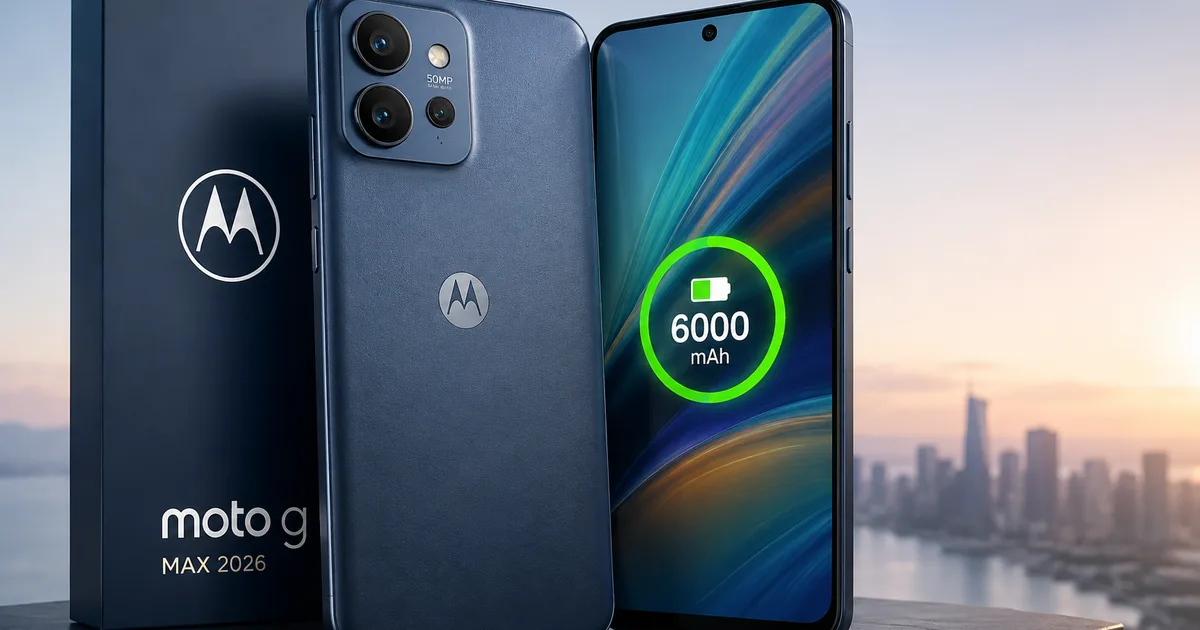
Look, the Moto G Max 2026 India launch finally happened on August 14, and honestly, it's mostly about one specific thing, which is that absolute unit of a battery. If you're tired of your phone dying by 4 PM, this might be exactly what you need. I want to break down what you actually get for ₹27,999, because there are a few compromises you should know about before you hit that buy button.
Motorola is doing some interesting things in the Indian market lately, but this phone is basically a specialized tool. It's not trying to be a flagship killer or take the best photos. It's just trying to stay alive longer than you do on a Monday.
What the Moto G Max Specs Actually Offer Under the Hood
Motorola decided to go all in on battery life this year. They packed a 7,000mAh silicon-carbon battery into this thing. That's massive. Most phones tap out at 5,000mAh. So with 7,000mAh, you're realistically looking at two days of heavy use. Maybe even three days if you're just making calls and checking emails. In my experience, most people underestimate how much battery they actually use.
Here are the key specs you're getting:
- 7,000mAh silicon-carbon battery
- Snapdragon 6s Gen 4 (4nm) processor
- 6GB LPDDR5X RAM with 128GB UFS 3.1 storage
- 6.72-inch 120Hz display
- Two guaranteed OS upgrades
I know people who constantly carry heavy power banks in their bags everywhere they go. And with a 7,000mAh capacity, you can probably leave the power bank at home. Silicon-carbon technology is relatively new for mid-range phones. It lets companies pack more battery capacity into the same physical space compared to older lithium-ion tech. That's a good thing. A 7,000mAh lithium-ion battery would make the phone thick enough to double as a literal brick.
What else is under the hood? The phone has a Snapdragon 6s Gen 4 chipset. It's a 4nm processor, which is decent for everyday tasks. You get 6GB of LPDDR5X RAM and 128GB of UFS 3.1 storage. They threw in a feature called RAM Boost. But honestly, 6GB is a bit tight for Android in 2026 (annoying, I know). RAM Boost just uses some of your storage space as virtual memory. And virtual memory is never as fast as actual physical RAM.
If you want to play heavy games on max settings, this probably isn't the phone for you. You'll definitely see some frame drops. But for YouTube, fast UPI payments at the local kirana store, and regular apps, it'll run perfectly fine. You can check out our processor comparison guides if you want to understand exactly how the Snapdragon 6s Gen 4 stacks up against the competition.
Display and Everyday Usage
You get a 6.72-inch display with a 120Hz refresh rate. Scrolling through menus and news feeds will feel buttery smooth. It's a big screen. Which makes sense, because you need space to hide that giant battery.
Just keep in mind that this phone is going to feel heavy in your pocket. Even with the newer battery technology, you can't escape physics. A 7,000mAh battery adds serious weight. If you prefer small phones that you can easily use with one hand while standing in a crowded metro, you might find this device a bit unwieldy. But the 120Hz refresh rate is a nice touch. It makes the whole interface feel snappy.
Is the Moto G Max Price in India Justified?
This is where it gets interesting, and maybe a bit frustrating. The Moto G Max comes in just one variant in India. It has 6GB RAM and 128GB storage for ₹27,999.
I think that price is a bit high. For nearly 28,000 rupees, you can find phones with much faster processors and more RAM. Devices like the Realme 16x 5G or the OnePlus Nord CE 6 Lite offer stiff competition in this segment. But they don't have a 7,000mAh battery. That's the trade-off. You're paying a premium purely for the battery endurance.
If you're someone who works out in the field all day, this battery life is a lifesaver. Think delivery executives or site engineers. No more hunting for a power bank while trying to scan a QR code for a payment. When you're out on the road, knowing your phone won't die when you need Google Maps the most is worth a lot.
But if you work at a desk with a charger always nearby, you might want to look at other smartphone options that offer better performance for the price. The ₹27,999 price tag makes sense only if you specifically need that marathon battery life.
Gaming performance and realistic expectations
I need to be very clear about gaming on this phone. Mobile gaming in India is massive. Everyone wants to know if a new phone can run BGMI or Free Fire smoothly. The short answer for the Moto G Max is yes. But there are limits.
The Snapdragon 6s Gen 4 isn't a flagship gaming chip. When you combine that with 6GB of LPDDR5X RAM, you hit a ceiling pretty quickly. You can definitely play BGMI on medium settings, and you'll get decent frame rates. The 120Hz display makes everything look fluid. But if you try to push the graphics to the maximum settings, the phone will stutter. The RAM just can't hold enough textures in memory for heavy gaming over long sessions. I'm not sure exactly why they didn't offer an 8GB variant.
The ironic part is that the 7,000mAh battery makes this phone perfect for long gaming sessions, but the processor holds it back.
If you're a casual gamer who plays a quick match on the train, you'll be completely fine. Hardcore gamers need to look at devices with better thermal management and at least 8GB of physical RAM.
Cameras are usually where mid-range phones cut corners
Cameras are usually where mid-range phones with giant batteries cut corners.
Motorola hasn't focused heavily on the camera specs in their marketing for a reason. You get a standard primary sensor and an ultrawide lens.
For scanning documents for DigiLocker or taking quick photos of your Aadhaar card for KYC, the camera is perfectly fine. It'll take decent photos in bright daylight. But if you're trying to take photos in a dimly lit restaurant, you'll notice the limitations. The 4nm processor helps a bit with image processing, but it can't fix average hardware. Honestly, if photography is your main reason for buying a phone, you'll be disappointed here.
5G Connectivity and Indian Networks on the Moto G Max
The Moto G Max is a 5G phone, which is practically mandatory in 2026. It supports all the major 5G bands used by Jio and Airtel in India. So you'll get fast download speeds when you're in areas with good coverage.
But running 5G constantly drains the battery faster than 4G. This is exactly where that 7,000mAh capacity shines. On a normal phone, leaving 5G on all day can kill the battery by late afternoon. With the Moto G Max, you can leave 5G on, use a hotspot for your laptop, and still make it home with battery to spare. For people who travel frequently on Indian Railways and rely on their phone for internet access, this combination of 5G and massive battery life is ideal.
Software, Updates, and Clean Android
Motorola usually gives you a clean Android experience without annoying ads popping up every five minutes. That's a huge plus. Some other brands in this price range fill their phones with bloatware and ads in the system apps. Motorola keeps it clean. If you ask me, that's a big deal.
They promised two major OS upgrades for the Moto G Max. So it'll stay relevant for a few years. It isn't the four or five years of updates that some premium brands offer. But for a mid-range phone, two years of OS updates and three years of security patches is acceptable.
If you're upgrading from an older budget phone, you'll really appreciate how clean the interface is. You won't have to deal with pre-installed apps that constantly send you spam notifications. And you can always read our detailed tech guides if you need help setting up new privacy features.
Charging accessories and box contents
One detail that often gets overlooked is what actually comes in the box. A 7,000mAh battery takes a long time to charge. Motorola includes a fast charger in the retail box. Which is a relief. Many brands have stopped including chargers completely, forcing you to spend another thousand rupees just to power your device.
But you have to manage your expectations with the charging speed. Even with a fast charger, pushing power into a 7,000mAh silicon-carbon cell takes time. You aren't going to get a full charge in thirty minutes. You should expect it to take well over an hour to go from zero to one hundred percent. The numbers here are a bit fuzzy, but it takes a while.
This is why your charging habits will need to change if you buy this phone. The best approach is overnight charging. You plug it in before bed, and it's ready when you wake up. Because the battery lasts so long, you'll rarely find yourself needing a quick afternoon top-up.
Comparing the 7,000mAh battery to older phones
Think back to phones from just three or four years ago. A 4,000mAh battery was considered standard. We all got used to carrying power banks or constantly looking for a wall socket at the airport.
The Moto G Max is a massive jump in battery tech. Silicon-carbon batteries are denser than old lithium-ion batteries. This means Motorola can fit 7,000mAh of power into a phone without making it impossibly thick. It's still a heavy phone. Don't get me wrong. But it isn't a literal brick.
This much battery capacity changes how you use your device. You can leave your screen brightness on high all day. You can use GPS navigation for hours without worrying. These are things that normally kill a standard smartphone by lunchtime.
If you're a student attending back-to-back online classes, this is a massive advantage. You can always check our latest tech news to see how other brands are responding to this massive battery trend.
The Final Verdict on the Moto G Max
The Moto G Max 2026 India launch brings a very specific type of phone to the market. For ₹27,999, you're buying peace of mind. Basically, you're buying the ability to leave your charger at home.
If your biggest daily frustration is your phone dying before you finish work, the Moto G Max is built exactly for you. But if you care more about gaming performance or camera quality, this isn't the right choice.
You have to accept 6GB of RAM, which feels outdated, and a processor that's just average. You also have to accept a heavier phone and basic cameras. But for many Indian users, those compromises are worth it for a 7,000mAh battery.