Picture this scene from a typical Sunday evening. You're returning to Delhi from Jaipur on National Highway 48. Traffic moves well at 90 km/h until you spot a line of red brake lights stretching half a kilometre before the toll gates. You wait ten minutes in second gear while a scanner struggles to read an older windshield tag three cars ahead. The boom barrier lifts and drops over and over. The NHAI GNSS satellite toll system 2026 aims to eliminate that entire waiting game by shifting highway fees to direct satellite coordinates.
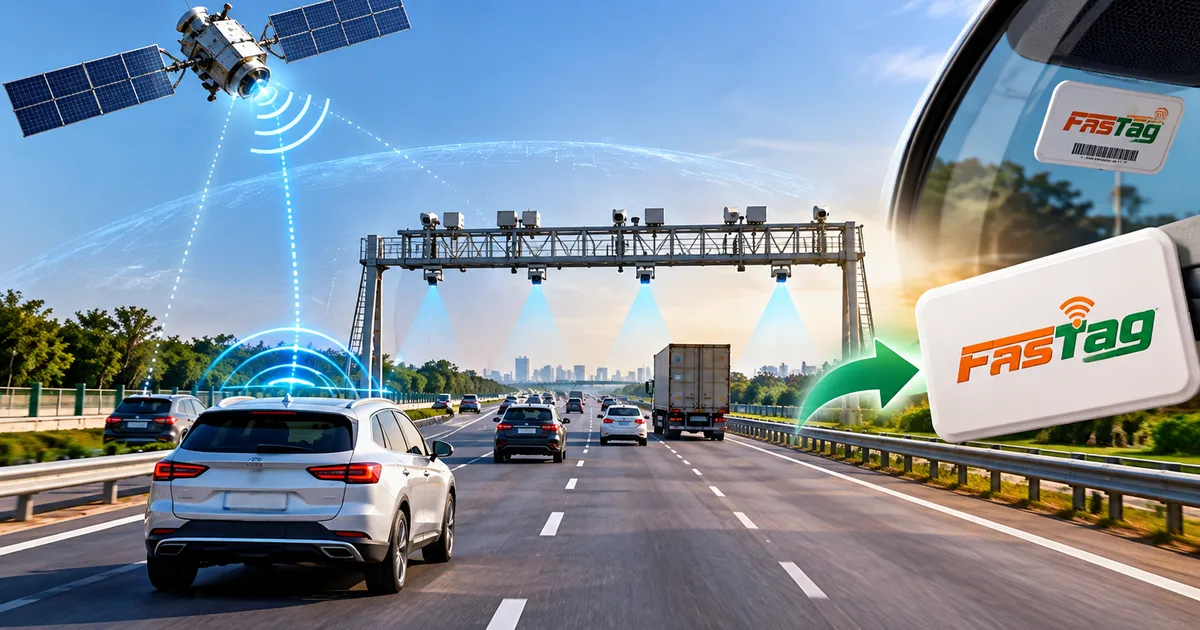
Honestly, that sounds futuristic, but the basic concept is simple enough. Instead of forcing cars to halt at concrete toll plazas, the National Highways Authority of India uses navigation satellites and highway gantries to record when your car enters and exits a highway. You keep driving at cruising speed. The fee gets calculated for the exact distance you drove, and the amount comes straight out of your linked digital wallet.
Nobody likes paying flat toll rates for short drives.
Look at how the traditional toll booth setup works. If you join a national highway two kilometres before a toll plaza and exit one kilometre after it, you still pay the full plaza fee. That's Rs 135 or Rs 185 for a stretch of road you barely touched. In my experience, nothing frustrates daily commuters more when they just need to reach a nearby town or business hub. Satellite tolling replaces that fixed charge with pay-per-kilometre pricing, which feels much fairer to anyone driving shorter highway segments.
For a broader breakdown of how digital systems are reshaping Indian transport, check our detailed tech explainers on government platforms.
How barrier-free tolling actually works on Indian expressways
To make sense of this change, you need to understand what multi-lane free flow tolling means in practice. Basically, the system relies on two pieces of technology working together: satellite tracking via a Global Navigation Satellite System network, and overhead highway gantries equipped with high-resolution cameras.
When your vehicle travels along a designated national highway, the satellite system monitors your position inside a virtual boundary called a geofence. Think of a geofence like an invisible digital fence drawn over the highway map (which makes sense, actually). As soon as your car crosses that virtual boundary, the system logs your entry point. When you take an exit ramp to enter a state road, the system logs your exit point.
All the math happens on central servers run by the National Payments Corporation of India and highway authorities. The software calculates the exact distance between your entry and exit points. Then it applies the approved per-kilometre tariff for your vehicle class and deducts the final rupee amount.
Sounds simple enough. But how does the highway authority know which vehicle is actually moving along the road?
What the on-board tracking unit does inside your vehicle
Commercial vehicles like long-haul freight trucks and interstate buses already carry an on-board unit fitted under government fitness rules. This unit combines a positioning receiver with a cellular data module. It connects to navigation satellites, including India's own NavIC constellation and international GPS networks, to pinpoint the coordinates of the vehicle in real time.
The device transmits encrypted movement pings to toll clearing servers. If you drive a private car, you might wonder whether you must drill holes in your dashboard to install expensive hardware right away. The short answer is no. The rollout details for private cars are still a bit fuzzy, but Union Minister of Road Transport and Highways Nitin Gadkari confirmed in a written reply to the Lok Sabha that the transition will start on pilot corridors as an added facility alongside existing infrastructure.
"It has been decided to initially implement GNSS based Electronic Toll Collection system at selected sections of national highways on pilot basis as an added facility along with FASTag."
Commercial fleets will adopt dedicated tracking units first. That makes practical sense, if you ask me, because heavy transport accounts for a major share of total toll revenue across interstate freight corridors.
The role of overhead gantries and number plate cameras
Satellites can't solve every issue by themselves. What happens if a receiver loses signal under a dense flyover, or someone tampers with the tracking device? That's where overhead highway gantries step in.
NHAI installs metal gantries across all highway lanes. These gantries carry automatic number plate recognition cameras alongside radio-frequency readers. As your vehicle passes underneath at 100 km/h, the high-speed cameras snap your vehicle registration plate and cross-check it against the VAHAN national vehicle registry. The camera feed is an audit layer. It confirms that the physical vehicle on the asphalt matches the digital pings received by the satellite network.
Pilots are already operating on busy stretches across the country. NHAI set up barrier-free lanes at six toll plazas, including Choryasi, Mundka, Daulatpura, Gharaunda, Manoharpur, and Shahjahanpur. (Six locations, which gives engineers plenty of real-world data.) In July 2026, the Mundka-Bakkarwala plaza on Delhi's Urban Extension Road-II began processing non-stop commuter traffic with automated camera verification. If you want a deeper look at the operational roadmap, our GNSS-based FASTag toll collection rollout analysis covers specific state timelines.
What changes for existing FASTag users
The biggest worry among car owners is whether their current FASTag sticker becomes worthless trash overnight. Let me reassure you: your current tag isn't getting scrapped anytime soon.
India crossed 6.23 crore active FASTag users by mid-2026, according to official data presented in Parliament. The government collected over 98% of highway toll fees through the electronic tag system. Throwing away that network would cause chaos for millions of drivers. It would be a complete mess. So instead of discarding tags, the satellite setup uses your existing FASTag account as the primary payment backend.
Here's what happens behind the scenes. Your FASTag is already tied to your vehicle registration number and your verified bank wallet under RBI rules. When the satellite network logs your road journey, the charge routes through that same National Electronic Toll Collection framework. Your bank balance or linked wallet balance pays the toll just like before.
However, the government tightened the rules to prepare for seamless deductions. Under the One Vehicle One FASTag mandate, any vehicle with multiple active tags saw secondary tags deactivated. And if you still have pending KYC updates with your tag-issuing bank, finishing that verification is essential. Unverified tags risk blacklisting, which will prevent automated clearance on free-flow lanes.
You can read our comprehensive guide to satellite toll collection in India for details on tag-wallet linkings and bank settings.
The 20-kilometre local exemption and Rajmargyatra passes
If you live near a highway toll plaza, you probably rely on local discounts to visit the market or commute to work. You don't lose that discount under the satellite setup.
NHAI maintains the standard 20-kilometre exemption rule for residents living close to toll gates. To make the process smoother, authorities extended a digital local pass facility across 121 toll plazas nationwide. Instead of visiting a physical toll office with paper utility bills, you handle the whole application through the official Rajmargyatra mobile app. I'm not sure why it took so long to digitize these passes, but it saves local drivers endless headaches.
The digital verification runs through paperless government databases:
- The system checks your residential address through DigiLocker consent to establish your residence.
- It queries the VAHAN database to verify that the car registration belongs to your household.
- GIS mapping technology measures the exact road distance from your registered home address to the toll plaza boundary.
- Once verified, your linked FASTag wallet receives a discounted monthly pass valid for unlimited crossings through that designated plaza.
This automated verification removes arguments with toll booth attendants. And it ensures that only genuine residents qualify for local fee concessions.
Why the government is transitioning away from physical toll plazas
The shift to barrier-free highways is driven by practical problems that physical booths cannot fix. Even with RFID tags, slowing down to 10 km/h creates massive traffic snarls during holiday weekends like Diwali and extended holidays. (annoying, I know) Idling vehicles burn crores of rupees in wasted petrol and diesel every single day.
Cash handling remains another headache. NHAI pushed proposals to end cash transactions at national highway plazas by April 2026. Cash lanes slow down the entire corridor because booth operators must handle currency notes and dispense loose change. Eliminating physical booths removes cash disputes entirely.
Then there's the land issue. Building and maintaining vast physical toll plazas requires valuable land. On crowded expressways near major metros, expanding toll plazas to 16 or 24 lanes costs massive sums in land acquisition. Gantries span the existing road without taking up additional real estate beside the highway.
Practical steps to keep your highway travel smooth
You don't need to panic or buy sketchy tracking devices from unverified online sellers. Highway authorities are rolling out the tech in phases, starting strictly with commercial transport.
Here are several practical habits you should adopt today to ensure uninterrupted highway trips:
- Keep your FASTag wallet topped up with at least Rs 300 to Rs 500 to avoid negative balance flags on free-flow lanes.
- Check your KYC status on your issuing bank's mobile banking portal or the National Payments Corporation portal.
- Ensure your vehicle windshield is clean and your physical tag remains undamaged so gantry cameras and backup readers capture clear data.
- Download the Rajmargyatra app from the Google Play Store or Apple App Store to track highway notifications and dispute incorrect toll deductions.
- Review our collection of hands-on tech guides to set up auto-recharge rules through UPI so your balance never dips below minimum thresholds.
Highway driving across India is changing quickly. While the technology behind satellite tolling sounds complex, your day-to-day routine behind the steering wheel gets simpler. Just keep your FASTag funded and verify your vehicle documentation on VAHAN. You can look forward to driving past old toll gates without hitting the brakes.