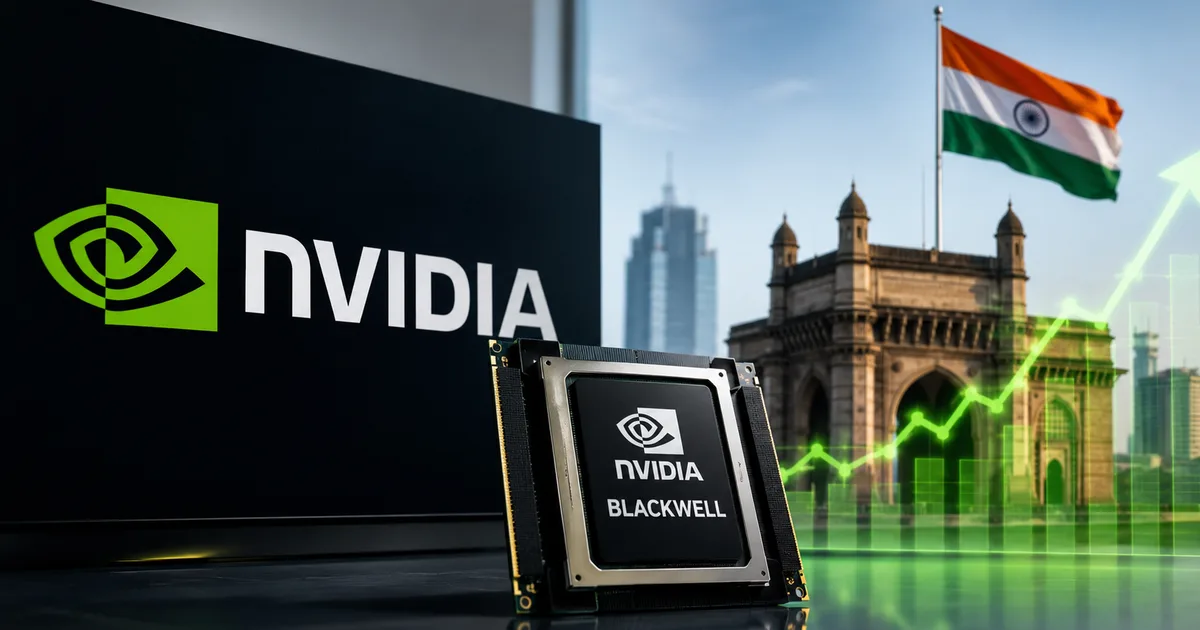
Nvidia just dropped their Q2 2026 earnings report, and the numbers are completely wild. If you follow the stock market or the tech industry, you probably knew Nvidia Q2 Earnings August 2026 was going to be big. But Blackwell AI chip demand has outpaced even the most aggressive Wall Street estimates. We're looking at a hardware company that's single-handedly dictating the pace of global technology right now. They're selling the most expensive, most sought-after product on the planet faster than their supply chain can handle.
So what does this actually mean for us sitting here in India? Honestly, the Indian tech sector is deeply connected to American IT budgets. When a US bank spends a billion dollars on Nvidia GPUs, that decision ripples down to tech parks in Bengaluru, Pune, and Hyderabad. Let me break down exactly what happened on this earnings call. I'll explain the hardware side, the geopolitical drama, and why this matters for your job in tech. In my experience, these hardware shifts always hit our service jobs eventually.
The raw numbers from the Q2 2026 earnings call
You really don't need a finance background to understand what happened on Wednesday. CEO Jensen Huang took his victory lap. And the company crushed expectations. But the real story wasn't just the massive revenue from their older Hopper chips. Everyone on the call wanted to know about the future. They wanted to know about Blackwell.
Blackwell is Nvidia's next generation AI architecture. The demand for these new chips is staggering. Huang confirmed during the CNBC broadcast that they're seeing orders stretching deep into 2027. We're talking about a trillion dollars in data center build-outs over the next few years (which is a totally insane number, honestly). This isn't just companies running small pilot projects anymore. Enterprise clients want scalable business value. They're building massive infrastructure to train models that make today's AI look basic. You can read more about global enterprise trends in our news section.
"We're seeing orders stretching deep into 2027. The demand for Blackwell is far exceeding our current supply capabilities across all sectors."
The money printer is running at full speed for Nvidia. And they know they have absolute pricing power right now.
Blackwell AI chips are basically gold dust right now
Let's talk about the hardware itself because it explains the market panic. The Blackwell architecture is a massive leap in performance for AI training and inference. And big tech companies are buying them in bulk. We saw reports from Livemint that Apple is tapping Nvidia Blackwell GPUs to power a massive iOS 27 Siri overhaul expected at WWDC 2026. When Apple starts writing massive checks to Nvidia instead of relying on their own silicon, you know the hardware is untouchable. If you ask me, that's the biggest signal of all.
There's competition brewing, sure. OpenAI recently claimed their new custom chip can outperform Blackwell. But nobody's actually canceling their Nvidia orders based on a press release. The waiting list for these GPUs is months long.
Because they have a monopoly on the most wanted product in the world, Nvidia is raising prices. Fortune reported that Nvidia notified customers about AI-related price hikes of over 15 percent. Companies will pay it. They have to pay it. If they refuse, their competitors will buy the allocation and beat them to market.
Why the US government stepped in this weekend
This is where it gets interesting for global politics. The Times of India noted an unusual weekend announcement where the US told companies to stop the passage of Nvidia Blackwell AI chips to certain regions. The American government wants to tightly control who gets access to this level of compute power. They treat these chips like weapons.
This export control creates a gray market. It also means allied nations and companies within them have an easier time getting hardware. Though they still have to pay the premium. India sits in a neutral spot here. But our companies still face the brutal reality of the waitlist and the price tag.
How the Nvidia boom hits the Indian tech sector
This is the part that actually affects your wallet and your career trajectory. The Indian tech sector is in a very strange transition period right now. We built a massive IT empire on outsourced services. Companies like TCS, Infosys, Wipro, and HCL run the backend systems for the world's biggest corporations. But generative AI changes the math entirely.
When a client company spends heavily on Nvidia hardware to automate their internal processes, they usually look to cut costs somewhere else to balance the budget. Very often, that means reducing their outsourced headcount in India. I'm not sure exactly why it always hits headcount first, but it does.
Pressure on Indian IT services and developers
I spoke to a friend working at a major IT firm in Hyderabad last week. His clients are demanding AI integration constantly, but they aren't increasing the total project budgets. They're literally taking money out of the traditional software testing bucket and putting it into the AI deployment bucket.
Indian IT firms are scrambling to upskill their workforce. They're setting up dedicated AI centers. You might've seen the news about L&T and NVIDIA setting up a B300 AI Factory in India. That's a direct response to this massive shift. But training half a million employees on new AI workflows takes time. And time is something the market doesn't give you freely (which is super frustrating). Check out our explainers for a deeper dive into how AI is shifting daily coding jobs.
The push for local Indian data centers
There's another angle to this whole situation. Because compute is so expensive and data sovereignty laws are getting stricter, we're seeing a massive push to build local data centers within India. The government's DPDP Act mandates that certain types of user data can't leave the country. This means global companies need local servers.
Real estate companies and traditional conglomerates are suddenly pivoting to build massive server farms on the outskirts of Mumbai, Chennai, and Noida. They're all trying to buy Nvidia hardware to stock these centers. Yotta Data Services, for example, previously announced massive purchases of Nvidia GPUs to build local AI clouds. This infrastructure build-out creates jobs. It requires structural engineers and cooling specialists. The AI boom is about writing code. But it is also about pouring concrete and laying heavy-duty fiber optic cables across the subcontinent.
But buying the land and building the warehouse is the easy part. Getting your hands on thousands of Blackwell chips when companies like Microsoft are buying them by the truckload is the real challenge for Indian infrastructure players.
The brutal cost of compute for Indian startups
If you're building an AI startup in Bengaluru today, your server bills are probably terrifying. Compute is incredibly expensive. With Nvidia raising prices by 15 percent, cloud providers like AWS, Google Cloud, and Microsoft Azure are going to pass those costs directly down to the end user.
An Indian startup raising seed funding in INR has to buy compute priced in USD. It's a brutal exchange rate reality. A million dollars simply doesn't buy you much time on a cluster of H100s, let alone the new Blackwell chips. This means Indian founders have to be significantly smarter than their well-funded American counterparts. They can't just throw raw compute at a problem. They have to optimize their code. They have to use smaller, more efficient open-source models. They have to fine-tune aggressively rather than training from scratch.
Are we actually in an AI bubble?
I have to address the obvious question here. Is this all just financial hype? Nvidia's earnings are basically testing the trillion-dollar data center bet. Wall Street investors are getting a little nervous. They want to see actual returns on all this hardware spending soon.
It's one thing for Meta or Google to buy 100,000 GPUs to build a massive cluster. It's a completely different thing for them to actually generate enough monthly recurring revenue from AI features to pay off that hardware before it becomes obsolete.
Right now, the demand is very real. But if these massive tech companies don't figure out how to monetize AI effectively by 2027, the spending might slow down. And if the global AI bubble pops, the shockwaves will hit Dalal Street and the Indian startup ecosystem hard. The numbers here are a bit fuzzy, honestly. But a lot of current valuations are based on the strict assumption that AI will create unlimited productivity gains. If that timeline stretches out by five years, startup funding will dry up fast. Be careful with your sector investments and cross-check new platforms on our guides.
What you should do about this shift
If you're a software engineer in India today, you need to adapt quickly. The days of doing basic CRUD operations and expecting a 30 percent salary hike every two years are gone. You need to focus on a few specific areas:
- Understanding how to integrate external LLM APIs into existing enterprise software.
- Managing and querying vector databases efficiently to reduce latency.
- Architecting complex workflows where AI agents handle the repetitive backend tasks.
- Optimizing cloud infrastructure costs because AI compute will drain startup budgets quickly.
You don't necessarily need to be a machine learning researcher writing custom PyTorch gradients. But you absolutely need to know how to use external APIs and how to orchestrate complex AI workflows. If you're a computer science student, focus heavily on system design and business logic. AI tools will write the boilerplate code for you soon anyway. Your actual value is in architecting the system and understanding what the client really needs.
And if you're just a regular internet user, expect your digital life to get more expensive. As companies spend billions on Nvidia chips, they'll try to recoup those costs through consumer subscriptions. We're already seeing premium tiers for AI features across all major apps. The completely free internet is shrinking. Keep an eye on our tools section to see which new AI platforms are actually worth paying a monthly fee for.
Don't fall for AI investment scams
I have to put this warning here because it happens every single time a major tech company reports massive earnings. Scammers use the news cycle hype to steal your money.
Right now, there are WhatsApp groups circulating fake investment schemes. They claim to offer guaranteed returns on Nvidia stock options or fake AI data center projects based in India. They'll show you photoshopped screenshots of massive profits. They'll tell you to download a sketchy APK file to start trading.
Don't do it. This is a very common scam. Here's exactly how it works. They add you to a Telegram or WhatsApp group without your permission. They build trust over a few weeks with free stock market tips. Then they ask you to invest via a custom app that isn't available on the Google Play Store or Apple App Store. Once you transfer your money via UPI, it's gone forever.
If you see these messages, block the number immediately. Never install APK files sent over chat apps. If you've already lost money to one of these groups, report it to the National Cyber Crime Reporting Portal at cybercrime.gov.in or call the 1930 helpline immediately. You can find more details on current financial frauds in our scams section. Also, use the government Sanchar Saathi portal to report the suspicious phone numbers so they get blocked nationally.
The bottom line for regular Indian users
Nvidia is currently the most powerful company in the world. Their Q2 2026 earnings proved that the hardware demand is still accelerating. The upcoming rollout of Blackwell chips is defining the next phase of computing capabilities across the globe.
But for India, the impact is complicated. It forces our IT sector to modernize rapidly. It makes building local AI startups much more expensive due to currency exchange rates and high compute costs. But it also creates massive opportunities for developers who can figure out how to apply these new capabilities to solve actual Indian problems. It is a mess right now, honestly. We'll keep tracking how this hardware arms race affects the software we use every day.