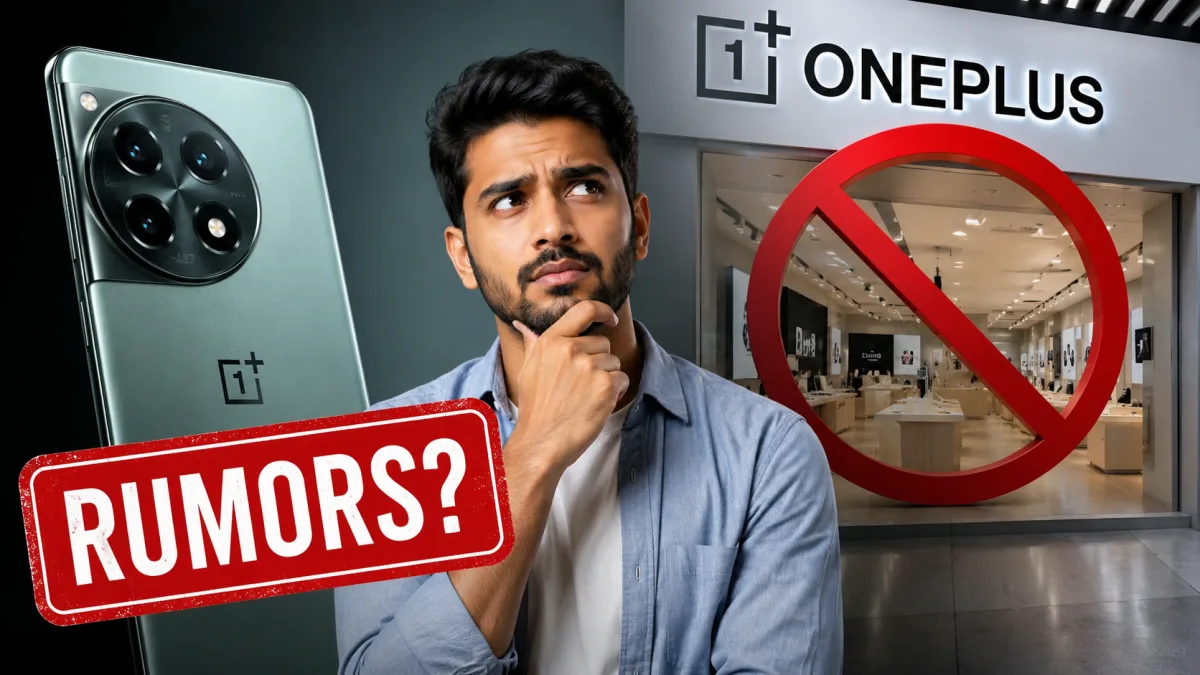
You've probably seen the headlines screaming about OnePlus packing up and leaving the country. The OnePlus shutdown rumors in India are everywhere right now. And honestly, they sound completely insane. We're talking about a brand that practically defined the mid-range premium smartphone segment here. But things are genuinely looking bad for the company.
Look, I bought the OnePlus One back in the day through that terrible invite system. It felt like a rebellious choice, if you ask me. You were getting flagship specifications for half the price of a Samsung Galaxy. Now? Over 150,000 mobile stores across India have straight up refused to sell their phones. That isn't a minor glitch in the matrix. It's a massive coordinated boycott by the people who actually sell phones to offline buyers in this country.
So what's actually happening? Let me break down the real story behind the retailer ban. And why people think the brand might disappear by 2027.
The reality of the offline retailer ban
If you walk into a neighborhood mobile shop today in Mumbai or Delhi and ask for a Nord device, they'll probably try to sell you a Vivo or a Samsung instead. Thing is, the South Indian Organized Retailers Association started this fire. And it quickly spread nationally. The All India Mobile Retailers Association joined in shortly after.
The shop owners are furious about profit margins. They claim the company gives them margins so thin they can barely keep the lights on, while offering massive discounts on Amazon and Flipkart. You can't expect a guy running a shop in a Tier 2 city to stock phones if he makes less than 500 rupees per sale. Especially when a customer can just open their phone and scan a QR code via UPI. Then they get a flat 2,000 rupee discount using an HDFC credit card online (which makes sense, actually).
And there are serious complaints about warranty support and delayed claim settlements. Retailers are stuck in the middle. Customers yell at the shopkeeper when their screen gets a green line issue. But the shopkeeper gets zero support from the brand to fix it. It's a terrible position to be in for a small business owner. They have rent to pay and employees to feed.
When the people who physically hand your product to the customer refuse to do business with you, your brand is in deep trouble. India is still heavily reliant on offline retail for smartphone sales. Not everyone buys a 40,000 rupee device on Amazon without holding it in their hands first. Honestly, I wouldn't do it either.
Service center nightmares and quality drops
Speaking of green lines, we need to talk about the hardware quality. I know dozens of people who bought the 8 and 9 series devices only to have a bright green line appear vertically across their AMOLED screens after a random software update. It was a mess. It became a huge scandal in India.
The company initially tried to charge users for screen replacements. They only offered free replacements or upgrade vouchers after massive public backlash on social media. But getting that replacement means visiting a service center. Then you hand over your device for weeks. And you just hope they actually have the spare parts in stock.
Motherboard failures are becoming common too. You buy a phone for 45,000 rupees. A year later it just dies in your pocket. People don't want to deal with this anxiety. When you spend a month's salary on a gadget, you expect it to last at least three years without major hardware failure.
The service center experience has degraded rapidly. What used to be a premium walk-in repair service with coffee and comfortable seating is now a crowded room full of angry customers holding dead phones. This shift in customer experience is a major reason why brand loyalty is dropping.
Why 2027 keeps coming up in the exit rumors
Multiple reports from publications like India Today and The Times of India point to a massive global restructuring by Oppo. Yes, Oppo. Because OnePlus is essentially just an Oppo sub-brand now. They share R&D and supply chains. The software teams are merged too.
The parent company is apparently bleeding money in Western markets. They're facing severe patent disputes with Nokia in Europe. That already forced them out of countries like Germany. They're also struggling to get any real traction in the US against Apple and Samsung. So the reports suggest that Oppo might just pull the plug on operations in the US and Europe. And India could be gone by 2027 too.
And I'm not 100% sure if they'll actually abandon India entirely. It seems crazy on paper. India is their biggest market globally. But business decisions in Shenzhen don't always make sense to us sitting in Bengaluru (annoying, I know). If the global operation is losing too much cash, they might just consolidate everything under the Oppo name to save marketing and distribution costs.
The corporate strategy seems to be shifting entirely toward Oppo and Vivo. Those are the other BBK Electronics siblings. They might decide that maintaining a separate brand identity just isn't profitable anymore. Especially when the products are becoming identical hardware clones anyway.
The official response from the company
The India team has completely denied the exit rumors. They issued a PR statement saying they are committed to the Indian market and will keep launching products.
We remain deeply committed to the Indian market and will continue to invest in our operations and product offerings for our community here.
But honestly, what else are they going to say? You can't trust corporate statements when a company is in survival mode. The sudden exit of their India CEO Robin Liu earlier this year didn't exactly inspire confidence either. He said it was "business as usual" regarding their India plans right before handing in his resignation.
You can't have your top executive quit in the middle of a massive retail crisis and pretend everything is fine. The numbers here are a bit fuzzy, but the silence on the actual retail margin issues speaks volumes.
The OxygenOS illusion
This is my biggest gripe with their modern phones. I used to recommend them simply because OxygenOS was clean and fast. It felt premium. It was the closest thing to stock Android outside of a Google Pixel in my experience.
Now? You're buying an Oppo phone running ColorOS with a slightly different font. The codebase merged a long time ago. Sure, they still call it OxygenOS on the box. But dive into the settings and it's exactly the same software you find on an Oppo Reno device.
They lost their soul. You don't have the enthusiast community flashing custom ROMs anymore. You just have people annoyed that their expensive smartphone comes pre-loaded with sketchy app stores and redundant system apps. If you want to know more about how Chinese software layers affect your data, read our privacy explainers.
They alienated the hardcore tech fans to chase the mass market. And now they're losing both. It's a classic case of corporate greed ruining a perfectly good product.
What this means for your wallet
If you're planning to buy a new phone this month, you need to think twice about investing your money here. I'm not saying your current device will suddenly stop working tomorrow. The phones will still turn on.
But think about the long-term implications for a second.
- Software updates might slow down significantly if the development team shrinks.
- Finding replacement parts like batteries or screens could become a nightmare in local markets.
- Resale value will absolutely tank if the brand officially announces an exit.
- Service centers might close down or convert exclusively to Oppo service centers.
Nobody wants to buy a used phone from a dead brand on Cashify. You'll get terrible exchange value when you try to upgrade in two years. That 40,000 rupee phone might only fetch 5,000 rupees. You have to treat smartphones as investments with a predictable depreciation curve. Right now, this brand is a toxic asset.
The Make in India angle
We also need to look at the manufacturing side. The brand heavily promoted its alignment with the Make in India initiative. They have assembly plants in Noida. If they shut down, phones will disappear from shelves. And we are looking at potential job losses for factory workers and supply chain logistics staff too.
The government is pushing hard for domestic manufacturing. If a major player exits, it leaves a vacuum. But honestly, other brands will just absorb that factory capacity. The real losers are the direct employees who face uncertain futures.
Alternatives you should consider instead
The smartphone market in India is incredibly competitive right now. You don't have to settle for a brand with an uncertain future. There are plenty of good options.
Samsung has aggressively priced the A-series and M-series. They offer solid update policies. You can find a service center in almost every Indian town. Motorola has also made a massive comeback in the sub-30K segment. Their Edge series gives you that clean, stock Android feel that old fans miss. They are priced very well and actually look stylish.
And if you want pure performance for gaming, iQOO is doing exactly what this brand used to do five years ago. Aggressive pricing and top-tier processors. They focus purely on speed. Check our latest smartphone buying guides if you need specific model recommendations.
If you're looking at the premium tier, just buy an iPhone or a Galaxy S series device. The price gap isn't that huge anymore. And the peace of mind is worth the extra cash. If you want to know about recent scams targeting phone buyers, check our scam alerts section.
The bottom line for Indian consumers
We're watching the slow decline of a brand that once had fans waiting in literal lines outside pop-up stores in Delhi. It's genuinely sad for the tech community.
The retailer ban is real. The internal management chaos is real. The software identity crisis is real. And the patent disputes in Europe are public record. A complete shutdown in India by 2027 might seem extreme given their current market share. But the writing is clearly on the wall. They're bleeding offline retail partners. And they're losing the trust of their core fan base.
I'd hold off on buying any expensive device from them until the dust settles completely. Your hard-earned money is better spent on brands that have a clear, stable roadmap for the Indian market.
For more updates on mobile brands and offline retail issues, keep an eye on our tech news section.