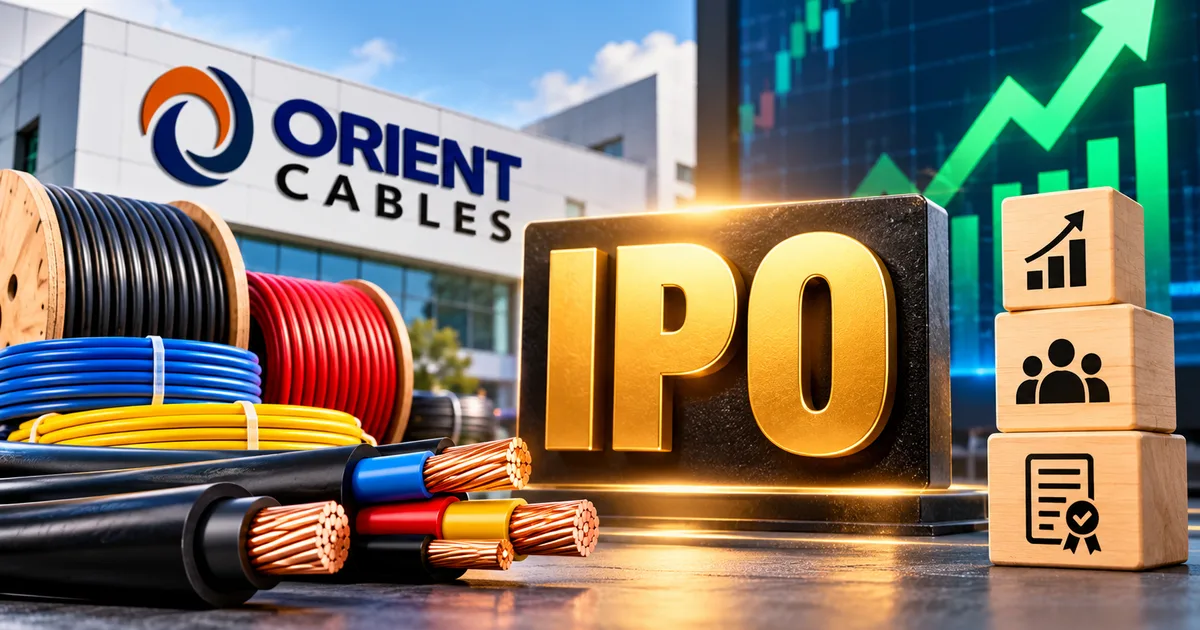
You open your phone, tap on your broker app, and see yet another IPO flashing on the dashboard. This time it's the Orient Cables IPO 2026. The noise around this issue is loud. Your WhatsApp groups are probably asking if they should apply, block their funds via UPI, and hope for the best. I get it. We all want those listing gains. The Indian stock market has seen a massive surge in retail participation lately, and IPOs feel like a quick lottery ticket. But before you blindly approve that UPI mandate on PhonePe or Google Pay, you need to know what you're actually getting into. The Orient Cables IPO closed its bidding recently, and the numbers are honestly quite surprising.
The total issue size is Rs 552 crore. That's a decent chunk of money. The company set a price band of Rs 258 to Rs 272 per share. If you're a retail investor, the minimum lot size is 55 shares. So you had to block Rs 14,960 in your bank account just to apply for a single lot. Most people apply at the cut-off price of Rs 272. And if you don't get the allotment, your money just sits stuck in your account until the refunds kick in.
The final subscription numbers tell you how crazy the demand is right now. By the time bidding closed on September 29, the issue was subscribed 92.27 times. You read that right. Investors placed bids for over 138 crore shares. The company only had about 1.49 crore shares on offer. I look at these numbers all the time in our tech explainers and this level of demand is definitely on the high side for a mid-sized manufacturing company.
Institutional buyers drove most of this frenzy. The Qualified Institutional Buyers (QIB) portion was subscribed 182.76 times. Non-Institutional Investors (NII) subscribed 115.63 times. (NII includes high net-worth individuals, which makes sense actually.) Retail investors saw our portion subscribed 30.55 times. That means about 30 people applied for every single retail lot available. The odds of you getting an allotment are basically 1 in 30. So if you don't see the shares in your demat account, don't feel bad. The math just isn't on your side.
What is the current grey market premium?
The grey market premium is a number everyone loves to track. Honestly, it's a bit sketchy. The grey market is an unofficial market where IPO shares are traded before they list on the NSE and BSE. It gives you a rough idea of the listing price. It's not a guarantee. But it is a popular metric.
Right now, the Orient Cables GMP is between Rs 72 and Rs 85 per share. You can do the math on that. The upper price band is Rs 272. Add a GMP of Rs 80, and you get an estimated listing price around Rs 352. That translates to a premium of roughly 29% to 31%. If you get allotted one lot of 55 shares, you're looking at a theoretical profit of about Rs 4,400 on day one.
The latest recorded GMP was Rs 85, implying an estimated listing price of around Rs 357 against the upper issue price of Rs 272.
But remember, the grey market is completely unregulated. A sudden market dip can wipe out that premium overnight. We saw similar fluctuations with the Technocraft Ventures IPO 2026 recently. The GMP is just a sentiment tracker. If the market opens weak on October 5, that 30% premium could shrink to 10%. Or the stock could even list at a discount. Look, never invest money you urgently need just because the GMP is tempting.
Where is the money actually going?
Whenever a company raises money from the public, they have to declare what they plan to do with it. The Rs 552-crore issue is split into two parts. First, there is a fresh issue of 1.18 crore shares worth Rs 320 crore. This money goes directly to the company. Second, there is an offer for sale (OFS) of 85.29 lakh shares worth Rs 232 crore. The OFS money goes to the existing promoters who are selling their stakes. They're just cashing out.
Out of the Rs 320 crore fresh capital, the company plans to use Rs 91.50 crore for capital expenditure. This involves buying new machinery and upgrading equipment. Another Rs 155.50 crore will go to repay existing borrowings. Paying off debt is a smart move. It reduces interest costs. And it improves profit margins in the long run. The rest of the funds are for general corporate purposes. The infrastructure sector in India is getting a massive government push right now. That partly explains why these companies are rushing to get capital.
How to check your allotment status online
The basis of allotment is scheduled to be finalised on September 30. If you applied, you're probably checking your phone constantly. You want that SMS from your bank saying funds are deducted. That SMS is usually the first sign you got the allotment. But if you want to be sure, check online.
There are three main ways to check your status. The most reliable method is through the official registrar. For this IPO, the registrar is KFin Technologies.
Checking via KFin Technologies
Here's the exact step-by-step process.
- Go to the KFin Technologies IPO status portal on your browser.
- Select "Orient Cables (India) Ltd" from the dropdown menu. This option usually appears only after the allotment is officially finalised.
- You have three options to verify your identity: your PAN card number, your application number, or your DP ID/Client ID. PAN is usually the easiest.
- Enter the details, type in the captcha code on the screen, and hit submit.
The screen will show you exactly how many shares you applied for and how many were allotted to you. If it says zero, your blocked funds will be released soon.
Checking via the BSE website
You can also use the Bombay Stock Exchange website.
- Visit the BSE investors application status page.
- Under the issue type, select "Equity".
- Find and select Orient Cables from the dropdown list.
- Enter your application number or your PAN.
- Check the "I am not a robot" box and click search.
Checking via the NSE website
The National Stock Exchange has a similar facility. You need to register an account on the NSE website first. Once logged in, go to the IPO bid verification page, select the company, and enter your details.
What happens after the allotment?
Assume you didn't get the shares. What happens to your money? The refund process begins on October 1. Since most people use UPI these days, you won't get a refund per se. The UPI mandate that blocked the Rs 14,960 will simply be cancelled. Your bank will unblock the funds. Then you can use that money again. Sometimes this happens late at night. Or it might take a day or two depending on your bank servers. If you used ASBA through net banking, the block is simply removed from your account balance.
If you're one of the lucky few who got the allotment, congratulations. The shares will be credited to your demat account by October 1. You'll see them in your Zerodha or Groww app. You can't sell them immediately. The shares will just sit there until the listing day.
The listing day strategy
The shares will list on both the NSE and BSE on October 5, 2026. Trading usually begins at 10:00 AM. But the pre-open session starts at 9:00 AM. This one hour is really important. During the pre-open session, the system matches buy and sell orders to discover the final listing price. By 9:45 AM, you'll know exactly what price the stock is going to open at.
You have a choice to make on listing day. Do you book your profits immediately, or do you hold the stock for the long term? I think many retail investors apply for IPOs purely for listing gains. They sell the shares at 10:01 AM. They take their 30% profit and move on to the next IPO. There's nothing wrong with that approach. The stock market is unpredictable. Booking a guaranteed profit is often the safest bet. We saw massive selling pressure on listing day for the Dhoot Transmission IPO 2026. That selling wiped out a good portion of the early gains.
If you decide to hold, you need to treat it like a regular stock investment. You have to read the quarterly reports. You have to track the management performance. You need to see if they're actually using the Rs 91.50 crore capex money effectively. A manufacturing business takes time to scale. Buying new machinery today might not show up in the profit margins for two years. You have to be patient.
The UPI mandate problem
I want to address a common issue many Indian investors face. The UPI mandate system is convenient. But it's kind of a mess sometimes. Sometimes you apply on your broker app, but the UPI request never shows up on your PhonePe. Other times, you approve the mandate and the money is deducted. But the broker app still shows the application as pending. (Annoying, I know.)
This happens because multiple entities are involved in a single transaction. Your broker, the exchange, the NPCI, and your own bank are all part of it. A delay at any of these nodes causes a bottleneck. If your mandate fails, the best thing to do is cancel the application on your broker app and apply fresh. Don't wait until the last hour of the final day to approve your mandate. The banking servers always choke under the heavy load of last-minute retail applications.
And regarding unblocking funds, banks are notoriously slow. The official timeline says October 1. But some public sector banks might take until October 3 or 4 to actually reflect the available balance. You just have to wait it out.
Why cables matter right now
I should talk a bit about why cables are generating so much interest right now. You might think it's just wires. But India's current economic phase is heavily tied to infrastructure. Every new highway needs cables. Every metro project needs cables. The numbers on the 5G telecom rollout are a bit fuzzy, but it's consuming optical fibre at a crazy rate. When a company like Orient Cables goes public to raise capital, they're preparing for this long-term demand.
We also have to consider the government push for local manufacturing. Policy shifts have placed heavy import restrictions on certain electronic components. This forces domestic companies to rely on local suppliers. Cable manufacturers with the capacity to scale up production will benefit from these changes. That's partly why institutional buyers threw so much money at this IPO. These large funds employ teams of analysts to track these trends. When you see a QIB subscription of over 182 times, it means the big money believes in the sector.
But you also have to look at the risks. The manufacturing sector is highly vulnerable to raw material prices. Cables require immense amounts of copper and aluminium. If global commodity prices spike, the profit margins can compress rapidly. They can't always pass on the increased costs to their customers. This is the kind of detail you need to track if you plan to hold the allotted shares beyond listing day.
The Orient Cables IPO definitely has strong demand backing it up. The subscription numbers are clear evidence of that. The grey market is signalling a healthy premium. Now, it's just a waiting game to see if you beat the odds for the retail allotment. Keep an eye on your bank SMS alerts today.