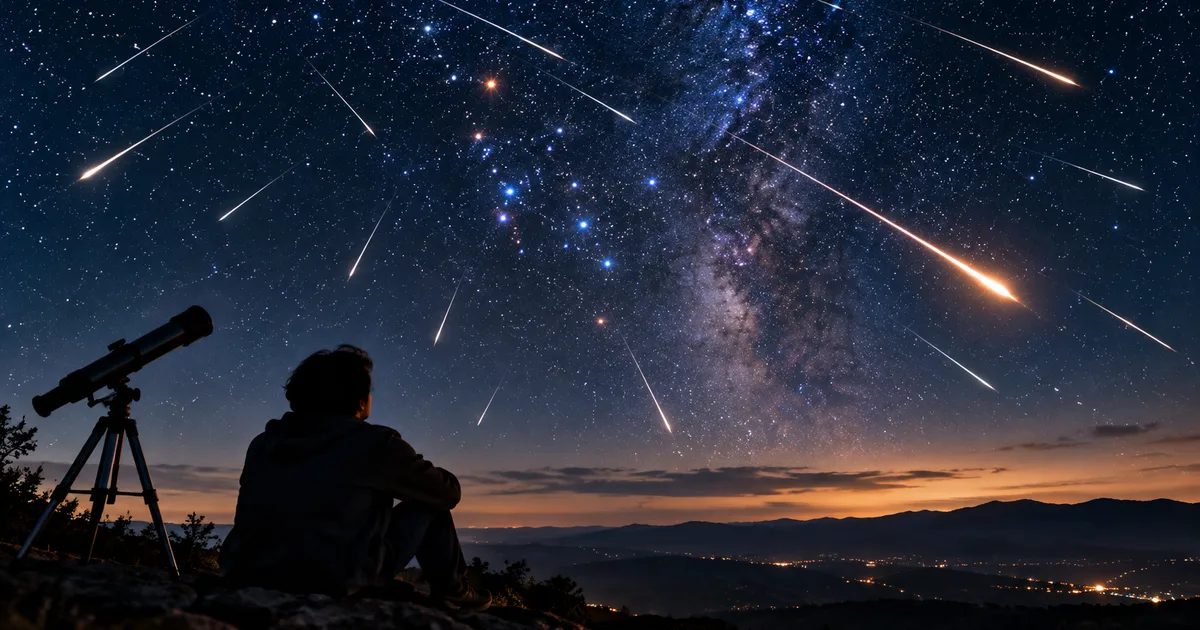
Picture this: it's mid-October, and Diwali preparations are buzzing around your neighborhood. The night air on your terrace is finally pleasant enough to sit outside without sweating. You've poured a hot cup of adrak chai. Your smartphone is face down on the parapet. You lean back and look straight up into the clear post-monsoon sky. Then you wait. If you pick the right night this week, you won't have to wait long before catching a sudden, bright streak of light ripping across the stars. The Orionid meteor shower October 2026 is reaching its peak right now, and it is easily one of the cleanest skywatching opportunities of the year for stargazers across India.
You don't need fancy optical equipment. You definitely don't need a degree in astrophysics. Honestly, you don't even have to leave your building terrace if you can find a reasonably dark corner away from direct streetlight glare. But you do need to know the exact hours to step outside, and you need a plan for this year's pesky moon. Also, in my experience, staring straight at the constellation Orion is the quickest way to miss them completely.
What makes the Orionid meteor shower worth staying up for
Speed is what sets this shower apart. Pure speed.
Orionid meteors slam into our upper atmosphere at around 66 kilometers per second. That is over 237,000 kilometers per hour. Just crazy fast. For comparison, a commercial flight cruising between Delhi and Bengaluru travels at about 850 kilometers per hour. These space particles are moving roughly 280 times faster than that plane.
Because they move at such absurd speeds, Orionid meteors often produce what astronomers call glowing trains. Basically, these are streaks of ionized gas and hot dust. They linger in the dark sky for several seconds (and occasionally up to a full minute) after the main flash vanishes. And every so often, a particle is slightly larger than a grain of sand. When that happens, it turns into a brilliant fireball that lights up the sky like a silent camera flash.
NASA estimates that under ideal dark skies, the shower produces around 10 to 20 meteors per hour.
Now, let's be completely upfront about what that number means for you here in India. If you are standing on a terrace in Mumbai, Bengaluru, Pune, or Delhi NCR, light pollution and atmospheric dust will easily cut that count in half. You won't see twenty meteors in an hour. But if you ask me, catching five or six genuinely bright shooting stars with persistent trails over sixty minutes is still a thrilling experience, especially once you realize where that dust came from.
How debris from Halley's Comet creates these fireballs
Every meteor you see during the Orionids is an ancient piece of comet 1P/Halley.
Most folks know Halley's Comet as the famous celestial traveler that swings past Earth roughly once every 76 years. Its last visit happened back in 1986. NASA notes that it won't return to our inner solar system until 2061, which feels like ages away. But here's the deal: you don't have to wait until 2061. You can watch pieces of it burn up right above your hometown this week.
Think of a comet as a dirty snowball hurtling through space. As it approaches the sun, solar heat causes frozen ice and gases to vaporize. That violent process blasts loose billions of tiny fragments of rock and gritty silicate dust. Over centuries, these shed particles spread out into a massive, invisible ring of debris looping along the comet's entire orbital path.
Earth's orbit around the sun intersects that dusty debris trail twice every single calendar year. We pass through one edge in May, and that creates the Eta Aquariid shower. Then, in mid-October, we plough right through the opposite stream. That is what produces the Orionids.
The physics works just like driving down the Mumbai-Pune Expressway at night during monsoon season. When your car is parked, rain falls straight down. But the moment you cruise forward at high speed, raindrops seem to rush straight at your windshield from a single point ahead. Earth hurtles along its orbital path at 30 kilometers per second, so it collides head-on with Halley's dust stream. Those tiny specks, many no larger than a grain of sooji or a mustard seed, collide with air molecules and compress the air in front of them until it is scorching hot. Then they vaporize in a brilliant burst of light.
If you enjoy understanding how cosmic events touch our everyday lives, check our severe solar storm October 2026 explainer to see how space weather affects mobile towers and power grids down here on Earth.
Peak dates and best viewing time in India
The Orionids remain active from October 2 through November 7, but the bulk of that activity is too faint to bother with. You want to aim squarely for the peak window.
For 2026, the peak arrives overnight between October 21 to 22.
Mark that Tuesday night into Wednesday morning on your calendar. If clouds spoil your view on the 21st, the night of October 22 to 23 will still deliver decent activity, though the numbers here are a bit fuzzy and counts taper off quickly after that.
Timing your watch session properly is where most beginners make their biggest blunder. I'm not sure exactly why, but people often walk out to their balcony at 9:00 PM or 10:00 PM and stare up for fifteen minutes. When they see nothing, they give up, assuming the news reports were exaggerated.
Here's the deal: before midnight, the constellation Orion hasn't climbed high enough above India's eastern horizon. And this year has an extra hurdle you have to plan around.
A waxing gibbous moon dominates the sky during the first half of the night. With more than 75 percent of the lunar surface illuminated, that moonlight washes out faint meteors just as aggressively as a sodium streetlamp (annoying, I know). Trying to hunt for shooting stars while the moon is blazing overhead is mostly a waste of time.
So, when should you actually set your alarm?
You need to step outside after the moon sets below your western horizon. Across most of India, moonset on the night of October 21-22 happens between 2:00 AM and 2:30 AM IST. That leaves a golden window of around two and a half hours, from 2:30 AM until twilight begins breaking around 5:00 AM, where the sky is truly dark and the shower's radiant sits high overhead.
Here's a quick look at estimated local conditions for major Indian cities:
- In Delhi NCR and North India, moonset occurs around 2:15 AM on October 22, giving nearly three hours of dark sky before pre-dawn twilight creeps in.
- In Mumbai and Pune, moonset happens around 2:35 AM, with relatively clear coastal skies expected once the monsoon moisture clears out.
- In Bengaluru and Chennai, expect moonset near 2:20 AM, though you should check local cloud radars to make sure evening convective clouds have dispersed.
- In Kolkata and Eastern India, moonset happens earlier, around 1:50 AM, but dawn also breaks earlier, meaning your prime viewing window runs from 2:00 AM to 4:15 AM.
Always check your local weather app or the IMD Mausam portal before committing to an all-nighter. Passing low-altitude clouds will ruin your view faster than light pollution ever could.
A practical skywatching guide for Indian terraces and rooftops
You don't need to drive out to Ladakh or the Spiti Valley to enjoy this shower. While rural dark-sky reserves in places like Hanle have unmatched views, everyday terraces across tier-2 cities and quiet suburbs work surprisingly well if you set things up smartly.
First, leave the telescope in its closet.
I see this mistake every year. Someone buys an entry-level telescope or a pair of birdwatching binoculars and points them at Orion hoping to see meteors zooming through the eyepiece. It doesn't work that way. Telescopes have an extremely narrow field of view, usually showing you a patch of sky no wider than your thumbnail held at arm's length. Meteors streak across thirty or even eighty degrees of the sky in a fraction of a second. Trying to catch one through a telescope is like trying to spot birds by looking through a drinking straw. Your naked eyes, with their wide peripheral vision, are your best possible tool.
Second, understand the radiant point.
The Orionids get their name because their paths trace backward to a spot near the club of Orion, just north of the bright red star Betelgeuse. But you shouldn't stare straight at Orion. Meteors that appear right at the radiant point have very short trails because they are heading almost directly toward your line of sight. To spot the longest, most dramatic streaks, lie down with your feet pointed toward the southeast or south. Look about 45 to 60 degrees away from Orion, taking in broad stretches of open sky toward Gemini or Taurus instead.
Third, respect your eyes' dark adaptation.
When you step out of a brightly lit bedroom onto a dark terrace, your eyes can't see much. It takes around 25 to 30 minutes in total darkness for your pupils to dilate fully and for a chemical called rhodopsin to build up in your retinas (which makes sense, actually, since night vision takes time to develop). That night vision is fragile. Glancing at your phone screen for just three seconds to check WhatsApp or Instagram resets that clock instantly. And that means you are stuck waiting another twenty minutes in the dark.
Here are a few low-cost skywatching preparations that make a genuine difference:
- Carry a thin durrie, yoga mat, or folding camp cot so you can lie flat on your back without straining your neck.
- If you picked up camping gear or portable recliners during the recent Amazon Prime Day sale deals, set them up on your terrace facing southeast.
- Cover your phone's flashlight with two layers of red cellophane paper, or buy a cheap ₹150 red LED torch from a hardware store, since red light preserves your eyes' natural night vision.
- Keep a thermos flask filled with hot chai or filter coffee nearby to stay alert through the chilly 3:00 AM breeze.
- Download free, offline sky map tools like Stellarium Mobile before heading upstairs so you can identify surrounding constellations like Orion, Taurus, and Sirius without turning on bright data screens.
For more practical tech walkthroughs, take a look at our step-by-step skywatching guides covering offline smartphone tools and backyard observation setups.
What to expect when you look up
Let's keep expectations honest.
Hollywood movies have convinced millions of people that meteor showers look like non-stop fireworks shows, with fifty flaming rocks raining down simultaneously every few seconds. If you go upstairs expecting that, you'll walk back down disappointed and grumbling about wasted sleep.
Real meteor watching is a slow, quiet hobby (which, for the record, I think is actually a good thing because it forces you to slow down). It's patient work.
You might stare into the quiet sky for twelve minutes and see nothing at all except familiar stars twinkling gently. Then, suddenly, a streak of bright silver-white or emerald green zips across the constellation Gemini. It leaves a thin smoky line that hangs in the air for three seconds before dissolving into the darkness. Two minutes later, another quick dart flashes near the horizon. Then you get another quiet stretch of eight minutes.
According to NASA, Orionid meteors travel at roughly 66 kilometers per second into Earth's atmosphere, making them some of the fastest meteors of any annual shower. Under dark skies, you can expect between 10 to 20 meteors per hour.
That cadence is part of the charm. In an era where our brains are wired to short-form video reels that change every five seconds, spending two quiet hours on a cool terrace watching real cosmic debris collide with our atmosphere feels grounding. It gives you a sense of scale that screen time never provides.
If you enjoy breaking down complex science into straightforward ideas, you can explore our full collection of in-depth science and tech explainers covering everything from satellite orbits to digital infrastructure.
Common skywatching mistakes you should avoid
Most people who miss out on annual meteor showers fail because of small, avoidable planning errors.
The biggest mistake is relying on your phone while waiting. Staring at an illuminated screen while waiting between meteors guarantees you'll miss the fainter streaks. If you must use your phone to track coordinates or chat, dig into your phone's accessibility settings and turn on the native red screen filter (available on both Android and iOS).
Another common pitfall is ignoring the local ambient light right next to you. You don't need complete pitch-black wilderness, but you must block direct light bulbs. If your neighbor's balcony light or a nearby streetlamp shines directly into your eyes, position yourself behind a rooftop water tank or a solar panel structure so that direct glare stays hidden from your view.
Finally, don't rush back indoors after five minutes. Give yourself at least an hour on the terrace between 2:30 AM and 4:30 AM on October 22. Dress in light layers, bring along a friend for company, and relax your gaze. Then let Halley's ancient dust put on its quiet, brilliant show.