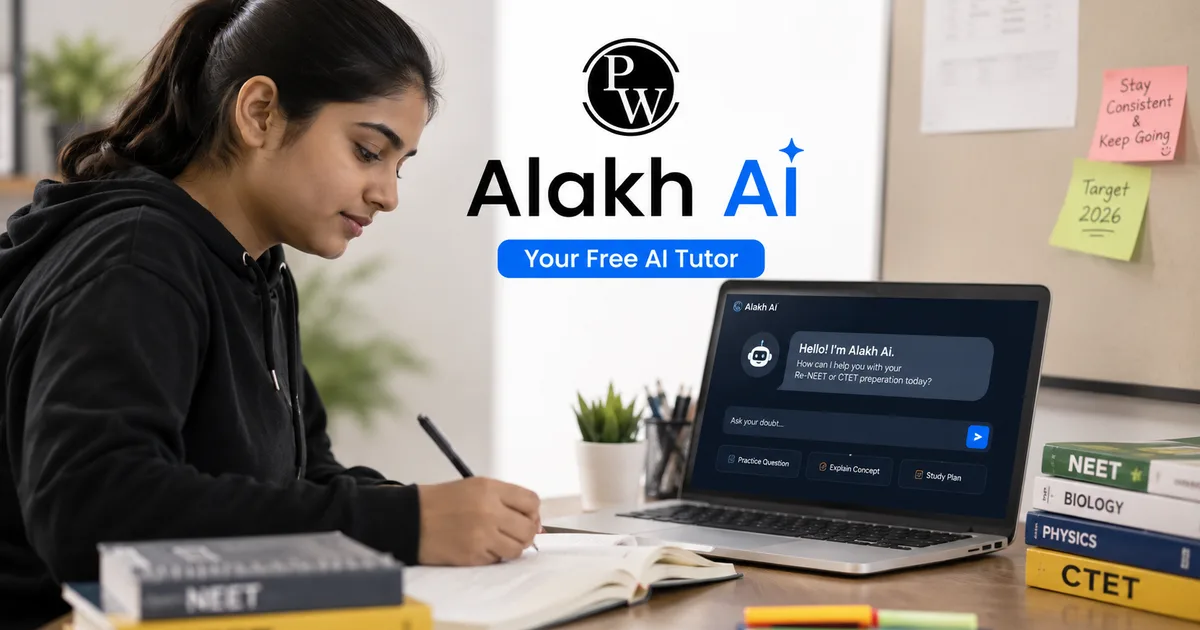
Preparing for Indian competitive exams is exhausting. You already know this. The syllabus never ends. The pressure from relatives is constant. Re-NEET is a harsh reality for many students this year. CTET 2026 is creeping up fast for teaching aspirants. You're probably staring at a mountain of textbooks right now. If you're looking for a way to untangle complex topics without paying thousands for extra tuitions, you might want to look at Physics Wallah Alakh AI. I've been testing this specific tool to see if it actually helps with Re-NEET and CTET 2026 prep or if it's just another marketing gimmick.
AI in education is a mess right now. Honestly, every ed-tech company claims they have a smart assistant. Most of them are just basic ChatGPT wrappers with a fresh coat of paint. They spit out generic answers that don't align with the NCERT syllabus. But Physics Wallah took a slightly different route. They built something specific for the Indian student.
What exactly is the Alakh AI tutor?
Physics Wallah recently launched their proprietary AI model called Aryabhata 1.0. This is the engine that runs Alakh AI. It's designed specifically to handle Indian competitive exams. So it understands the weird quirks of JEE and NEET. It also gets those teaching exams like CTET.
When you ask a generic AI to explain a physics concept, it gives you a boring Wikipedia-style summary. But Aryabhata 1.0 is trained on PW's massive library of lectures and study materials. It tries to explain things exactly how an actual Indian coaching teacher would. It uses familiar examples. It breaks down numericals step by step, and it even understands Hinglish (which makes sense, actually, given their target audience).
You can find this tool integrated directly into the PW ecosystem.
Having a 24/7 doubt-solving assistant that doesn't judge you for asking basic questions at 3 AM is a massive relief. We've all stared at a chemistry equation for an hour feeling completely stuck. This tool simply unblocks you.
Step-by-step guide to using the Alakh AI tool
Getting started is super straightforward. You don't need a separate subscription to access the basic doubt-solving features. Here is how you use it.
- Step 1: Download or update the PW app. You need the latest version from the Google Play Store or Apple App Store. Log in with your mobile number.
- Step 2: Locate the AI Chat icon. [Screenshot description: The main dashboard of the PW app with a bright red arrow pointing to the floating 'Ask Alakh AI' chat bubble icon at the bottom right corner of the screen].
- Step 3: Choose your input method. You can type your question directly. You can use voice notes if you are tired of typing. You can also upload an image of a tricky question from your workbook.
- Step 4: Refine your prompt. Don't just upload a photo and say "solve". Ask specifically what part of the solution confuses you. For example, type "Explain how we got the value of friction in step 3 of this image".
The image upload feature is probably the most useful part if you ask me. The optical character recognition (OCR) is surprisingly good at reading messy handwriting. It does struggle a bit with poorly lit photos. Just make sure you're in a bright room when snapping pictures of your notes.
Why it actually works for Re-NEET 2026
Re-NEET preparation is a totally different beast. You aren't starting from scratch. You're just trying to plug specific holes in your knowledge. You probably know the biology theory but keep messing up physics numericals. Or maybe you get confused by tricky assertion-reasoning questions in chemistry.
Alakh AI is genuinely helpful here.
I tested it with some classic rotational mechanics problems. It didn't just give me the final answer. It actually broke down the free body diagram concepts and showed the formula application. When I asked it to explain the concept "like I'm a 10th grader", it simplified the language immediately.
For biology, rote memorization is a massive part of the battle. You can ask the AI to generate quick mnemonic devices for complex plant kingdom classifications. I typed "give me a funny Hinglish mnemonic to remember the essential amino acids". It generated a completely ridiculous but memorable sentence in seconds. You can do this with any AI tools of course. But Alakh AI keeps the context strictly aligned with the NCERT curriculum.
They've also integrated this heavily with their new PI OTT platform. If you're watching NEET 2026 online classes on PI OTT, the AI assistant sits right there. You can pause the video. You ask a question about what the teacher just said. It is a smooth experience.
The CTET angle for teaching aspirants
Most people associate Physics Wallah with engineering and medical entrance exams. But their teaching exam vertical is massive. Millions of B.Ed graduates are prepping for CTET 2026 right now. The syllabus here is entirely different.
Child Development and Pedagogy (CDP) is the toughest section for many CTET aspirants. It's highly theoretical. You have to understand Piaget or Vygotsky. Even Kohlberg. More importantly, you have to apply their theories to hypothetical classroom situations.
Alakh AI handles pedagogy questions remarkably well. I asked it a situational question. "A student in class 5 is struggling with fractions, how would Vygotsky approach this?" The AI responded with a clear explanation of scaffolding and the Zone of Proximal Development. It then gave a practical classroom example using physical blocks. This is exactly the kind of conceptual clarity you need to clear the CTET.
You can also ask it to generate mock questions. Type "give me 5 tough multiple-choice questions on inclusive education based on the latest CTET pattern". It generates them instantly. You practice. Check your answers. Then ask it to explain where you went wrong. It beats reading a static guide book any day.
The dark side of AI study buddies
I need to talk about the mental health aspect of this.
Studying for these exams is incredibly lonely. Sitting in a room for 12 hours a day breaks your brain. It's very easy to blur the lines between a study tool and a companion.
Moneycontrol recently reported a disturbing case. A 21-year-old NEET aspirant ended up chatting with AI bots for 10 hours a day. The news report described her situation as "beyond repair". She isolated herself completely from human contact. She just treated the AI like a best friend.
This is a real danger. AI chatbots are designed to be conversational and engaging. They never get tired of talking to you. But they aren't your friends. They're basically calculators for words. When you use Alakh AI or any other chatbot for competitive exams, you must set strict boundaries. Open the app. Ask your doubt. Read the answer. Close the app. Don't start chatting about your exam anxiety. Talk to your parents or call a friend. Take a walk instead.
Pricing, PI OTT, and the 2026 ecosystem
Physics Wallah is pushing hard into 2026 with new formats. They heavily promoted their new PI OTT platform during the Vishwas Diwas 2026 event. The idea is to make educational content consumption feel like watching a web series on Netflix. I'm not sure exactly why they think students want to binge physics like it's a TV show, but that's their angle.
The online classes for JEE and NEET are running on this PI OTT platform. Gate 2026 is there too. They offer affordable subscriptions and free trials. The Alakh AI integration is a major selling point for these subscriptions. The basic doubt-solving chatbot is free for registered users on the app. But the deepest integrations are locked behind their paid batches.
Is the paid version worth it? That depends entirely on your discipline. If you actually use the AI to clear doubts instantly instead of scrolling Instagram, the subscription pays for itself. If you just buy it because of FOMO and never open it, you're wasting your money.
Comparing the reality against the hype
Nothing is perfect. The Aryabhata 1.0 model is impressive. But it hallucinates just like any other AI. Sometimes it gives confidently incorrect answers for highly complex physics derivations. You still need to apply your own brain.
| Pros of Alakh AI | Cons of Alakh AI |
|---|---|
| Excellent NCERT and Indian curriculum context | Can struggle with highly complex, multi-step math derivations |
| Great OCR for reading handwritten doubts | Requires a stable internet connection at all times |
| Understands Hinglish perfectly | Sometimes gives overly long explanations when you just want the final answer |
| Free basic access for app users | Deepest features require paid batch subscriptions |
Always verify the final answers if something feels off. Use the AI to understand the process. Don't use it to cheat on your homework. If the AI says the answer is 42 but your textbook says 45, trust the textbook. AI models are bad at basic arithmetic sometimes. They predict the next logical word. They don't actually calculate numbers in the traditional sense.
Final thoughts on your prep strategy
Technology can't study for you. No matter how advanced the Aryabhata model gets, you still have to sit in the chair and memorize the biology diagrams. You still have to practice the math. Alakh AI just removes the friction. It stops you from giving up when you hit a roadblock at midnight.
For Re-NEET 2026 students, time is your most valuable asset. Don't waste an hour stuck on one concept. Snap a photo. Ask the AI. Understand the logic and move on. For CTET aspirants, use it to master pedagogy concepts through practical examples.
Be smart about your study hacks. Treat this tool exactly like what it is. It is a highly efficient digital tutor. Exploit its strengths. Ignore its weaknesses. Keep your focus on the actual exam paper.