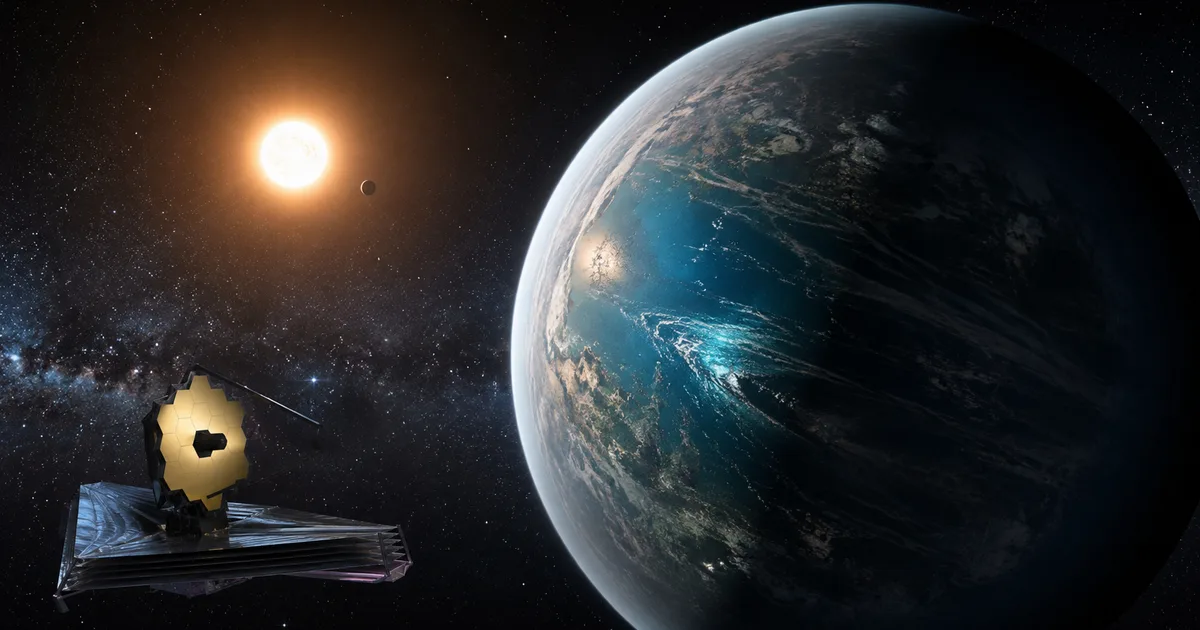
Look, space news usually bores me. Another day brings another blurry dot millions of miles away that scientists get overly excited about. But today's news about Planet LHS 1140b: James Webb Telescope discovery and the search for alien oceans explained is genuinely different.
I've been following this since Thursday. The James Webb Space Telescope (JWST) spotted a new planet. It found an atmosphere on a rocky, Earth-like planet. Honestly, this planet sits right in the habitable zone where water doesn't boil away or freeze solid.
Think about that for a second. For years, astronomers found these rocky planets and assumed they're dead, airless rocks (which makes sense, actually). Like our moon. But LHS 1140b has an atmosphere. And it might even have an ocean.
What is LHS 1140b anyway?
Imagine you're house hunting. You avoid places too close to a noisy main road, and you skip places stranded in the middle of nowhere. You want a middle ground.
LHS 1140b is a super-Earth located around 48 light-years away in the constellation Cetus.
Now, 48 light-years sounds impossibly far. If you booked an Uber going at the speed of light, it would take 48 years to get there. But in space terms, that's practically our next-door neighbour. This planet is bigger than Earth. It's about 1.7 times our size. It orbits a red dwarf star, which is cooler and smaller than our Sun. So the planet can sit much closer to it and still be comfortable.
And here's the kicker. The JWST data suggests this isn't a giant ball of gas like Jupiter. It's a rocky world. The new data from the James Webb telescope published in the journal Science proves it has a nitrogen-rich atmosphere. Earth's atmosphere is 78% nitrogen.
Why an atmosphere matters
You can't have life without an atmosphere. It's that simple.
Think of an atmosphere as a planet's blanket. It traps heat. It protects the surface from nasty cosmic radiation. And it allows liquid water to exist on the surface instead of just evaporating into the void of space.
Before this, astronomers kept finding planets in the habitable zone, only to realise their stars had blasted away any atmosphere they might have had. They were stripped bare. Finding a rocky planet that managed to hold onto its air is a big deal.
Scientists from the Science study figured this out by watching the planet pass in front of its star. As the starlight filtered through the planet's edges, the JWST analysed the light spectrum. Different gases block different colours of light. In my experience, this data is usually a mess to read. But the telescope picked up clear signals of an atmosphere. Specifically, the researchers noticed helium leaking from it. This strongly suggests a thick atmosphere underneath.
How telescopes see air from 48 light-years away
This is the part that always confused me. So I dug into how it actually works. JWST doesn't take a photograph. It doesn't work like the camera on your phone. Instead, it uses a process called transit spectroscopy.
Imagine shining a torch through a glass of water that has a drop of red food colouring in it. The light that hits the wall behind the glass will look slightly red. The red water absorbed the other colours.
Basically, when LHS 1140b moves directly between its star and the JWST, the starlight has to pass through the planet's atmosphere to reach us. The chemicals in that atmosphere absorb very specific wavelengths of light. I'm not sure exactly why it took us so long to perfect this tech, but it's incredible. The telescope breaks the incoming starlight into a rainbow spectrum. If a specific slice of the rainbow is missing, astronomers know exactly which chemical absorbed it.
That's how they found the helium leak. And it's why they're so confident about the nitrogen. You can read more about how modern tech helps process this data in our explainers section.
Why Venus and Mars fooled us before
To understand why this LHS 1140b discovery is so huge, we have to look at our own solar system.
For decades, people thought Venus or Mars might hide alien life. Mars is in the habitable zone. Venus is just on the edge. But they both turned out to be dead ends for surface life.
Venus has an atmosphere. But it's a runaway greenhouse effect nightmare. The surface is hot enough to melt lead, and it rains sulfuric acid (which is terrifying, actually). Mars lost its magnetic field billions of years ago. Without that shield, solar winds stripped away its atmosphere. Now, it's a freezing desert.
This is why astronomers get so nervous when they find a planet in a habitable zone. Being at the right distance from a star isn't enough. The planet needs to hold onto its air. LHS 1140b has managed to do that.
It orbits a red dwarf, which is known for shooting out violent solar flares that can rip away atmospheres.
The fact that LHS 1140b still has a thick blanket of nitrogen means it might have a strong magnetic field protecting it, just like Earth does.
The alien ocean theory
This is where it gets wild.
Because the planet is so large and its density is lower than a pure rock ball, researchers think a massive portion of LHS 1140b is made of water. We aren't talking about a few puddles. We're talking about a global ocean. It could be thousands of kilometres deep. To put this in perspective, Earth's oceans make up less than 1% of our planet's mass. On LHS 1140b, water could make up 10% to 20% of its entire mass.
It's a giant water world.
And because the planet is tidally locked, the same side always faces its star. Our moon does the same thing with Earth. So the side facing the star could have a massive, liquid ocean staring right back at the sun.
The dark side of the planet would be completely frozen solid in a permanent ice age. But right in the middle, at the terminator line between day and night, the temperature would be mild. I think the terminator line is the most fascinating part of all this.
I know, it sounds like a sci-fi movie. But this is real data from a $10 billion telescope.
How does this compare to ISRO's plans?
You might be wondering why India isn't making these discoveries. ISRO is doing amazing work, especially on a tight budget. Our Chandrayaan-3 mission cost around ₹615 crores. That's cheaper than making some Bollywood movies.
But the James Webb Space Telescope cost over $10 billion. That's roughly ₹83,000 crores. It's an international collaboration led by NASA, ESA, along with the CSA. It's parked 1.5 million kilometres away from Earth. And it is specifically designed to look at the universe in infrared light.
ISRO's current focus is much closer to home. We're looking at the Sun with Aditya-L1 and planning manned missions with Gaganyaan. We're also building out our own internet infrastructure, which is why things like JioSpaceFiber are popping up. If you ask me, that focus makes perfect sense right now. Speaking of which, watch out for fake booking links. Check our scams tracker if you see suspicious WhatsApp forwards about satellite internet.
Finding alien oceans on exoplanets needs the kind of heavy-duty, expensive hardware that JWST provides. Maybe in a decade, an Indian telescope will be the one finding the next big Earth clone.
What this means for Indian students
I get emails all the time from college students in Bangalore and Pune asking if astrophysics is a good career path. News like this proves that it absolutely is.
Thing is, we are in a huge era of space exploration. The data coming back from JWST is public. Researchers in Indian universities can download the exact same raw data that NASA scientists are looking at.
You don't need a billion-dollar budget to analyse the light spectrum of LHS 1140b. You just need a good computer and the right training in data science. If you're studying physics or computer science right now, the skills you're learning are exactly what's needed to process this kind of astronomical data.
The hunt for alien oceans isn't just happening in American labs. It's happening on laptops in Indian dorm rooms too.
Could there be life?
The honest answer is we don't know yet.
Having water and air doesn't automatically equal aliens. It just means the basic building blocks are there. It's like having flour and yeast. You have the ingredients for bread, but you don't necessarily have a bakery yet.
But astronomers are very optimistic. The conditions are the most Earth-like we've ever seen on a planet outside our solar system. And the surface temperature is mild enough for liquid water.
The next step is for the JWST to stare at this planet a lot more. They want to look for specific biosignatures. They're looking for gases such as methane or oxygen that are usually produced by living organisms. The numbers here are a bit fuzzy right now on how long that will take. But if they find those gases, it'll be massive news.
The timeline of discovery
Basically, LHS 1140b was actually discovered back in 2017. But at the time, our telescopes weren't powerful enough to tell if it had an atmosphere. It was just a blip on a screen.
Fast forward to 2026. The JWST points its massive golden mirrors at it. And suddenly we have proof of an atmosphere. In less than a decade, we went from finding a rock to finding a rock with air and a giant ocean.
Every year, our tech gets better. The cameras get sharper. We can read more articles in the news about new discoveries, but this one actually matters. We have hard data showing that Earth isn't the only rock in the galaxy with air and water.
What happens next?
I suspect we'll hear a lot more about LHS 1140b in the coming years. Astronomers are going to fight for observation time on the JWST to look at this planet again and again.
They need to figure out a few things about the atmosphere:
- Is it purely nitrogen?
- Is there carbon dioxide mixed in?
- Are there thick clouds blocking our view?
And for us regular folks in India? We get to watch it happen. It's easy to get bogged down in daily stuff. Paying bills, dealing with traffic, managing your Aadhaar or DigiLocker documents, or worrying about the latest tech layoffs. But every now and then, you look up and realise we're actively figuring out if we're alone in the universe.
Right now, this weird, watery, slightly-too-big planet 48 light-years away is our best shot at finding out.
I'll keep following this and update the post if they find anything else. Even if it's just a dead rock with some air and water, it's still pretty amazing that we can see it from here. If you want to keep up with the tech that makes this possible, browse our tools guide for more info.