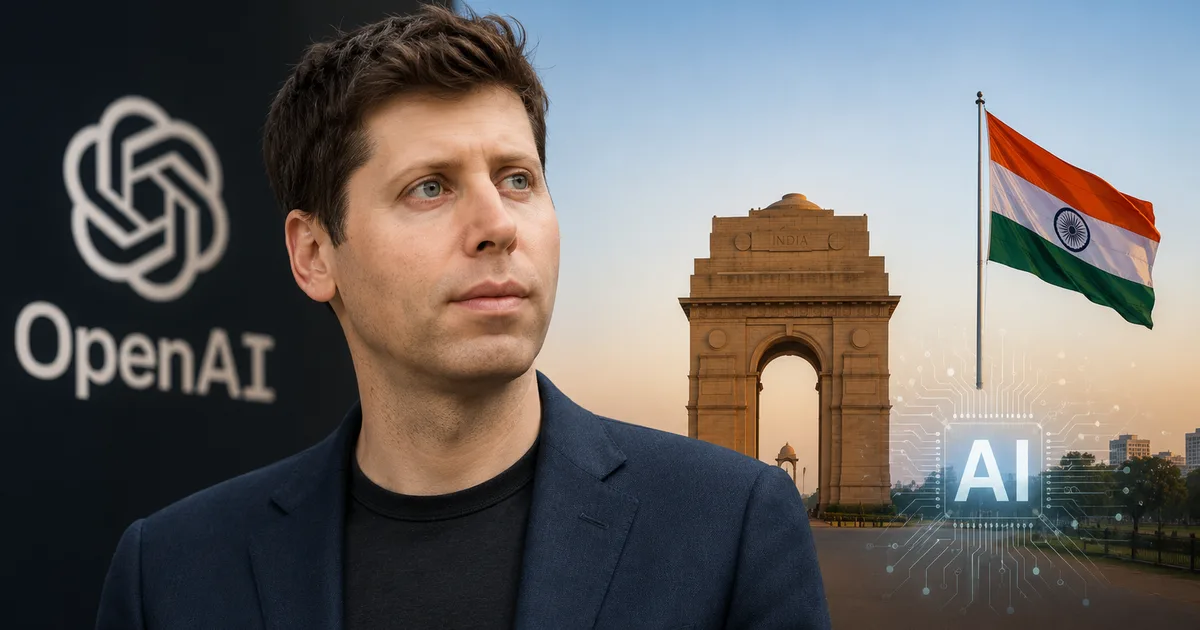
Sam Altman's India visit in 2026 wasn't a diplomatic formality. The OpenAI CEO flew into New Delhi for the India AI Impact Summit, met Prime Minister Modi, and came out calling India a "full-stack AI leader", a phrase that's been doing the rounds on every Indian tech publication since. Whether that's genuine conviction or polished PR, the announcements that came alongside the visit are worth paying attention to if you use ChatGPT, build on OpenAI's APIs, or just want to understand where AI in India is heading.
What actually happened at the India AI Impact Summit
The summit had a rough start. BBC reported that delegates complained of long queues and general confusion on opening day. Not exactly the seamless, tech-forward image anyone was hoping to project. But that's a logistics problem, not an AI one, and what was happening inside the rooms was a completely different story.
Global AI leaders came to New Delhi for the event. One moment that went viral was an apparently awkward interaction between Altman and Anthropic CEO Dario Amodei. The two run what are arguably the most consequential AI labs right now, and their history is messy. Amodei co-founded OpenAI before leaving to start Anthropic (which, if you ask me, makes every public encounter between them inherently interesting). The Times of India covered the moment at length. The internet did what it always does.
More substantively, Altman met PM Modi. His public comment afterward was "Love his vision on AI." That's a pretty clear signal that OpenAI sees India as a serious strategic market, not just a passive user base.
The 1 billion image milestone and what it actually tells you
Here's the number Altman has been citing. Indian users generated over 1 billion images using ChatGPT Images 2.0. One billion. The tool launched in early 2025, and the adoption in India has been faster than most people expected.
Altman's exact framing was "ChatGPT Images 2.0 loves India." That's a marketing line. But the underlying number is real and it says something meaningful about how Indian users adopt AI tools. Students are making images for school projects. Small business owners are making product visuals without hiring a designer. YouTube and Instagram creators who'd otherwise be paying for Canva Pro or putting ₹1,500 a week on a freelancer are using it instead. That's who's driving those billion creations.
It tracks with what I see when I talk to people running small businesses or studying at colleges outside the major cities. ChatGPT has become table stakes. The image generation feature landed particularly well (possibly because the free tier exists), and the quality has crossed a point where it's genuinely useful rather than just a novelty to screenshot once and forget.
OpenAI for India: what the announcement actually means
OpenAI made a formal announcement called "Introducing OpenAI for India" around the time of the summit. This is the first time the company has set up a dedicated country-level presence here. Planned offices in Mumbai and Bengaluru are on the cards. That makes obvious sense since that's where the enterprise clients and developer communities are.
What does this mean in practice? Honestly, the official details are still thin. From what's been reported:
- Local offices to serve Indian businesses and developers directly, instead of routing support through a US-based team across timezones
- Partnerships with Indian companies and likely integration with government initiatives under the IndiaAI Mission
- A commitment, at least in principle, to treating India as a priority market for product decisions rather than an afterthought
Basically, the office announcement matters more than it might seem. Right now, if you're an Indian startup trying to get enterprise support from OpenAI, you're dealing with a team in San Francisco. Local offices change that. They also mean OpenAI intends to hire and partner locally rather than just selling subscriptions from afar.
What "full-stack AI leader" means for you and your wallet
"India has all the ingredients to be a full-stack AI leader," Sam Altman said at the India AI Impact Summit in May 2026, pointing to the country's developer base, data scale, and government investment in AI infrastructure.
For everyday users, this should translate over time into better local support and improvements to ChatGPT's responses in Hindi, Tamil, Telugu, and other Indian languages. Right now, Hindi responses are decent. Tamil and Telugu work, but they're noticeably weaker than the English outputs. I'm not sure exactly how fast that improvement will come, but the direction seems right. If the India push leads to real investment in regional language quality, that matters a lot for the hundreds of millions of Indian internet users who aren't primarily comfortable in English. You can dig into India's broader AI infrastructure plans in our AI explainers section.
ChatGPT Plus costs ₹1,699 per month in India right now. That's steep for a student or a small business owner outside the major metros. I haven't seen any official announcement of a cheaper India-specific tier, and I'm not holding my breath for one. But it's the obvious pressure point. If OpenAI wants to compete against Google Gemini, which is free and built into every Android phone, and Microsoft Copilot, which ships with Office 365, pricing will eventually have to come up.
For small businesses especially, AI tools are already changing what a single person can do without extra staff. Writing product descriptions, generating social media images, handling customer queries, drafting vendor agreements. If you're running a small operation on Meesho or Amazon India, or even just a WhatsApp Business account, ChatGPT is worth learning on the free tier. Our AI tools guide covers what's actually free and what's worth paying for in the Indian context.
The real competition OpenAI faces in India
OpenAI's India push comes into a market that's no longer waiting for it. Google's Gemini is baked into Android, which is the platform most Indians use. Microsoft Copilot ships with Office 365. Anthropic's Claude is gaining ground among developers who find it more reliable for coding tasks. The first-mover advantage ChatGPT had in 2023 isn't the same story in 2026, and OpenAI's India team knows that.
There's also the data question, which nobody's talking about enough. India's Digital Personal Data Protection Act is now in effect, and any company processing Indian user data has real obligations under it. OpenAI's India offices will need to navigate this carefully (annoying, I know, but these things matter). Whether local data storage becomes part of their India strategy is worth watching. For ongoing coverage of what the DPDP Act means for the apps you use daily, our news section keeps that updated.
And there's a talent angle worth mentioning. Thousands of Indian AI researchers and engineers work at OpenAI, Google DeepMind, Anthropic, and Meta AI, mostly out of the US. A local office doesn't automatically reverse that, but it creates career paths that didn't exist before. For CS students at IITs and engineering colleges right now, an OpenAI India office potentially means roles that don't require a US work visa and a Bay Area relocation. If that's you, check our AI career guides for what skills are actually in demand right now.
One thing to stay realistic about
Altman's visit comes during a complicated period for OpenAI internally. The drama has been real. There was a near-removal from the CEO role. Texts involving former CTO Mira Murati resurfaced publicly. And then there's the ongoing structural shift from nonprofit to for-profit organisation. India Today covered the corporate turbulence at length. None of it directly changes what OpenAI does in India, but the company selling partnerships here is going through a real transformation. Long-term commitments from companies mid-transition deserve a bit of scrutiny.
Office announcements are easy. What's harder is everything that comes after. Sustained local hiring. Actual product localisation for Indian languages. Pricing that works for someone in Ranchi or Coimbatore and not just Bengaluru or Mumbai. Those are what will determine whether "OpenAI for India" becomes something real over the next two or three years, or stays a summit announcement.
India generating over a billion AI images and drawing OpenAI's CEO to New Delhi is a real marker of how fast things have moved. Whether the commercial decisions actually keep pace with that enthusiasm is the question worth watching now.