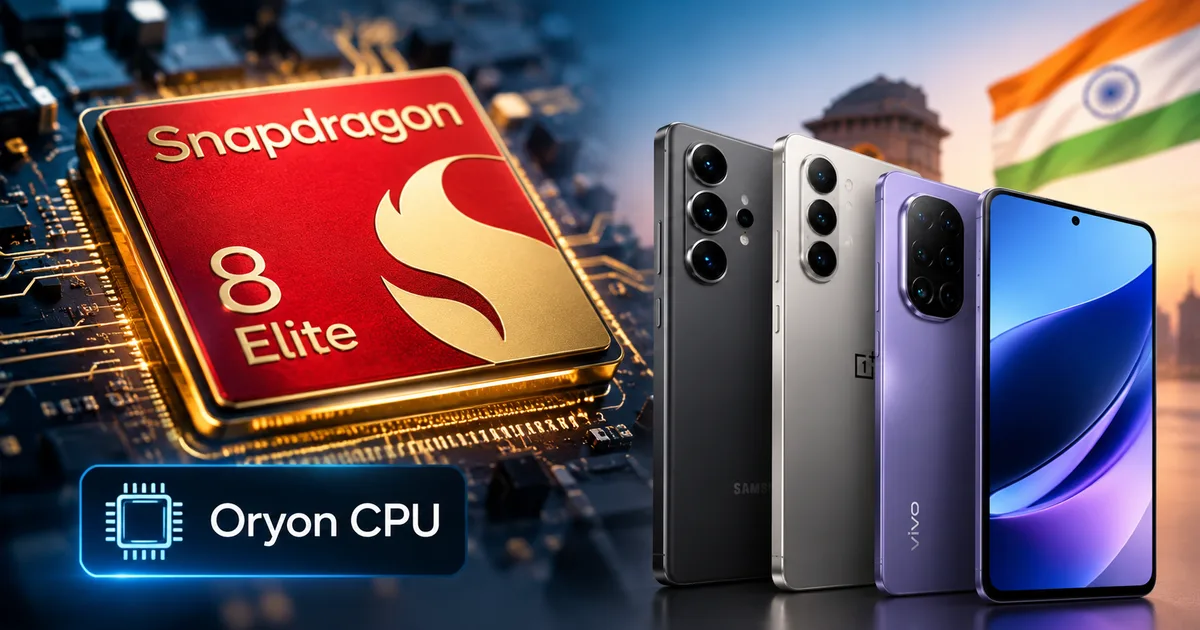
Qualcomm just announced the Snapdragon 8 Elite at the India Mobile Congress in New Delhi, and if you follow Android phones, this is the biggest architectural shift we've seen in years. For almost a decade, Qualcomm relied on standard Arm Cortex designs for its top-tier silicon. That arrangement is officially done. With this release, the company brings its custom Oryon CPU architecture into smartphones, built on a fresh 2nm process. It promises desktop-grade CPU speeds and massive on-device artificial intelligence capability that leave Apple and MediaTek scrambling to catch up. But high clock speeds on a spec sheet don't always translate to smooth daily performance when you're standing at a sunny bus stand in Ahmedabad with a phone warming up in your pocket. Here's a clear look at what the silicon delivers and which devices will reach Indian buyers first.
Every single year brings another processor with big promises of thirty percent higher speeds. Most of the time, you barely notice. Opening WhatsApp, scanning a UPI QR code at the local kirana store, checking your bank balance, or streaming a cricket match on JioCinema feels identical whether your handset is a year old or brand new. But this year is different. The jump to custom cores is a clean break from the past. And if you ask me, it directly changes how these phones will handle intense gaming and battery drain under the harsh Indian sun.
What the custom Oryon CPU change means for real performance
To see why this launch matters, you've got to look under the hood. Qualcomm spent billions buying Nuvia back in 2021 to design custom silicon instead of licensing standard Cortex cores from Arm. We first saw those Oryon cores inside Windows laptops. In my experience, they actually delivered on battery life and raw single-core muscle. Now, Qualcomm has shrunk that architecture down for phones using TSMC's 2nm fabrication node.
On paper, the prime core hits a wild 5.0GHz clock speed. Think about that for a second. Five gigahertz in a slim handheld with no fan whatsoever. Next to the prime cores, the cluster has dedicated performance cores clocked high, without a single traditional low-power efficiency core anywhere in the layout. Qualcomm says the custom architecture is efficient enough at idle that tiny efficiency cores just aren't needed anymore. It's a massive gamble.
"Moving to custom Oryon architecture gives us the headroom to achieve desktop-grade computing efficiency inside a pocket thermal envelope," Qualcomm representatives stated during their technical briefing at India Mobile Congress 2026.
Look, paper specs and daily reality rarely line up. Qualcomm showed demo units touching 5.0GHz on stage, sure. But early telemetry tests reported by Tech Times show the silicon settling closer to 4.6GHz under continuous stress (which makes sense, actually). That's still blisteringly fast. A sustained 4.6GHz cluster will crush any mobile workload you throw at it without breaking a sweat. Marketing teams simply love clean, round figures. A bold 5.0GHz banner looks a lot sexier on metro station hoardings across Delhi and Bengaluru than 4.6GHz.
The shift away from standard Arm designs
Why did Qualcomm spend so much cash and effort ditching standard Arm blueprints? Independence. Plain and simple. When every Android brand relies on the exact same Arm Cortex-X design, standing out is nearly impossible. Qualcomm and MediaTek always ended up building chips that landed within five to seven percent of each other every year. By designing the Oryon CPU in-house, Qualcomm now controls instruction pacing, cache sizes, clock curves, and power states directly. That lets them tune the silicon directly for their Adreno graphics and Hexagon neural engines. It runs tighter.
If you read our detailed smartphone explainers, you'll know that custom silicon is exactly how Apple kept its massive battery and speed advantage for years. Qualcomm is borrowing from that exact playbook now. For buyers in India, this level of control should mean fewer stutter bugs and healthier batteries over three or four years of Android updates. At least, that's the theory.
AI benchmarks and the 5.6 million AnTuTu score reality check
If you follow tech YouTube or Twitter, you've probably seen the wild headlines already: early test units cleared 5.6 million points on AnTuTu. That's a ridiculous score. It beats current Android flagships by nearly twenty percent, and it pulls ahead of Apple's latest Pro silicon in pure multi-threaded grunt. Geekbench 6 runs show similarly bonkers results, with single-core scores topping 3,400 points and multi-core tallies pushing past 10,500.
Those numbers look great on social feeds. But what does 5.6 million AnTuTu points actually get you day to day? Honestly, very little if your routine is just scrolling Instagram, tracking stocks on Zerodha, watching reels, or texting family on Telegram. Phones have been plenty fast for normal apps since 2022. Where these synthetic gains actually show up is in two distinct places: heavy 3D gaming with ray tracing switched on, and complex on-device AI tasks.
Agentic AI features on the new Hexagon NPU
The big buzzword during the keynote was "agentic AI." Instead of shipping your voice recordings or photo edits to cloud servers in Virginia or Frankfurt, the upgraded Hexagon NPU runs the models directly on your device. It processes multimodal data together. That means it can look through your camera viewfinder and hear your voice commands at the exact same moment without sending data off your device.
Think of where this actually helps in an Indian context:
- Translating regional spoken languages like Hindi or Tamil in real time on phone calls without needing an active 5G connection.
- Transcribing long college lectures or office catch-ups locally, pulling key action points straight into your notes app.
- Scrubbing sensitive info like Aadhaar cards and bank account details right on the device before any document image touches cloud storage.
- Handling real-time background segmentation inside camera apps so your portrait videos don't fall apart under harsh noon sun.
Because the heavy lifting happens locally, you don't blow through your daily 1.5GB cellular quota. Even better, your personal financial documents and private voice memos never touch some remote tech company's servers. Given how rampant digital fraud and scam calls are across India right now, keeping neural processing on the device is a genuine privacy upgrade. It isn't just marketing fluff.
Upcoming India phones getting the new chipset
You won't have to wait months to spot this silicon in Indian stores. Multiple brands used the India Mobile Congress stage to announce quick launch dates for their new flagships. If you follow our latest tech news updates, you know the fight for your wallet is already getting heated ahead of the festive shopping season.
Flagships arriving from Motorola and iQOO
Motorola dropped one of the biggest surprises of the event by confirming its premium phone ahead of typical rivals. You can read our full breakdown of the Motorola Signature 27 launch details, which has clean Android software running on top of this 2nm hardware. Moto has been super aggressive with its Indian pricing lately. Pairing this silicon with bloat-free software could make it a killer pick if you hate spam notifications.
Vivo's gaming sub-brand isn't sitting quietly either. The upcoming iQOO 16 5G launch takes aim at mobile gamers who want locked frame rates in titles like Battlegrounds Mobile India and Genshin Impact. iQOO usually pairs top-tier Qualcomm silicon with massive vapor chambers and aggressive tuning. If you want raw, unthrottled frames during long gaming marathons, that's the one to keep an eye on.
Beyond these two brands, expect launches from Xiaomi with its 18 series, OnePlus with its next flagship, Realme with a GT refresh, and Samsung with its Galaxy S lineup. Even tablets are joining the party early. Word is that high-end slates like the OnePlus Pad series have variants coming with this silicon to tackle heavy multitasking and split-screen work.
Thermal throttling, Indian summers, and battery life
Here's my biggest worry with this chip, and frankly, reviewers sitting in air-conditioned Western studios always overlook it. Hitting 5.0GHz inside a sealed glass sandwich takes serious electrical juice. Sure, TSMC's 2nm node improves energy efficiency per cycle. But running eight performance cores with zero low-power efficiency cores produces heat. Lots of it.
In Western Europe or North America, ambient indoor temps hover around 20 to 22 degrees Celsius. In North India during May or June, outside temperatures easily cross 42 degrees. If you take an uncooled phone outside in Delhi, crank the display to maximum brightness, and boot up BGMI at 120 frames per second on Jio or Airtel 5G, thermal throttling kicks in fast. (I've seen flagship phones cut screen brightness in half inside ten minutes under that brutal afternoon sun.)
Brands will have to pack in serious dual-layer vapor chambers and chunky graphite sheets. Without them, you won't see anything close to those 5.6 million AnTuTu scores in our weather. If a brand cuts corners on cooling just to keep a device thin, you'll buy a 5.0GHz monster that quickly downclocks to 2.8GHz to save your fingers. Don't rush into buying. Watch independent Indian thermal tests closely before putting your cash down.
Pricing in India and who should actually upgrade
Let's talk money. TSMC's cutting-edge 2nm wafers cost a fortune, and Qualcomm passes those production bills straight down the supply chain. Because of that, flagship phones in India keep getting pricier with every hardware cycle.
Expect baseline flagships packing this silicon to land around ₹55,000 to ₹65,000 in India. Premium models will easily cross ₹75,000, while top-shelf Pro and Ultra models from Samsung or Xiaomi will stretch past ₹90,000 all the way to ₹1,20,000 (the numbers here are a bit fuzzy, but that's where leaks point). Sure, bank cards and exchange bonuses on Amazon or Flipkart might shave off ₹5,000 or ₹7,000. Still, that's serious cash for any regular Indian buyer.
Should you actually upgrade? If you're carrying a phone with a flagship chip from 2024 or 2025, my honest advice is simple: skip it. Your current handset handles games and camera tasks with plenty of speed. You won't notice enough daily difference to justify dropping sixty thousand rupees. But if your daily driver is three or four years old, with a dying battery, sluggish charging, laggy software, and washed-out cameras, jumping to this new silicon in late 2026 makes total sense. Just do yourself a favor: wait for honest Indian heat tests before hitting the buy button.