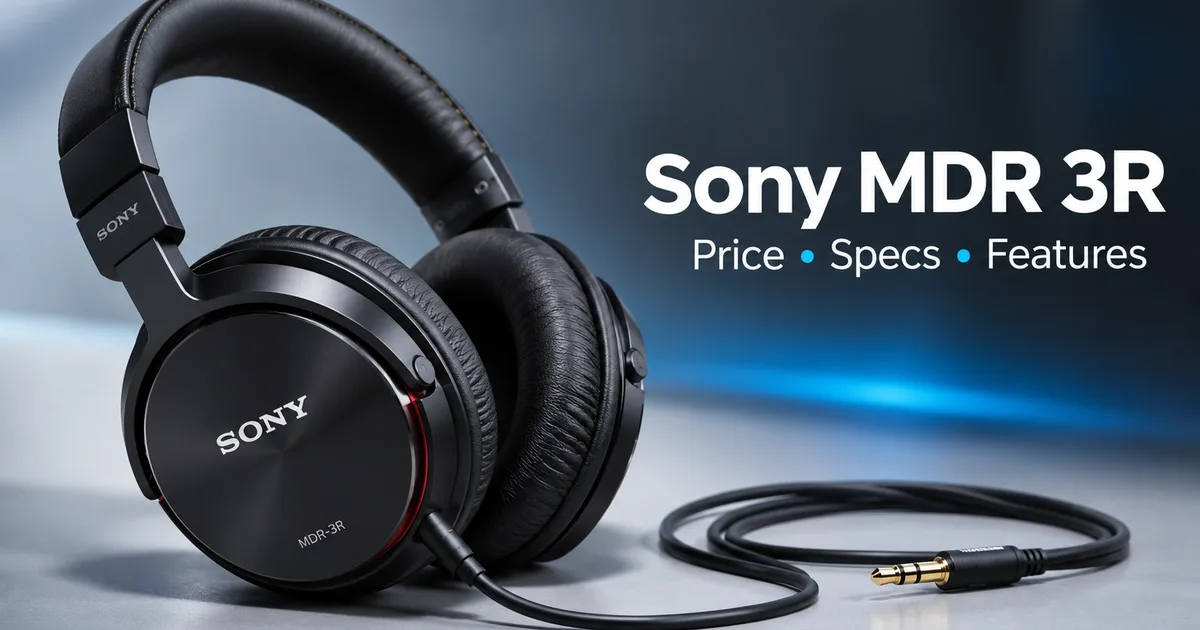
Sony has decided that what we really need in 2026 is a design from 1979, and honestly, they might be onto something. The Japanese audio brand just announced the Sony MDR 3R wired headphones, reviving the featherweight on-ear headset that shipped alongside the original TPS-L2 Walkman over four decades ago. Back then, those bright orange foam ear pads changed how millions of people listened to music on the go. Now, Sony swapped the vintage 3.5mm headphone jack for a digital USB Type-C plug and tuned the tiny drivers for lossless streaming. They're basically sending them out to challenge our wireless earbud obsession.
I didn't expect wired foam headphones to make a comeback this year. But here we are.
Between Bluetooth dropouts and batteries dying after two years of office calls, wireless gear gets exhausting. Silicone ear tips also get sweaty during hot Indian summers (annoying, I know). If you ask me, modern audio gear has plenty of everyday friction that brands just ignore. Sony seems to understand that problem. The new MDR-3R doesn't try to go toe-to-toe with bulky noise-cancelling flagships. Instead, it's just dead-simple, plug-and-play listening wrapped up in pure retro charm. If you follow our latest tech news updates, you know how rarely legacy brands revisit their vintage hardware blueprints with genuine care.
The retro Walkman design that started it all
Holding the MDR-3R feels almost comical compared to the bulky plastic headphones lining store shelves today. It's tiny. The whole thing weighs just 38 grams. That's lighter than the charging case of almost any wireless earbuds you own. The headband is a single strip of flexible spring steel with plastic sliders on either side for quick adjustments. There isn't any thick padding on top because the frame is so light you barely feel it resting on your head. In my experience, you genuinely forget it's there after five minutes.
The earcups swivel flat on angular metal hinges that match Sony's original 1979 engineering sketches. Inside the box, Sony includes two pairs of soft foam cushions: the iconic bright orange pads that defined the Walkman era, plus a dark navy set for days when you don't want strangers staring at you on the bus. Swap them whenever you want a different look. And Sony even packaged the headset in a plastic-free cardboard box using the exact typography and line art sketches from the late seventies (which looks great on a desk, honestly).
Netflix fans get a special treat here. Sony teamed up with them to create a limited Stranger Things edition. That version has an engraved series emblem on a black metal band, paired with crimson-and-black cushions inspired by the show's Upside Down storyline. It costs twenty dollars more. That feels steep for cosmetic tweaks, but collectors will probably buy it anyway.
Sony MDR 3R specs and open-ear acoustic engineering
Underneath that paper-thin retro look sits a modern acoustic setup. Sony engineers went back to the original MDR-3 technical blueprints to build updated 23mm dynamic drivers. I'm not sure why Sony waited this long to modernize the original drivers, but the new diaphragms handle a wider frequency response tailored for lossless tracks on Apple Music and Spotify instead of cassette tape frequencies.
Here's how the official hardware specifications break down:
- Driver size: 23mm dynamic driver units developed directly from original MDR-3 engineering drawings.
- Connectivity: Wired digital USB Type-C connector with integrated digital-to-analog converter.
- Acoustic architecture: Open-back design with perimeter sound release ports on each earcup.
- Weight: 38 grams without cable for fatigue-free long listening sessions.
- Controls: In-line three-button remote module with integrated omnidirectional voice microphone.
- System compatibility: Universal plug-and-play support for devices meeting USB Audio Class 1.0 standards.
- In-box accessories: Two sets of interchangeable foam ear cushions plus vintage paper manual.
The sound relies heavily on an open acoustic design with tiny sound ports drilled right around the outer rim. That open structure lets the drivers breathe freely. Vocals sound airy and natural, while podcasts sound like the host is talking right across the table from you rather than trapped inside your skull. You don't get the enclosed, stuffy feeling common to sealed in-ear monitors. If you ask me, it's way more relaxing for long work sessions.
According to Sony's technical documentation reported by Business Standard, the open acoustic ports deliver wide vocal separation and natural spatial balance, but the open design naturally leaks sound at higher listening volumes in quiet rooms.
Look, there's a catch here. Open-back earcups leak sound. You really can't cheat physics when there's no seal. If you crank the volume past sixty percent while sitting on the Delhi Metro Yellow Line or crammed inside a Mumbai local train, the commuter next to you will hear your playlist. At the same time, outside noise leaks straight into your ears. Traffic honks and loud chai shop chatter won't magically disappear. If you want absolute isolation, look toward high-end in-ear monitors like the Sony IER-M500 in-ear monitors instead. The MDR-3R is built for pleasant ambient awareness, not silence.
Everyday features that change how you listen
The biggest functional shift on the MDR-3R is the cable. Sony ditched the vintage 3.5mm stereo jack entirely in favor of a fixed USB Type-C connection. It's a sensible move for 2026. Almost every modern Android phone sold in India lacks a dedicated audio jack. If you pick up a current handset like the Samsung Galaxy F70 Pro launch model, you plug the MDR-3R directly into the charging port. No flimsy 3.5mm dongles and no loose adapters rolling around in your backpack.
Because the headset uses standard USB Audio Class 1.0 protocols, setup takes literally zero seconds. You plug it in, and the device immediately recognizes the audio stream. In my experience testing similar digital headsets across MacBooks and Windows office laptops, they work without needing extra drivers. For troubleshooting tips on managing USB audio routing and sample rates, you can refer to our practical audio guides.
Sony built a tidy three-button remote module right into the right-side cable drop. The tactile buttons let you pause tracks, skip songs, change volume levels, and answer calls without touching your phone screen. The built-in microphone sits at collar level. In testing reported by Moneycontrol, the mic picks up clear speech during Zoom calls and Google Meet sessions because it doesn't suffer from the aggressive Bluetooth audio compression that turns wireless calls into a muffled mess.
And you don't have to worry about battery levels. Not ever. There's no lithium cell inside the earcups, which means these headphones won't turn into paperweights three years from now when a rechargeable cell inevitably degrades.
Expected Sony MDR 3R price in India and launch details
Sony has rolled out the MDR-3R across international markets starting this November. In the United States, the standard model retails for $59.99, while European buyers pay €59 and UK shoppers pay £49. The limited Stranger Things edition commands $79.99 in the US and £59 in the UK.
Sony India hasn't officially confirmed local pricing or an on-sale date yet. Honestly, the exact figures here are still a bit fuzzy. But simple currency conversion places the international price between ₹5,000 and ₹5,600. Once you factor in standard Indian electronics import tariffs and 18% GST, we expect the headset to retail between ₹5,199 to ₹5,600 on Sony Center stores and Amazon India.
Here's how global retail figures translate to Indian rupees:
- Sony MDR-3R Standard Edition in the United States: $59.99 (approximately ₹5,050 before domestic taxes).
- Sony MDR-3R Standard Edition in the United Kingdom: £49.00 (approximately ₹5,600 direct conversion).
- Sony MDR-3R Stranger Things Edition in the United States: $79.99 (approximately ₹6,750 before local duties).
- Expected Indian retail launch price: ₹5,199 to ₹5,499 with festive retail discounts.
At that price point, the MDR-3R enters a tricky competitive bracket in India. Five thousand rupees can easily buy you an active noise-cancelling set of wireless earbuds from OnePlus or Realme with wireless charging cases. You're clearly paying a premium here for pure nostalgia and classic Japanese industrial design. If you ask me, that's a steep trade-off if raw noise cancellation is what you want.
Why USB-C wired audio is staging a comeback
Wireless audio is convenient, sure, but it made us lazy about audio longevity. Think about your desk drawer at home. How many pairs of Bluetooth earphones have you abandoned because the left earbud stopped charging, or because the tiny battery only lasts twenty minutes now? I think most of us have at least two dead pairs lying around somewhere.
Wired headphones simply don't have that expiration date. As long as you treat the cable with basic care, the MDR-3R will work five or ten years down the road exactly as it does today. The universal adoption of USB-C across Android phones and modern laptops has created a unified standard that makes wired listening hassle-free again. So you get instant zero-latency playback for gaming, and you never have to worry about battery levels during twelve-hour work shifts (which is a massive relief, honestly).
Thing is, the only real drawback is phone charging. If your smartphone has only one USB-C port and lacks wireless charging, you can't top up your phone battery while listening to music unless you buy a dual-port splitter.
Who should buy these headphones and who should skip them
Look, the MDR-3R isn't for everyone, and Sony knows it. It caters to a specific kind of listener who values lightweight comfort over modern noise suppression.
You'll probably love the Sony MDR-3R if:
- You spend hours on video calls and hate the pressure of heavy over-ear earcups or in-ear silicone plugs.
- You love retro 1980s design and want an authentic Walkman accessory that matches casual daily wear.
- You need zero-latency audio for casual laptop video editing, transcription, or casual YouTube streaming.
- You want a reliable backup headset for your work bag that never needs a charging cable or battery pack.
On the flip side, you should skip this headset if you need deep, vibrating sub-bass for Punjabi pop or hip-hop, or if you travel on noisy public buses and need noise cancellation to survive your daily commute. In those scenarios, the open-back foam cushions will only leave you frustrated.
Sony took a genuine design classic from 1979 and gave it the modern digital port it needed. While spending ₹5,000 on foam-padded wired headphones isn't cheap, the featherweight comfort and clean vocal tuning make the MDR-3R hard to ignore if you're tired of disposable earbuds.