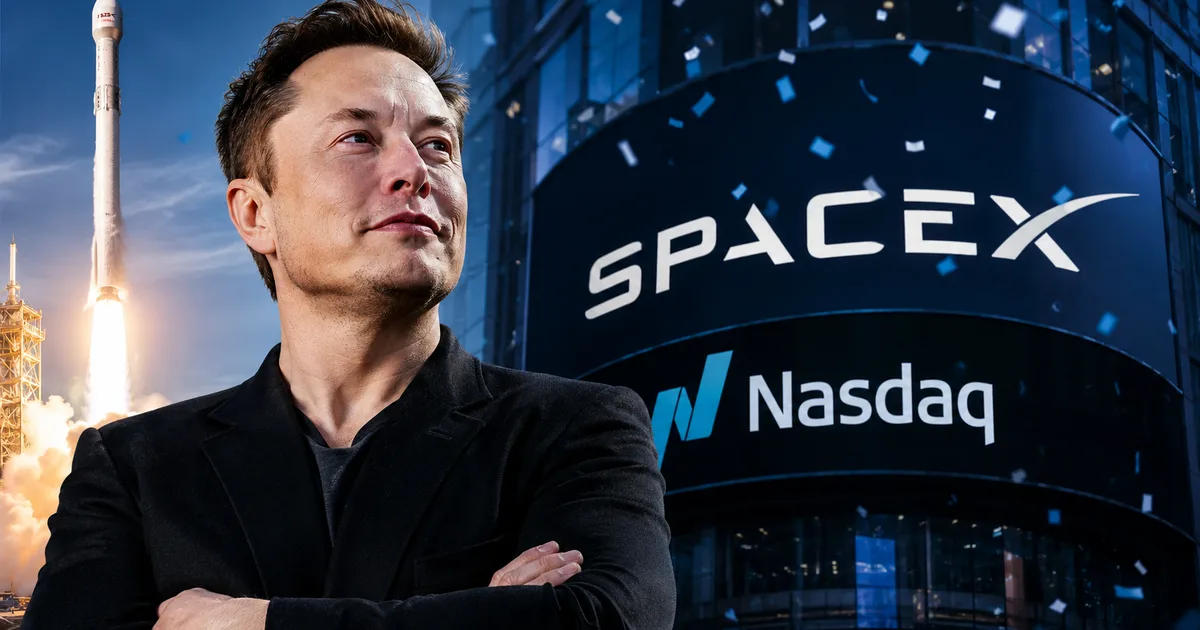
Yesterday, the stock market changed forever. Elon Musk officially became the world's first trillionaire, thanks to the massive SpaceX Nasdaq IPO that finally hit the public markets. Honestly, I didn't think we'd see a trillionaire this decade. But here we are. The tech giant's space venture launched its shares under the ticker SPCX. It got over $75 billion. In fact, it's now the biggest public listing in history. For everyday Indian retail investors watching Nasdaq from their phones, this is a massive deal.
How the SpaceX Nasdaq IPO made history
Look, SpaceX listed on the exchange and blew the doors off. The company got a staggering $75 billion. Let that sink in. If you ask me, that's more than the annual budget of many small countries.
So, the stock debuted on Nasdaq under the ticker SPCX. Opening trading was wild. Shares crossed the $175 mark in early hours before they settled down. By the time the closing bell rang, SPCX closed at $161. That's a 19% jump from its debut price. But honestly, the retail demand was unlike anything US markets have seen since the early tech boom.
And lots of other people got rich too. The New York Times reported that this IPO could turn around 4,400 SpaceX employees into paper millionaires. I think that's the best part of the story. Employees who took stock options early on are suddenly looking at life-altering bank accounts.
But listing a rocket company is sketchy. SpaceX relies heavily on government contracts from NASA and the US military. If one Starship launch fails spectacularly on live television, the stock will crash. That's just how the space business is. It's high risk, high reward.
Breaking down Musk's trillion-dollar fortune
So, how does a person even reach a net worth of $1.1 trillion? It's almost impossible to comprehend. Let's look at the actual math. In rupees, that's around 92 lakh crore. Honestly, it's a completely ridiculous sum of money.
Musk holds a massive chunk of SpaceX. Before the IPO, his stake was around 42%. With SpaceX's valuation surging past $300 billion on its market debut, his wealth jumped instantly. When you add his holdings in Tesla, brain-chip startup Neuralink, the Boring Company, and his social media platform, the total goes past the trillion-dollar mark.
To put this in perspective, Al Jazeera noted that Musk now has more wealth than Taiwan's entire GDP. He's richer than major economies. In my experience, having this much wealth concentrated in one individual is a mess. One person with more economic power than entire nations feels unequal. But it's the direct result of companies that do things nobody else can.
The Bloomberg Billionaires Index has been tracking this daily. The gap between Musk and the second richest person in the world has widened to a chasm. It's no longer a close race.
How this wealth compares to Indian companies
To understand how big 92 lakh crore rupees is, we should compare it to the valuation of India's biggest companies. Reliance Industries, TCS, HDFC Bank, and Infosys are the giants of our stock market. But if you combine the market capitalization of all four, they still don't come close to Musk's net worth. It's a mind-boggling realization. A single individual has more wealth than the combined value of the companies that power India's economy.
Thing is, Musk's wealth is tied up in stock, rather than stored in a bank account. Musk can't just withdraw a trillion dollars to buy a country. If he started selling his shares, the stock prices of Tesla and SpaceX would crash. So, it's paper wealth. But he can borrow against that stock to fund new projects. That's how he bought Twitter. And that's how he'll likely fund his Mars colony. I'm not sure exactly why it works this way, but it's a system that works well for him, even if it draws criticism from tax advocates.
How you can buy SpaceX shares in India
If you're sitting in Mumbai or Bengaluru, you're probably wondering if you can get a piece of this. The answer's yes. But buying these shares is more complicated than using your Zerodha app.
First, you need to use the Liberalised Remittance Scheme. The RBI allows Indian residents to send up to $250,000 abroad every financial year to invest in foreign stocks. That's around 2 crore rupees (which is more than enough for most of us, honestly). You'll need to get a broker that offers US stock trading. Platforms like Groww, Vested, Indmoney, and Interactive Brokers allow this.
Here's how the process works:
- Create an account with an Indian broker that has a partnership with a US custodian.
- Complete your KYC process using your PAN card and Aadhaar card.
- Fund your account by transferring rupees to the broker's partner bank. They will convert it to US dollars.
- Search for the ticker SPCX on the platform and place your buy order.
But wait. There's a catch. Taxes in India on foreign investments are steep. The Indian government charges a Tax Collected at Source of 20% on foreign remittances over 7 lakh rupees in a financial year. You'll get this back when you file your tax returns, but it locks up your capital. Also, you'll face double taxation issues if you don't file your foreign asset disclosures properly. So, you must speak with a chartered accountant before investing.
And I should also mention the exchange rate. When the rupee weakens against the dollar, your US investments become worth more in rupee terms. But if the rupee strengthens, your returns shrink. It's just an extra layer of risk.
If you want to read more about how global finance works, you can check out our other news updates. Before sending money abroad, you should read our comprehensive guides on foreign investing.
What this means for the broader tech market
This IPO is a big deal for both tech and space. For years, SpaceX was funded by private venture capitalists. By going public, they've opened their books. Now we can see exactly how much money they make, and how much they spend.
And this could trigger a wave of other listings. Other space startups might try to follow. But honestly, most of them are nowhere near SpaceX's scale. SpaceX has a virtual monopoly on commercial satellite launches. Their Starlink internet service is already making money in several markets. Other companies simply don't have that kind of recurring revenue.
Look, space is expensive. Developing reusable rockets took decades and billions of dollars. Most startups don't have that kind of time or money. So, while this IPO is historic, it doesn't mean every space company is a safe bet. You should be extremely careful before buying smaller space tech stocks.
If you're concerned about online investment frauds, read our reports on financial scams.
I think we'll see a lot of volatility in SPCX over the next few months. Speculators will drive the price up, and any minor delay in a launch will pull it down. If you want to invest, be prepared for a bumpy ride.
Basically, this is a long-term play. If you believe humanity is going to Mars, then SpaceX is the company to back. If you want quick listing gains, you might get burned. That's my honest opinion.
The Starlink factor in India
We can't talk about SpaceX without talking about Starlink. That satellite internet service is the real cash cow, honestly. In India, Starlink has been in a regulatory limbo for years. The Department of Telecommunications and TRAI are debating satellite spectrum allocation. While Musk wants administrative allocation (which is how the rest of the world does it), Indian telecom giants have pushed for auctions. So far, no final license has been granted for commercial operations in India.
But if Starlink gets the green light, it could change rural connectivity. Millions of homes in remote parts of Uttarakhand, Himachal, Sikkim, or the Northeast have terrible broadband. Starlink could fix that overnight. The question is pricing. In the US, it costs around $120 a month. In India, they'll have to price it much lower to compete with Jio and Airtel fiber. If they can offer a plan for under 2,000 rupees a month, it'll fly off the shelves. I suspect they'll use a subsidized model for the Indian market.
The Indian Space Association outlined the growth potential in their latest sector report:
The satellite communication market in India is expected to reach $7.9 billion by 2026, driven largely by demand in rural and maritime sectors. Spectrum pricing will be the deciding factor for foreign players who enter the market.
So, the potential's massive. If you're buying SPCX, you're also betting on Starlink's global expansion. And India is one of the biggest untapped markets left.