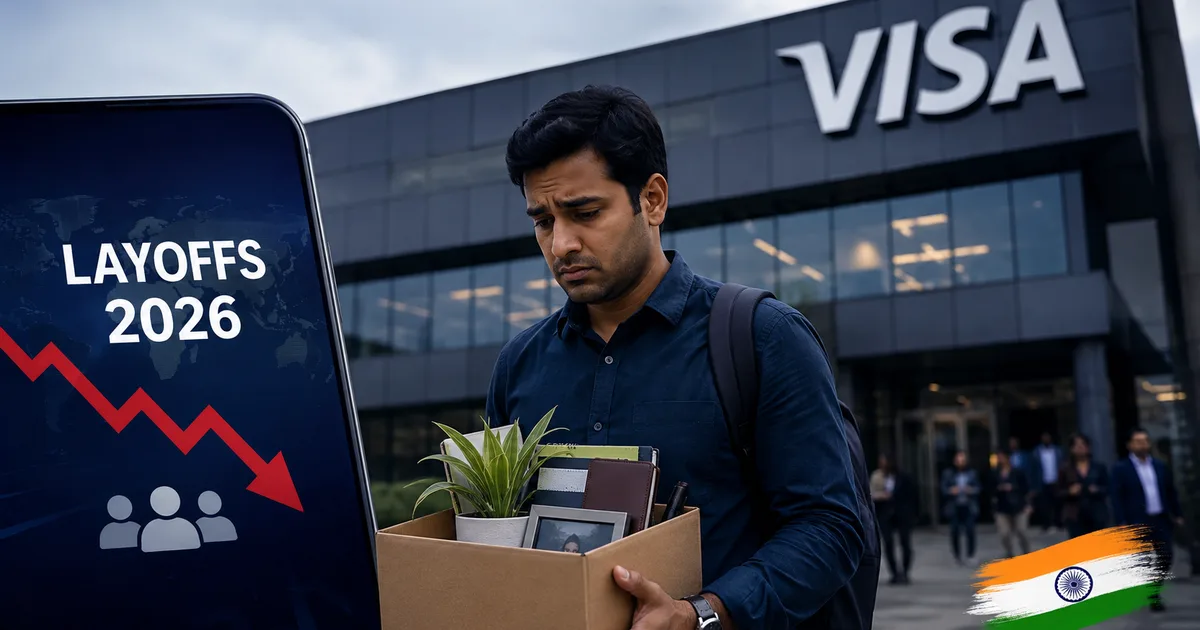
If you work in tech in Bengaluru or rely on an H-1B visa in the US, the news about the Visa layoffs 2026 probably hit your WhatsApp groups like a ton of bricks. Honestly, it feels like we just can't catch a break this year. Every other week, another giant corporation decides to trim the fat. This time, it's Visa. The payments giant is cutting around 2,600 jobs.
That's about 7 percent of their entire workforce. And the kicker? These aren't just any jobs. They're hitting the technology and product teams hard.
I've been reading through the memos and reports. CEO Ryan McInerney basically sent out a message about an efficiency push. Let's be brutally honest about what that means. They're replacing engineers with Artificial Intelligence. Yes, the very AI we built is taking our jobs. I think it hits too close to home.
What exactly is happening with the Visa restructuring?
Look, we all know Visa makes an absurd amount of money. Every time you swipe your card or scan a QR code for a UPI payment linked to a Visa card, they take a tiny cut. Billions of tiny cuts add up. So why lay off 2,600 people on the exact day they announce their third-quarter earnings?
It's all about the bottom line.
The company is shifting its investment heavily toward AI. They're automating payment network engineering. The people who used to manually monitor and fix the systems that process our transactions are out. Automated systems are in. It makes financial sense for them, but honestly, it's devastating for the engineers who built that network. You might want to check out our guide on AI in banking to understand the exact mechanics.
The H-1B nightmare for Indian techies in the US
Here's where it gets really ugly for Indian professionals.
A massive chunk of the tech workforce in the US has an H-1B visa. I know friends who've lived there for ten years, bought houses, and had kids. They're still waiting on that green card backlog that stretches for decades. When an H-1B worker loses their job, a countdown timer starts. You have exactly 60 days to find a new employer. They have to sponsor your visa. If you don't find one, you have to pack up your entire life and leave the country.
Sixty days. And that's in a market where every major tech company is freezing hiring or doing layoffs.
It's a terrifying situation (and frankly, a total mess). An Indian AI engineer got laid off when his project moved entirely to India. His H-1B status was no help at all. He had to move back. You'd think working in AI would make you safe right now. Apparently not. The irony of an AI engineer getting fired so the company can save money using AI is just too much. Read our survival guide for laid-off techies for practical advice on handling this.
Bengaluru office impact and performance reviews
You might be thinking you're safe because you work out of the Bengaluru office. After all, Indian talent is cheaper than US talent. The companies usually offshore work to us when they cut jobs in America. But the Visa layoffs 2026 are different. The cuts are happening globally.
There was a trending post from a former employee. They said their Bengaluru-based manager lost their job despite having an outstanding performance review.
Let that sink in. You can do everything right. You can work 12-hour days and meet every deadline. You can get top ratings from your superiors. And you still get a calendar invite for a quick chat with HR on a random Tuesday morning. In my experience, that random Tuesday chat is never good news.
"Outstanding performance didn't save my manager. We were all shocked. The entire team feels completely demoralised now."
That quote tells you everything you need to know about corporate loyalty. It doesn't exist. Your company isn't your family. They'll cut you the second a spreadsheet says it'll boost their stock price.
The financial reality of the severance packages
When an Indian techie gets laid off in the US, the severance package is often their only lifeline. Visa stated they'll provide support. What does that actually mean? Usually, it means two to four months of base pay. No bonuses. No unvested stock options. If you wanted those restricted stock units vesting in November, you can forget about them.
The taxation on that severance is brutal. When you convert those remaining dollars to INR, it might seem like a lot of money to your relatives back home. But factor in the cost of breaking a lease in San Francisco or Seattle. Factor in selling your car at a loss. Add in last-minute flight tickets for a family of four to fly back to Mumbai or Hyderabad. That severance money vanishes fast. I'm not sure exactly why people assume US salaries mean endless savings, because the expenses are just as huge.
For the folks in the Bengaluru office, Indian labor laws provide some basic protections. Companies usually have to give a two-month notice period or basic pay instead of notice. Two months of salary doesn't go far when every other tech firm in Bellandur and Whitefield has a hiring freeze. The competition for open roles is fierce right now.
Why AI is targeting product teams specifically
It's easy to understand why manual testing or basic coding jobs are disappearing. Thing is, the Visa layoffs 2026 are also heavily targeting product teams. Product managers used to be the untouchable bridge between business and engineering.
The truth is, AI tools are getting very good at data analysis. A good product manager spends a lot of time analyzing user data and A/B test results to decide what feature to build next. Now, an AI can process a million user interactions in seconds. It can identify the drop-off points in a payment flow. Then it instantly generates a specification document for the engineering team to fix it.
The role of the product manager is shrinking (which makes sense, actually, given the automation). You don't need a team of five PMs to manage a payment gateway anymore. You need one senior PM. They review the AI recommendations and approve the strategy. The middle management layer is getting completely hollowed out. This is a massive shift for Indian professionals who viewed product management as the ultimate career upgrade from software engineering.
How AI actually replaces software engineers
Consider the tech side of this for a minute. How does an AI system actually replace a network engineer at a company like Visa?
It's not like they have a robot sitting at a desk typing on a keyboard.
The payments network is a massive web of servers and databases. In the past, you needed hundreds of engineers to monitor server loads and reroute traffic during outages. You needed them to patch security vulnerabilities. Now, they feed all that operational data into large language models. These tools predict traffic spikes before they happen. They automatically write scripts to balance server loads. They identify sketchy transactions faster than any human.
Instead of a team of ten engineers managing a specific network segment, they need one engineer to supervise the AI. The other nine are part of the 2,600 people looking for work today. If you ask me, that ratio is only going to get worse. Keep an eye on our latest tech news updates to track how fast this automation is spreading.
The impact on freshers and campus placements
We can't talk about global tech layoffs without talking about the kids just graduating from engineering colleges. When a giant like Visa cuts 2,600 experienced professionals, those people flood the job market. They're willing to take pay cuts. They're willing to take lower-level titles just to get an income.
Who suffers the most?
The freshers. Why would a startup hire a 21-year-old straight out of college and spend six months training them, when they can hire a former Visa engineer for almost the same salary? The trickle-down effect on campus placements in India is going to be brutal this year.
I've spoken to placement officers at engineering colleges. They're terrified. The mass recruiters aren't showing up. The product companies are offering a fraction of the roles they did a few years ago. If you're graduating this year, you can't just rely on your college to get you a job. You have to build projects. You have to contribute to open source. You have to prove you can do the work from day one.
What this means for the Indian IT sector
Visa isn't alone in this. We've seen similar moves from Meta, Amazon, and Oracle. Big tech is shrinking its human workforce and redirecting those salaries into computing power for AI.
For the Indian IT sector, this is a massive wake-up call. For decades, our entire model has been based on providing large numbers of software engineers at lower costs. If an AI can do the job of ten junior developers for a fraction of the cost, that entire business model collapses. The numbers here are a bit fuzzy, but the trend is obvious. Service companies are already slowing down their fresher hiring. They know what's coming.
How to protect your tech career right now
I don't want to just give you bad news and leave you panicking. There are things you can do right now to protect yourself. It requires a shift in how you view your career.
- Build a massive emergency fund. I'm talking at least six months of living expenses in an easy-to-access fixed deposit or liquid mutual fund. If your EMI is ₹40,000 and your household expenses are ₹60,000, you need at least ₹6,00,000 saved up. Don't touch this money for anything else.
- Stop focusing purely on writing code. AI can write code. You need to focus on solving business problems. Learn how to talk to clients. Learn how to design system architectures. Move up the value chain.
- Network constantly. When you're looking for a job in a tough market, your resume will just get lost in a pile of thousands. You need someone inside the company to refer you directly to the hiring manager.
- Diversify your skills. If you're a backend developer, learn a bit of frontend. Understand cloud deployment. The engineers who survive these cuts are the generalists who can adapt to whatever the company needs on any given day.
The psychological toll of tech layoffs
We don't talk about this enough in India. The shame associated with losing a job is immense.
We tie so much of our self-worth to our job titles and our salaries. When that's taken away suddenly, it can absolutely break a person. I've spoken to people who hid their layoff from their parents for months. They'd wake up, put on their formal clothes, and take their laptop bag. Then they'd sit in a coffee shop all day just to keep up appearances. It's heartbreaking.
If you've been affected by the Visa layoffs 2026, please remember that this isn't a reflection of your worth or your skills. It's a macroeconomic shift. You were just a number on a spreadsheet that needed balancing. Talk to your family. Tell your friends. You'll be surprised by how much support you receive. So many people are going through the exact same thing right now.
Looking ahead for payment technology
Visa is still going to process billions of transactions. The technology won't stop working. It might even get more efficient. But we're losing the human element in how these systems are built and maintained.
Over the next few years, we're going to see a split in the tech industry. There will be the companies that build the AI, and the companies that use the AI to replace their workers. Right now, Visa is firmly in the second category. They're betting that their new automated systems can handle the sheer volume of global payments without the 2,600 people they just let go.
Will it work? Probably. From a purely technical standpoint, AI is getting incredibly good at managing infrastructure. But the human cost is massive. Think about the families forced to relocate. Think about the careers derailed. Then there's the constant anxiety hanging over the people who survived the cuts. That's the real legacy of this restructuring. Keep your skills sharp. Save your rupees. Don't ever assume that your job is safe just because you got a good performance review last quarter. The rules of the game have completely changed.