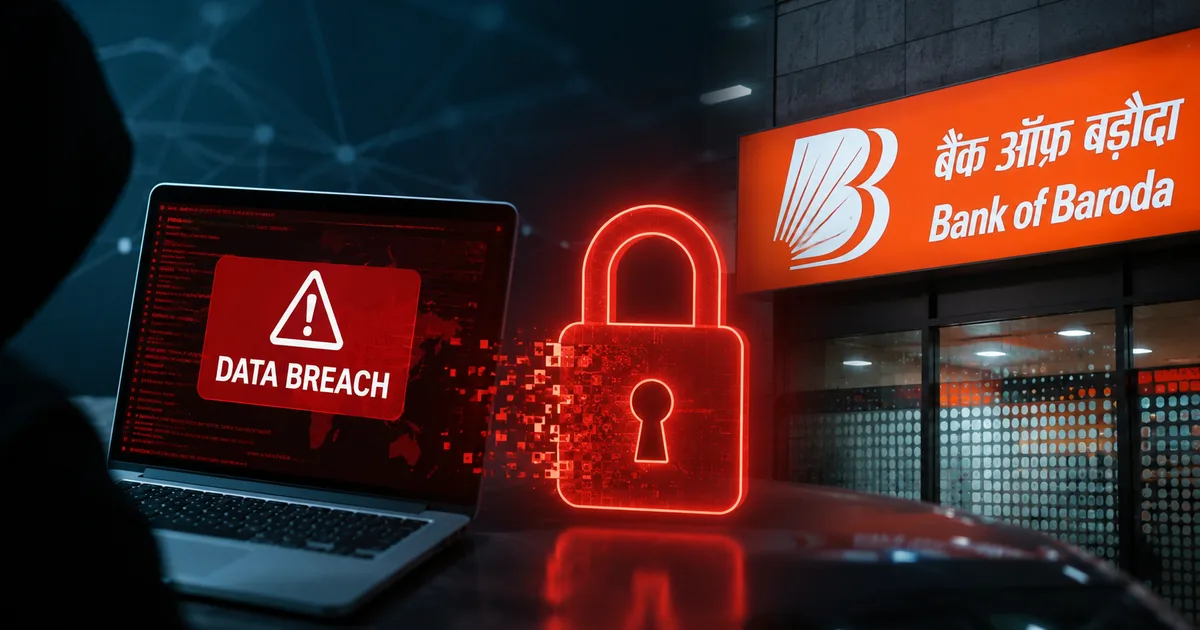
Imagine waking up to find your Aadhaar number and PAN card details pasted on a public notice board for anyone to copy. That's basically what a data breach looks like today. And right now, millions of Indians are dealing with exactly this nightmare following the Bank of Baroda 2026 security incident. The state-owned bank confirmed a cyberattack that allegedly leaked a massive 1TB of highly sensitive customer information onto the dark web. I've been tracking this situation since the news broke. Honestly, it's one of the more concerning incidents we've seen in Indian banking recently.
We need to break down exactly what happened here without all the confusing tech jargon. Understanding how your data gets stolen is the first step to making sure nobody can actually use it against you. And I think that's the only way to feel safe.
Understanding what a data breach actually means
A data breach happens when someone who shouldn't have access to your private information manages to break into a secure system and steal it. Think of it like a burglar breaking into a bank vault. They just take everything. But instead of stealing physical cash, they steal digital files containing everything a bank knows about you. Your name. Your phone number. Your home address. Your Aadhaar number. Your loan details. All of it gets copied. (Which is terrifying, honestly.)
The biggest issue is that once digital data is stolen, it can be copied infinitely.
It doesn't just disappear from the bank's computers. It gets copied and sold on hidden parts of the internet called the dark web. From there, scammers buy this information to target you with incredibly convincing frauds. They buy lists of thousands of names and just start calling people down the list. So they might call you tomorrow.
You might be wondering how these hackers actually get in. It's rarely like what you see in Hollywood movies with people typing furiously at green screens. Most of the time, it's shockingly simple. A bank employee clicks a bad link in a fake email. Or someone uses a weak password. In the Bank of Baroda case, early reports from The Times of India indicate that a compromised email led to the data leak. Just one compromised email account can sometimes give attackers the keys to the entire castle. It's incredibly frustrating when you think about it. Basically, human error is always the weak link.
Once inside, hackers often use automated software to scrape as much data as possible before they are detected. They package this data up and either demand a ransom from the company to delete it, or they just go straight to selling it to other criminals. Cybersecurity researcher Srikanth Lakshmanan stated that the alleged leaked Bank of Baroda data appeared to be the work of TripleX. TripleX is a known cybercrime and data extortion group.
The Bank of Baroda 2026 security incident explained
Hackers claimed to have accessed and shared around 1TB of customer and internal banking details. To put that in perspective, 1TB of text data is roughly equivalent to millions of thick phone books full of personal information. It's an absolute mountain of data. And the sheer scale of this leak is what makes it so dangerous for everyday consumers. I've never seen anything quite this big.
The bank has officially confirmed the cyber incident. They initiated a forensic investigation to figure out exactly what was stolen and how the attackers got in. They also appointed a CERT-In empanelled agency to investigate. CERT-In is the Indian Computer Emergency Response Team. Basically, they are the government's top cybersecurity agency. But the bank also stated that the cyber incident is unlikely to materially impact their daily operations. That might be true for the bank's internal systems. But it doesn't offer much comfort to a customer whose PAN card is now floating around online. It's just a mess.
The bank's operations might be running fine, but the real victims here are the everyday customers whose identities are now at risk of being misused for targeted financial fraud.
The leaked data allegedly includes Aadhaar numbers, account details, names, and phone numbers. This is the exact combination of information scammers need to pull off devastating financial crimes. If a scammer knows your name and your bank account number along with your Aadhaar details, they can call you up pretending to be a bank official. They will sound incredibly convincing because they already know your personal details. They might tell you your account is blocked due to the data breach and ask for an OTP to secure it. If you give them that OTP, your money is gone in seconds.
This is why you have to be extremely paranoid right now if you bank with them. Check out our latest scam alerts to see exactly how these criminals operate in the real world. You really can't be too careful.
Why scammers want this specific data
You might wonder why a hacker even cares about your Aadhaar number or your PAN. It's not like they can just walk into a bank branch with your Aadhaar number and withdraw physical cash. The true value of this data is in digital impersonation.
When a scammer buys your profile from the dark web, they are buying a complete digital identity. With your Aadhaar number, they can sometimes bypass security checks for telecom providers to issue a duplicate SIM card. Once they have your phone number, they control your OTPs. Once they control your OTPs, they control your bank accounts, your email, your digital life, and your privacy. This is why the 1TB leak from Bank of Baroda is so concerning. It's a huge list of names. And it's allegedly the complete package of identity verification documents too.
This is also why we constantly see secondary scams pop up after a major breach. Scammers know you are panicked. They will send you fake SMS messages claiming to be from the bank, offering a link to check if your account was compromised. If you click that link, they steal your login credentials directly. We cover these specific tactics in our latest cybersecurity news updates. You have to stay informed to stay safe. I'm not sure exactly why people still click these links, but they do.
How this affects your digital life in India
We rely on our phones for everything now. We use UPI for buying groceries. We keep our documents in DigiLocker. Our Aadhaar is linked to our bank accounts and our phone numbers, plus our tax returns. This interconnected system makes life incredibly convenient. I can pay a street vendor in two seconds with my phone. But it also means that when a central pillar like a major bank gets breached, the ripple effects are massive.
Thing is, we're all exposed.
If someone has your Aadhaar and PAN, they might try to take out loans in your name. They might try to intercept your OTPs through SIM swap frauds. The cost of data breaches in India is hitting record highs. Recent reports indicate average costs reach INR 22 crore per incident. But that's the cost to the companies. The cost to you, the consumer, is the endless anxiety of monitoring your bank statements. You also have to fend off scam calls from strangers who know way too much about you.
I strongly recommend reading our comprehensive security guides to learn how to lock down your digital footprint. You can't rely entirely on corporations to keep your data safe. You have to take matters into your own hands immediately.
Step by step guide to protect yourself
If you have an account with Bank of Baroda, or honestly any major Indian bank right now, you need to take immediate defensive actions. Don't wait for the bank to send you a letter. Act right now. Like, today.
- Monitor your bank statements daily for the next few months. Look for any transaction you don't recognize, even if it's just for two or three rupees. Scammers often do tiny test transactions before draining an account completely.
- Change your net banking passwords immediately. Make it a long phrase that's hard to guess but easy for you to remember. Don't use your pet's name or your birth date.
- Never share an OTP with anyone over the phone. Real bank employees will never ask for your OTP. If someone calls claiming to be from the bank and asks for a code, hang up immediately.
- Lock your Aadhaar biometrics using the mAadhaar app or the UIDAI website. This prevents anyone from using your fingerprint or iris scan to authenticate transactions without your permission.
- Keep an eye on your CIBIL score. You can check it for free once a year. If you see loan inquiries you didn't make, someone might be using your leaked PAN card to apply for credit in your name.
If you do notice sketchy activity or realize you have been scammed, you must report it immediately. Call the national cybercrime helpline at 1930. You can also file a complaint online at cybercrime.gov.in. Speed is your best weapon here. If you report a fraudulent UPI transfer within an hour, your bank has a much better chance of freezing the scammers account and getting your money back safely. In my experience, waiting even a day is too long.
The technical reality behind banking security
You might be asking why a massive institution with thousands of crores in profit can't keep a few hard drives secure. It's a fair question. The reality is that defending a massive computer network is incredibly difficult. A bank has to defend against thousands of attacks every single day. They have to be perfect 100 percent of the time. A hacker only has to get lucky once. (Which makes sense, actually.)
Banks also have thousands of employees. Many of them have access to sensitive systems. It only takes one tired employee clicking the wrong link in a phishing email to compromise the whole network. And many legacy Indian banks are running on outdated software that's hard to secure against modern threats. Upgrading these massive systems takes years and millions of rupees.
We are seeing this across the globe. It happens everywhere. Analog Devices recently disclosed a breach. Origin Energy had an incident affecting 900,000 accounts. It's a systemic issue. We need stronger data protection laws in India that actually penalize companies heavily when they fail to protect our data. Until then, these breaches will just be written off as the cost of doing business for these large corporations. The numbers here are a bit fuzzy, but the fines are definitely too low right now.
I highly recommend using strong password managers to secure your remaining accounts. You can find our reviews of the best options in our security tools section. Don't reuse your banking password anywhere else. Because if a completely different website gets hacked, criminals will try that same password on your bank account.
What to expect next
The forensic investigation will likely take weeks. The bank will eventually release a statement detailing exactly what was stolen. Until then, you have to assume the worst. Assume your data is out there and act accordingly. Be skeptical of any SMS, email, or phone call about your bank account. Take control of your own security.
I'll keep updating this space as we learn more about the specific mechanisms of this breach. In the meantime, lock down your accounts. You should also warn your family members, especially older relatives who might not be as tech-savvy. They are prime targets for the scammers who buy this stolen data. We cover these topics extensively in our tech explainers section if you want to understand more about how these digital systems actually operate in India.