If you've shopped online in India, you've probably used Amazon or Flipkart. Maybe Meesho for cheaper finds, or Blinkit for groceries. But there's a quieter shift happening underneath all of these platforms, one that could change how online shopping works in India more fundamentally than any single app ever could. It's called ONDC, short for Open Network for Digital Commerce, and by 2026 it has moved well past the pilot phase.
Think of ONDC the way you think about UPI. Before UPI, sending money between apps from different banks wasn't straightforward. UPI broke that wall. ONDC is trying to do the same thing for buying and selling online.
What exactly is ONDC?
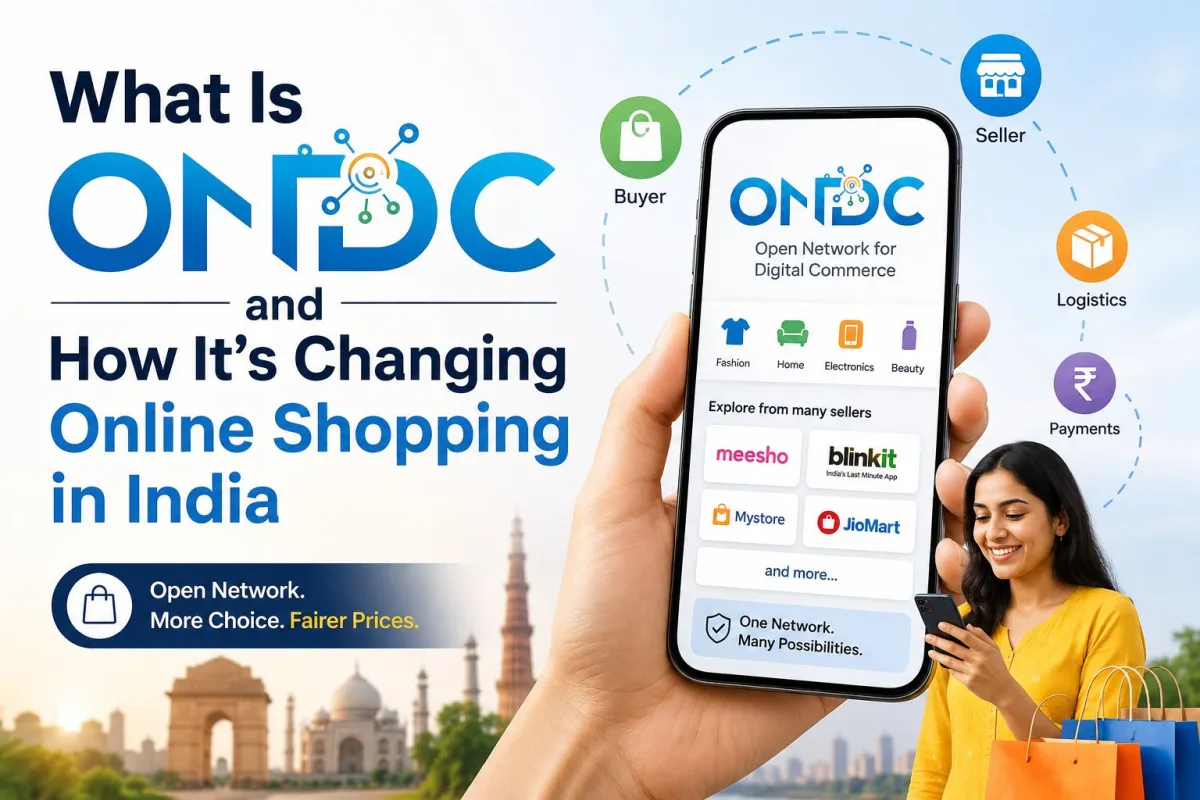
ONDC is a government-backed open network, not an app or a marketplace. It was launched by the Department for Promotion of Industry and Internal Trade (DPIIT) under the Ministry of Commerce in 2022. The idea is straightforward: instead of sellers having to be on Amazon to reach Amazon's customers, or on Zomato to reach Zomato's customers, any seller can list on any ONDC-compatible app and be discovered by buyers using any other ONDC-compatible app.
That is a genuinely big deal. Right now, if a kirana store in Nagpur wants to sell online, they have to go through a platform that takes significant commission. Amazon charges sellers anywhere from 5% to 25% depending on the product category. Flipkart has similar structures. For a small shop running on thin margins, this eats into profits badly.
ONDC doesn't charge sellers that way. It runs on open protocols, similar to how the internet itself works. Anyone can build on top of it, any app can plug into it, and the network doesn't belong to any single company.
How ONDC actually works
In the traditional model, Amazon or Flipkart are both the marketplace and the network. You, the buyer, are on their platform. The seller is on their platform. Everything goes through them: pricing, search visibility, returns, and the percentage they keep from every sale.
ONDC splits this into two separate pieces:
- Buyer apps that shoppers use to search and place orders
- Seller apps where merchants list their products and manage their catalogues
These two sides communicate through the ONDC protocol. So a seller can list on Paytm's seller interface, and a buyer on Magicpin's app can find and purchase those goods. The two companies are completely separate, but the transaction still happens. Paytm, PhonePe, Magicpin, and several others have already built ONDC-compatible apps. Some banks are exploring buyer-side integrations too.
Payment happens through existing systems, including UPI, so there's no new payment infrastructure to figure out. If you can pay with UPI today, you can transact on an ONDC-powered app.
ONDC is designed so that a buyer on one app and a seller on a completely different app can complete a transaction, much like how a UPI payment from a PhonePe user to a Google Pay user goes through without either party being on the same platform.
Why this matters for small Indian sellers
The current e-commerce system in India is built for scale. It rewards sellers with warehouses, packaging teams, and budgets for professional product photography. A mithai shop in Indore or a handloom weaver in Pochampally doesn't have those resources.
ONDC is specifically designed to bring them in. The network covers grocery, food, fashion, electronics, and services including logistics and financial products. Wholsum Foods recently integrated into the ONDC network, which signals that food brands are treating it as a real distribution channel, not just an experiment.
ONDC is also planning a tie-up with the Ministry of Cooperation. India's cooperative sector includes millions of farmers, artisans, and small producers who currently have almost no direct access to online buyers. If cooperatives plug into ONDC, that changes the equation for rural India significantly.
The digital commerce space in India has long been dominated by large platforms that set the rules for everyone else. ONDC is the first real structural attempt to redistribute some of that power.
What's new with ONDC in 2026
A few things have happened this year that suggest ONDC is entering a more mature phase.
Vibhor Jain, who was ONDC's Chief Operating Officer, has stepped up to become CEO. This kind of leadership transition usually signals a shift from building the foundation to actually scaling it. The COO-to-CEO move suggests the organisation believes the infrastructure is ready for serious growth.
The more interesting development: the government has reportedly approached Amazon and Flipkart to potentially host ONDC storefronts on their platforms. The Times of India reported that ONDC is seeking these e-commerce giants' assistance to integrate. If that happens, buyers on Amazon could see products listed through ONDC sellers right alongside Amazon's own marketplace results. For small sellers, that would mean access to Amazon's enormous buyer base without Amazon's commission structure.
A 2025 market research report on India's B2C e-commerce sector specifically called out ONDC alongside Reliance Retail, Tata Digital, Amazon India, and Meesho as a force driving seller inclusion. That matters because it puts a government network on the same list as billion-dollar private platforms in terms of market impact.
The India Brand Equity Foundation (IBEF) has also highlighted ONDC as presenting new opportunities for local retailers. Local retail is a massive sector in India, and the tension between neighbourhood shops and big e-commerce has been real for years. Small business owners who felt locked out of online channels now have a route in that doesn't require handing over a large portion of revenue to a platform.
What ONDC means if you're a shopper
For most buyers right now, ONDC is still invisible. You might already be using an app powered by ONDC without knowing it. Magicpin has ONDC integration. Some food delivery apps have piloted it in certain cities. The experience isn't always as smooth as what you get on Swiggy or Amazon, which have years of UX refinement behind them.
But the advantages are real:
- More seller choice, including hyper-local shops that aren't on mainstream platforms
- Potentially better prices, since sellers pay lower commissions and can pass some savings on
- Access to products from local artisans, cooperatives, and small producers who wouldn't otherwise be online
The limitation worth knowing: post-order experience varies. Returns, customer support, and delivery speed depend on which buyer app and seller app you're using. ONDC sets the rules for the network, but doesn't standardise every detail of how individual apps behave. New users run into this inconsistency, and it's a legitimate drawback the ecosystem still needs to work through.
ONDC vs Amazon and Flipkart: the honest difference
Amazon and Flipkart are closed ecosystems. They own the buyer relationship, the seller relationship, logistics (largely), and the data from every transaction. Their business model depends on that control.
ONDC's design breaks that control deliberately. No single company owns the buyer-seller relationship. Logistics can be handled by a third-party provider on the network. Transaction data doesn't sit in one company's database. This mirrors how the internet was originally designed: open, interoperable, not owned by anyone.
Al Jazeera covered ONDC as a platform designed to curb the powers of Amazon and Flipkart in India. That framing is a bit dramatic, but the underlying point holds. ONDC gives India a structural tool to prevent any one company from controlling its digital commerce infrastructure the way a handful of companies globally now control search, social media, and cloud computing.
For a broader look at how India's digital public infrastructure works, from Aadhaar to DigiLocker to UPI, understanding ONDC completes the picture. Each layer is designed to be open and interoperable, and ONDC extends that philosophy to commerce specifically.
Is ONDC ready for everyday shoppers?
Honestly, not entirely, but it's moving faster than most people realise.
The network works. The technology is functional. Sellers are joining in meaningful numbers. But buyer-facing apps haven't yet matched the polish of established platforms, and awareness among regular shoppers is still low. If you search for something on an ONDC-powered app today and then on Amazon, the experience difference is noticeable.
For India's retail sector, though, the direction is clear. Lower seller costs, government backing, and the potential integration with Amazon and Flipkart's platforms all point toward ONDC becoming a bigger part of the online shopping landscape over the next two to three years. The analogy to UPI is imperfect but useful: UPI felt limited in 2017, and by 2022 it processed over 7 billion transactions a month. ONDC has that kind of ambition behind it.
If you want to try it, look for the ONDC integration label in apps like Magicpin, or check ondc.org for a current list of buyer apps live on the network. The sellers you find there are often ones you'd never discover on Amazon, and that alone makes it worth exploring.