Listen. If you run a YouTube channel in India, you probably check your analytics daily. Whether you teach people how to pass the UPSC exams, review the latest ₹15,000 budget phones, or just vlog your daily commute in Delhi, those view counts matter. They dictate your sponsorships and your perceived authority. And your motivation to keep recording is tied to them. But the way YouTube tracks those numbers is about to shift drastically.
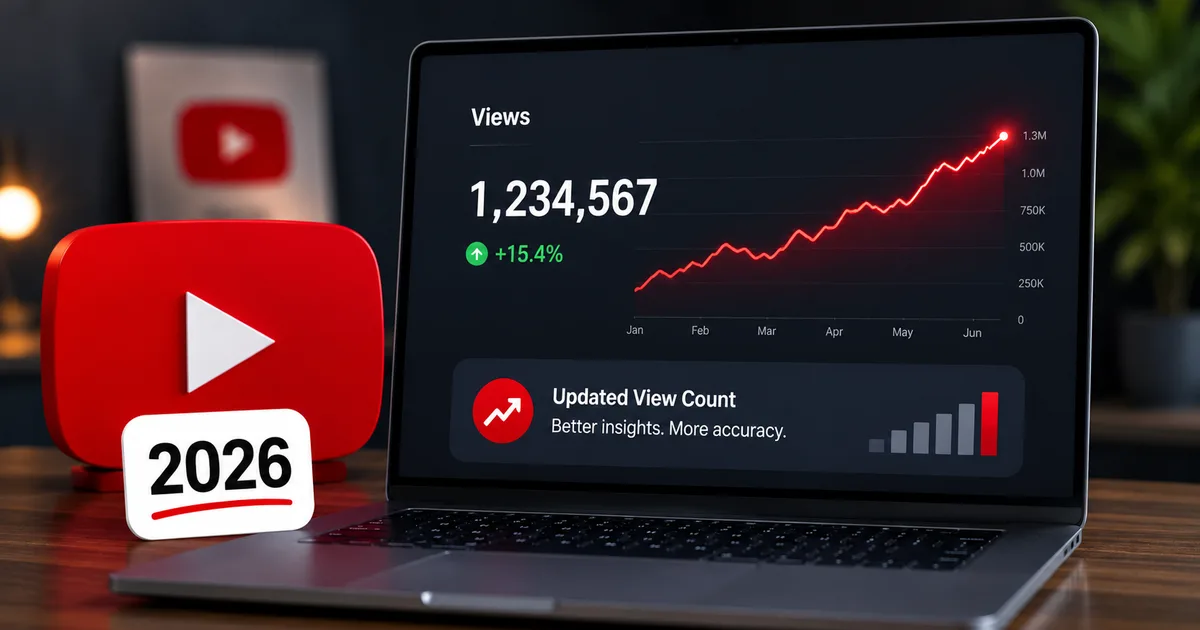
The YouTube view count update 2026 is officially rolling out on August 24, 2026. And it rewrites the fundamental rules on what actually counts as a view.
YouTube will now count a view from the very first frame of a video. Yes, instantly. They removed the minimum watch time requirement entirely.
Honestly, this is a massive change to their core system. It sounds like amazing news for your ego and your public subscriber-to-view ratio. But the actual impact on your Adsense earnings is a bit of a mess. I think long-term channel growth is a lot more complicated than it looks on the surface. We need to look closely at what this means for Indian creators.
The big YouTube view count update 2026: What's actually changing?
For years, YouTube had a slightly mysterious threshold for view counting (which makes sense, actually). If a viewer clicked your video, they had to stick around for a specific amount of time before YouTube's system officially registered it as a view. Most creators estimated this is around 30 seconds for standard long-form content. So if they clicked, saw your sponsor segment, and immediately closed the tab, you got zero credit.
That system is entirely gone now.
From minimum watch time to first frame
Starting August 24, 2026, you get the credit the exact moment your video starts playing on someone's screen. YouTube is calling this "first frame" counting. This applies across all video formats. It covers Shorts and standard long-form videos. Livestreams have it too.
If a user taps on your video and it loads the first frame, the view counter ticks up immediately. There's no waiting period.
I spoke to a few creator friends in Mumbai about this yesterday. The general reaction is a mix of relief and suspicion. We all want bigger numbers. But YouTube rarely gives out free engagement metrics without an ulterior motive. They're a data-driven advertising company.
Why's YouTube doing this right now?
Basically, we don't have to guess about their motivations. Google is losing the optical war to Instagram Reels and TikTok in countries where TikTok operates. On those competing platforms, view counts are notoriously inflated. That's because they count views almost instantaneously. Instagram counts a view the second a Reel loops into your feed, even if you're just scrolling past it quickly to get to a meme.
Think about a brand manager in Bengaluru deciding whether to spend ₹50,000 on an Instagram integration or a YouTube video sponsor spot. They look at the raw numbers. If a Reel gets 100k views and a YouTube video gets 40k views, the brand manager usually thinks the Reel offers better value. They don't always understand that the YouTube view required actual human attention. The Reel view just required someone scrolling past quickly on the toilet.
So by making the YouTube view count update 2026 a reality, Google is leveling the playing field. They're making sure YouTube numbers look just as big and impressive as Meta's numbers. It's purely a business move to attract more brand advertising money to the platform.
How this impacts your channel metrics
You need to know what to expect when you open your YouTube Studio app on the morning of August 25th. Things are going to look different.
Expect a sudden spike in total views
You'll absolutely see an increase in your overall view counts. For some creators, this spike could be massive. If you make highly searchable tutorial videos where people click on a lot of different search results before settling on one video, you'll benefit immensely. People clicking and bouncing after two seconds will now pad your stats.
And this is going to look great on your public channel page. It might even help you negotiate better brand deals if you work with local marketing agencies who only look at average views per video when pricing out sponsorships. I'm not sure exactly why they do this, but they do. You can confidently raise your rates if your baseline numbers jump by 20% overnight.
But don't expect a spike in your AdSense revenue
Monetization rules are completely unchanged. You don't get paid just because someone loaded the first frame of your video. You still get paid based on actual ad impressions. Total watch time is what matters.
Look, if a user clicks your video and generates a view under the new rules but leaves before seeing a single ad, your revenue doesn't move at all. In fact, you'll probably see your RPM (Revenue Per Mille) drop significantly next week. Because your total views are going up while your total revenue is staying the exact same, the average money you make per 1,000 views will mathematically decrease.
Don't panic when you see this RPM drop in YouTube Studio. Your actual bank deposits via wire transfer won't shrink. It's just the ratio calculation that is changing on the dashboard.
The reality for Indian creators in 2026
India is YouTube's largest market globally by a wide margin. We consume content very differently here. Our market is largely driven by cheap Jio data. There is also massive smartphone penetration in Tier 2 and Tier 3 cities. People click around a lot more.
Adapting your hook strategy
Many creators spend the first 30 seconds of their videos just saying hello. They ask people to like and subscribe before getting to the point. Under the old system, you had to keep viewers around past that intro to even register a view. If they left early, it was like they were never there.
Now, you get the view regardless of when they leave. But if you want the watch time and the actual ad money, your hook strategy's more important than ever before. The algorithm will now collect a huge amount of explicit data on "zero-second bounces."
Thing is, if you get 10,000 views but 8,000 of them leave after the first frame, YouTube's recommendation engine is going to bury your video fast. The view count might be a vanity metric now. But Average View Duration (AVD) is still the absolute king of the algorithm. You still need to deliver value instantly in the first five seconds. Stop wasting time with long animated logo intros.
The Shorts vs long-form dilemma
We've all seen Indian channels completely abandon long-form videos to just pump out daily Shorts (annoying, I know, if you make long stuff). With this YouTube view count update 2026, standard long videos are getting a metric boost that was previously only enjoyed by Shorts. Shorts always had a very generous, instant view-counting mechanism.
If you've been relying entirely on AI video editing software to churn out Shorts, you might want to look back at long-form content. The perceived performance gap between the two formats is going to shrink visually. A 10-minute video might suddenly start looking just as viral as a 15-second Short on your channel page. It's wild.
What this means for YouTube podcasts and documentaries
We've seen a massive surge in the Indian podcasting scene over the last three years. Everyone has a mic and a camera now. These two-hour-long interview videos thrive on deep engagement. But under this new algorithm, their metrics are going to look a bit sketchy.
If you upload a 90-minute interview with a startup founder, and a viewer clicks on it just to see who the guest is before leaving three seconds later, you still get the view. For podcasters, the gap between total views and actual watch hours is going to widen dramatically. You'll have 500,000 views but your watch time won't reflect a half-million people actually listening to your content.
This makes it even harder to figure out if your podcast is actually growing an audience or if your thumbnail is just acting as effective clickbait. You'll need to dig much deeper into the advanced analytics tab in YouTube Studio. Look for the audience retention curve specifically. The numbers here are a bit fuzzy, honestly. But that graph shows you exactly when people stop watching. If you see a massive cliff in the first ten seconds, your view count is completely misleading you.
Navigating sponsorships and brand deals
This update creates a weird situation for your brand deals. Local Indian brands and PR agencies often buy sponsorships based on a guaranteed number of views. If they pay you ₹1,00,000 for 100,000 views, they expect that return.
When your average views inflate next month, these agencies will be happy. But eventually, they'll realize that 100,000 views under the new system doesn't equal 100,000 views under the old system. The actual sales conversions they get from your video might drop. This happens even if the view count looks amazing.
You need to get ahead of this. Start selling your sponsorships based on Average View Duration or total watch hours. Educate your sponsors. If you can show a brand that people watch your entire 12-minute review of a new Tata EV, that's worth way more than 50,000 instant bounces on a Short.
Beware of new view-boosting scams
And whenever YouTube updates its algorithm, scammers come out immediately. I've already seen Telegram groups popping up this morning claiming they can exploit the new first-frame counting system. They promise to get you millions of views overnight using automated bots that just load the first frame repeatedly. It's a mess.
They'll usually ask you to pay ₹2,000 or ₹5,000 via UPI for a secret script or access to a bot network. Let me be perfectly clear. These are scams. Read our full guide on social media growth scams here for more context. Never pay for views.
YouTube's anti-fraud systems are highly sophisticated. They'll identify the bot traffic and remove the fake views. They will likely terminate your channel entirely. They know exactly what an unnatural spike in zero-second views looks like. If you see these offers floating around WhatsApp or Telegram, report them to the National Cyber Crime Reporting Portal at cybercrime.gov.in or call the 1930 helpline. Protect your account.
What you should focus on next
Keep making good videos. I know it sounds like boring advice, but it's the truth. Don't try to game this new system.
The YouTube view count update 2026 changes the public scoreboard. It doesn't change the actual game of content creation. You still need to make thumbnails that people want to click. You still need to make content that people want to watch.
- Ignore the sudden drop in your RPM metric next week.
- Focus heavily on improving your Average View Duration in YouTube Studio.
- Watch how brands react to these inflated numbers when negotiating your next sponsorship deal.
- Update your media kit to reflect your new, higher average view counts.
In my experience, it's a strange time to be a creator in India. If you focus on the fundamentals of audience retention, this update won't hurt you at all. Your real audience will still watch. Your real revenue will still arrive on the 21st of every month.