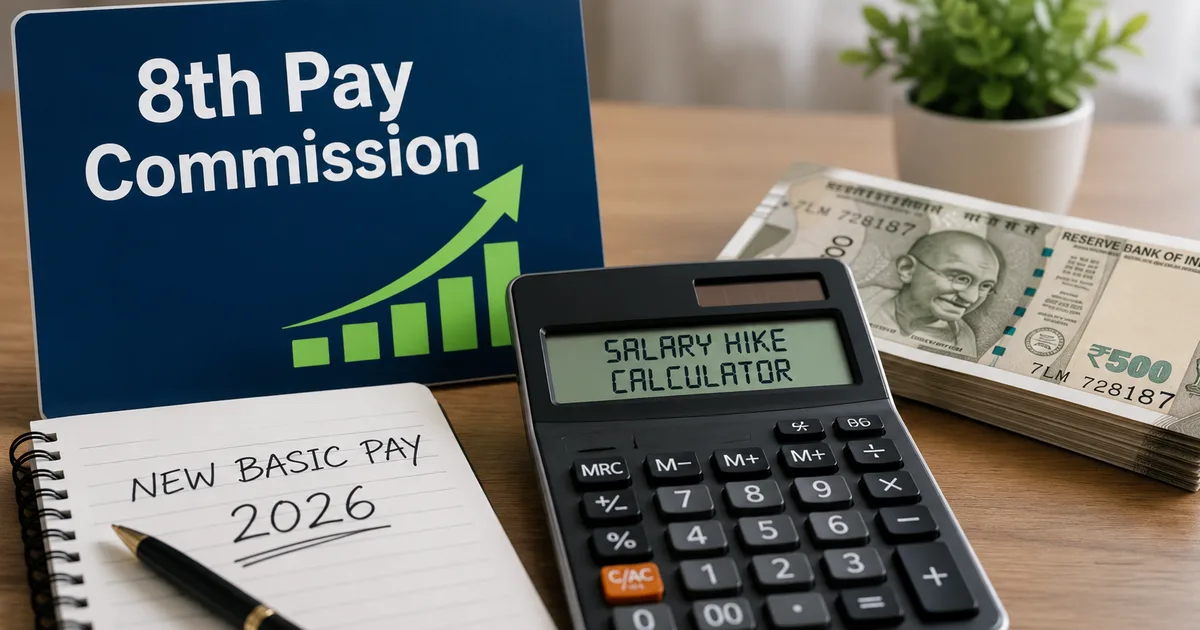
If you work for the central government, you've probably run this calculation in your head already. The 8th Pay Commission salary hike calculator comes down to one formula: your current basic pay multiplied by the fitment factor. That's it. The problem is nobody knows the official fitment factor yet, because the commission hasn't finalized its recommendations. So what you can do right now is plug in the proposed numbers and get a realistic range of what your new pay might look like.
The 8th Pay Commission was approved in late 2025. It covers over 1.1 crore people, central government employees and pensioners along with their family members. Implementation was targeted for January 2026, but as of May 2026, the feedback deadline has been extended and wage talks are still ongoing. The hike is coming. Just not confirmed to the rupee yet.
Understanding the fitment factor
The fitment factor is a multiplier applied to your current basic pay to get your revised basic pay. The 7th Pay Commission used 2.57, which raised the minimum basic from Rs 7,000 to Rs 18,000. Simple multiplication. Big result.
For the 8th Pay Commission, no official number exists yet. Here's what's actually being discussed:
- Around 1.92, which gives roughly a 44% increase on current basic. This is the more conservative estimate cited by financial analysts.
- 2.86, which multiple employee unions are pushing for, representing close to a 186% hike on current basic pay.
- The IRTSA (Indian Railway Technical Supervisors Association) has proposed a graded approach with factors from 2.92 to 4.38 depending on pay level. Their claim that salaries could jump "over 400%" uses the top of this range for lower-level employees.
The IRTSA proposal is almost certainly a negotiating position. Honestly, unions always ask for more than they'll get. The final number will land somewhere between what the government wants to offer and what the commission recommends after consultations.
How to calculate your new basic pay: step-by-step
You don't need a special app for this. Your phone's calculator is fine.
- Find your current basic pay. Pull up your most recent salary slip. The basic pay line is separate from DA, HRA, and all other allowances. If it shows Rs 35,400, that's your starting number.
- Know your Pay Level. Under the 7th Pay Commission Pay Matrix, every central government employee sits at a Pay Level from 1 to 18. Level 1 starts at Rs 18,000; Level 18 goes up to Rs 2,50,000. Your appointment letter or HR will confirm this if you're unsure.
- Pick your fitment factor scenario. Since the official number isn't out, model two: 1.92 for a conservative estimate, 2.86 for the optimistic one. Run both and you'll have a realistic range.
- Multiply: New Basic Pay = Current Basic Pay x Fitment Factor. If your basic is Rs 35,400 and you use 1.92, the new basic would be Rs 67,968. At 2.86, it would be Rs 1,01,244.
- Add revised allowances. DA resets to 0% when new scales kick in. HRA gets recalculated on the new basic at 27% for X-category cities (the six metros), 18% for Y-category, and 9% for Z-category towns. Add these to estimate your total gross.
Real examples at common pay levels
Grade Pay 1800, Pay Level 1, basic pay Rs 18,000. News24 reported that gross salary for GP-1800 employees could reach Rs 41,440 under certain fitment scenarios. At a 1.92 factor, new basic alone is Rs 34,560. Add HRA at 27% for a metro posting (Rs 9,331) and you're already past Rs 43,000 before transport allowance.
Pay Level 4, basic around Rs 25,500. At 1.92, new basic is Rs 48,960. At 2.86, it's Rs 72,930. That Rs 24,000 difference per month is entirely about which fitment factor the government picks, which is exactly why this number gets so much attention.
Pay Level 10, basic Rs 56,100. At 1.92, new basic is Rs 1,07,712. At 2.86, it's Rs 1,60,446. NDTV Profit covered how total emoluments at higher levels could go from Rs 1.1 lakh to Rs 9.57 lakh if union proposals get accepted at senior levels.
The graded fitment factor proposal, explained
The argument is that a flat multiplier just preserves existing salary gaps. If Level 1 earns Rs 18,000 and Level 12 earns Rs 78,800, a flat 2.86 gives both a hike but keeps the same ratio between their pays. If you ask me, that's the core frustration for lower-level employees.
The IRTSA's graded proposal tries to compress that gap:
- Levels 1 to 5 (lower Group C posts): fitment factor of 4.38 proposed
- Levels 6 to 8: around 3.68
- Level 9 and above: 2.92
The 7th Pay Commission kept a flat 2.57 for everyone. Whether the 8th breaks from that pattern is genuinely unknown. PW, a platform covering government exam and service news, reported that the graded matrix is being actively proposed but there's no sign yet it'll be accepted.
What happens to DA, HRA, and pension?
DA gets reset to 0% when new pay scales are notified. The existing DA (currently around 50% of basic, give or take) is absorbed into the new basic through the fitment factor. You don't lose it. From implementation day, DA starts building again on the new higher basic.
HRA is recalculated on new basic at 27% for X-category cities. If your new basic is Rs 50,000, HRA becomes Rs 13,500 per month instead of what you're getting now. Anyone posted in Delhi, Mumbai, Bengaluru, Chennai, Hyderabad, or Kolkata will notice the difference.
Basically, pensioners work the same way. Pension is 50% of last drawn basic pay. Apply the fitment factor to the last basic before retirement, and pension is 50% of the new figure. A last basic of Rs 40,000 at a factor of 1.92 gives a revised basic of Rs 76,800, making monthly pension Rs 38,400 instead of Rs 20,000.
For more background on how DA and HRA work, and how the Pay Matrix fits in, our explainers section covers these terms in plain language.
When will the salary hike actually land?
Honestly, not confirmed yet. The commission was approved in late 2025 with a January 2026 target. As of May 2026, the feedback deadline has been extended, wage talks are still ongoing, and the commission hasn't submitted its report.
If implementation gets delayed beyond January 2026, arrears would typically still be paid from that date as a lump sum once the government notifies revised pay scales. But a longer delay raises the question of installment-based arrear payments, which could affect your cash flow planning.
Economic Times has tracked the implementation timeline closely. India Today covered the delay scenario and how arrears would be calculated. The answer right now is to wait for the official gazette notification. That's what triggers everything else.
Don't make irreversible financial decisions based on an expected hike that hasn't been confirmed. Build in a buffer.
Online calculators and building your own
Mint published a guide on using fitment factor calculators to estimate revised salary. Economic Times has covered similar tools. Most of them ask for your current basic pay and Pay Level, along with which fitment scenario you're modeling, then give you estimated new basic, DA projection, HRA, and gross.
Or build it yourself in Google Sheets. Column A is your current basic. Column B is fitment factors (put 1.92 and 2.86 in separate rows, then add 2.57 if you want a middle scenario). Column C is =A*B. Add rows for HRA at 27%, 18%, or 9% depending on your city. Five minutes and you have a model you can update as official news comes in. (I genuinely think this beats most online calculators because you can see all your assumptions clearly.)
Check our news section for updates when the commission submits its report. That's the event that starts the clock on official numbers. And for a broader picture of what central government employees can expect from the 8th Pay Commission, beyond just the calculator, our guides section has more context.
The formula is simple. The uncertainty is in the number you plug into it. Once the official fitment factor is announced, you'll know exactly where you stand.