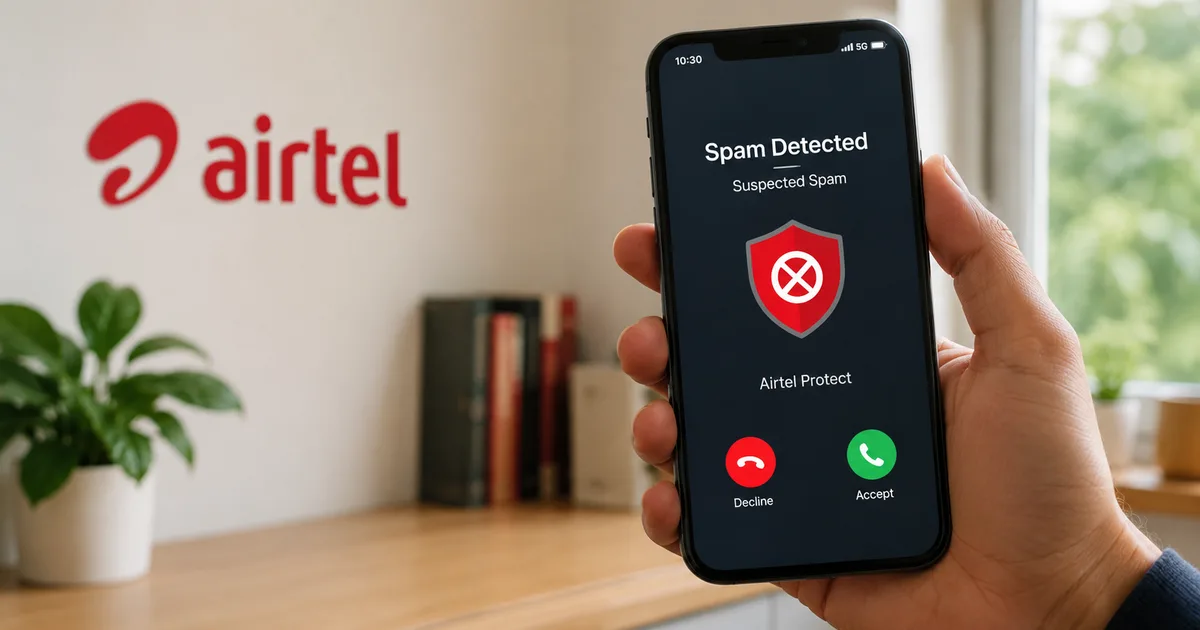
Airtel's AI-powered spam detection has been quietly getting better, and in 2026, it's genuinely one of the more practical things a telecom company has done for ordinary Indian users. Not just blocking a few robocalls. We're talking about a layered system that covers SMS, calls, RCS messages, mobile browsing, and even Wi-Fi networks. If you're on Airtel and you've noticed fewer scam texts lately, this is probably why.
Spam calls and fraudulent messages have been a nightmare in India for years. TRAI tried. The DND registry exists. And yet, somehow, your phone still rings at 11 AM with someone claiming your SIM card will be disconnected in 2 hours. The scale of the problem is staggering. According to the GSMA, India consistently ranks among the top countries globally for spam call volumes. And the scams have gotten smarter too — from fake Aadhaar KYC requests to delivery fraud to those elaborate "digital arrest" calls that drained lakhs from people's accounts before awareness caught up.
So what is Airtel actually doing about it?
How Airtel's AI spam detection works at the network level
The system Airtel has built doesn't wait for you to report something. It works at the network level, before the call or message ever reaches your phone.
Airtel's AI models analyze call patterns in real time. A number making 500 calls in an hour? That's not a human. The system flags it, and depending on the confidence level, either blocks it outright or labels it "suspected spam" when it rings through. This is different from what apps like Truecaller do. Truecaller relies on crowd-sourced reports, which means new fraud numbers can operate undetected for days. Airtel's network-level detection can catch unusual calling behavior even before anyone has complained about that number. I think that distinction matters more than people realize.
For SMS, the approach adds content analysis on top. Messages with sketchy links, certain keyword combinations, or patterns matching known phishing templates get filtered before delivery. Airtel has reported blocking over 1 billion spam messages per month. I couldn't independently verify the exact current figure, but their announcements at the India AI Impact Summit 2026 were consistent with that scale of operation.
Airtel's spam detection processes traffic across voice, SMS, and RCS for over 350 million subscribers using AI models specifically trained on Indian fraud patterns, including Aadhaar impersonation, fake delivery alerts, and financial phishing templates targeting UPI users.
The Google RCS deal and what it actually changes for your messages
This is the development that got the most coverage recently, and rightly so.
Airtel partnered with Google to bring AI-powered spam detection to RCS messaging in India. RCS (Rich Communication Services) is basically the upgraded version of SMS. It supports read receipts, high-quality images, group chats, and verification badges for businesses. Think of it as iMessage-style features but for Android, available across carriers without needing a separate app.
The problem RCS was built to address is that SMS is genuinely insecure and easy to spoof. Any business could register a sender header like "HDFCBK" and message you, and you'd have no real way of knowing if it was actually HDFC Bank or a fraudster who registered a similar-looking ID. RCS fixes part of this through verified sender IDs. Businesses have to register and prove who they are before they can message you under a branded name.
The Airtel-Google integration goes further. Google's on-device AI, which has been running spam detection on Android for a while, now works alongside Airtel's network-level detection. So if something slips past the network filter, the device itself has a second line of defense (which makes sense, actually). According to coverage in TechCrunch and MediaNama, Google specifically partnered with Indian carriers because the RCS spam problem here is particularly severe. India has one of the highest volumes of commercial messaging traffic anywhere in the world, and a substantial portion of it is fraudulent.
What this means practically: if a business tries to send you a phishing message disguised as a legitimate brand on RCS, the combination of verified sender IDs plus AI content filtering should catch most of it. Not all of it. But most.
Safe browsing on mobile data and Wi-Fi
Less covered but honestly just as useful. Airtel has extended its fraud detection to browsing as well.
When you're on Airtel mobile data, the network can detect if you're trying to reach a domain flagged as malicious. This covers phishing sites, fake bank portals, APK download pages for malware, and similar threats. The system blocks access and shows a warning instead of loading the page.
The Wi-Fi piece is newer. Airtel's safe browsing now also covers certain Wi-Fi networks, specifically through Airtel routers and hotspots. So if someone in your household accidentally clicks a dodgy link, there's a network-level block before the page loads. For parents worried about kids clicking random links from Instagram reels or YouTube comments, this is actually quite useful. The exact technical details of how the domain blocklist is maintained aren't fully public (annoying, I know), but Airtel has said it draws on threat intelligence feeds and AI models trained on Indian phishing patterns. The feature was announced through Airtel's official press channels in 2025.
Where Jio and Vi fit into this
To be fair, Airtel isn't the only carrier doing this.
Jio has its own AI-based spam and fraud detection running at the network layer. Vi (Vodafone Idea) has been building similar capabilities too, though given Vi's financial position over the past few years, their investment here has been more constrained. A Fortune India analysis from early 2026 put Airtel ahead of the other two in terms of depth and breadth of AI deployment for spam specifically.
TRAI's CNAP rollout (Calling Name Presentation, which shows verified caller names on incoming calls) also helps by making it easier to see who's actually calling you. That's a regulatory layer sitting on top of what the carriers are doing themselves. For more context on India's telecom regulatory developments, the pace of change in 2025-26 has been reasonably fast. The combination of TRAI rules plus carrier-level AI is starting to make a measurable dent in call spam volumes, at least for basic robocalls.
What Airtel's spam detection still can't protect you from
Here's where I'd push back a bit on the triumphant press release tone.
Network-level detection is good at catching high-volume automated spam. It's much weaker against targeted attacks. If someone calls you from a freshly registered number, has a real conversation in Hindi or your regional language, and socially engineers you into sharing an OTP, no AI catches that. That's your judgment call entirely, and it's still where most of the actual financial damage happens.
WhatsApp is largely outside the telecom carrier's control. Airtel can't inspect end-to-end encrypted WhatsApp messages for spam content. The bulk of the fraud that causes actual financial loss in India, fake job groups promising Rs 15,000 a day for simple tasks, crypto investment scams, "digital arrest" calls over WhatsApp video, happens on a platform where carrier spam filters simply don't reach. For those situations, understanding how these scams actually work is your main protection.
International numbers are another gap. Calls from the +92, +855, +251 prefixes you'll recognize from spam alerts come through international gateways and are harder to filter. Airtel and other carriers have gotten better at flagging these but haven't fully solved it. Honestly, I'm not sure exactly why this particular problem has been so stubborn, but the international gateway routing is a mess.
Should you do anything differently as an Airtel subscriber?
Honestly, not much. The spam detection runs automatically. You don't install anything. You don't opt in. It's just there as part of the network.
A few things worth knowing:
- If a legitimate call or message gets wrongly flagged as spam, report it through the Airtel Thanks app. The feedback loop is supposed to improve the model over time.
- For the full benefit of the Airtel-Google RCS integration, you need to be using Google Messages as your default SMS app on Android. Third-party messaging apps won't get that layer of protection.
- The safe browsing feature on mobile data is on by default. You can check or manage it through the Airtel Thanks app if you need to.
- None of this replaces reporting actual scam attempts. If you receive a suspicious call or message, file a complaint at cybercrime.gov.in or call the 1930 helpline. This builds the national fraud database that helps all carriers and law enforcement act faster.
Airtel also called for joint industry action on telecom fraud in a statement covered by MediaNama, essentially arguing that spam detection needs coordination across all carriers, not just individual efforts. That's the right instinct. A fraudster blocked on Airtel just switches to a Jio SIM. Until there's a shared real-time blocklist mechanism across carriers, gaps will always remain.
The bigger picture: AI across Airtel's infrastructure
Airtel used the India AI Impact Summit 2026 to present several AI deployments beyond spam, including cloud infrastructure management, customer service automation, network optimization, and tower power efficiency. The spam detection piece is actually one of the more grounded ones because the problem is measurable and the benefit is immediate and tangible for users.
A lot of "AI in telecom" announcements are fairly abstract. This one isn't. If you've received a text message this month that got quietly filtered before reaching your inbox, there's a reasonable chance Airtel's models caught it. That's about as direct a benefit as you get from network-level AI.
For a deeper look at how digital fraud works in India and the mechanisms behind it, that section has detailed explainers. And for practical step-by-step guides on protecting your accounts and recognizing scams before they land, those are worth bookmarking. The network tools have gotten better. Staying informed is still the first line of defense.