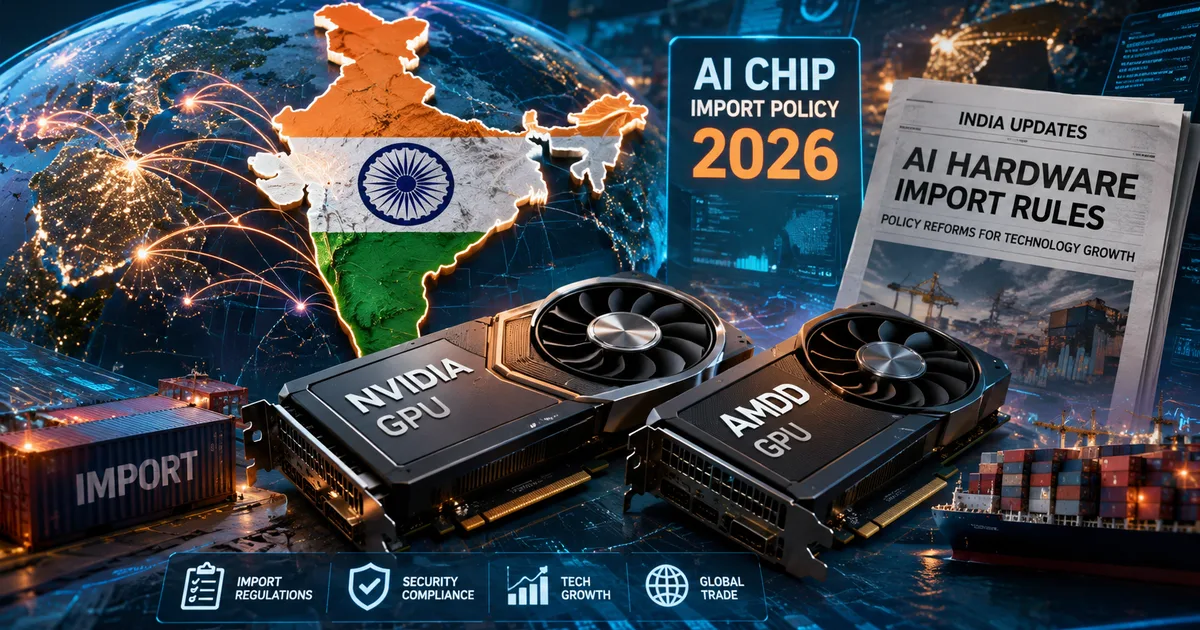
India's AI chip import policy has become one of the more consequential and complicated policy areas of 2026. If you're an AI startup founder, a researcher at an IIT, or someone trying to understand why building an Indian large language model costs what it does, this directly affects you. And it's been moving fast.
The short version: importing Nvidia H100s, H200s, and AMD Instinct cards into India has always been expensive and logistically thorny. In 2026, a combination of new US export rules, the India-US interim trade deal, India Semiconductor Mission 2.0, and Trump-era tariffs have changed the equation. Not always in India's favour. But more strategically than before.
What's actually happening with GPU imports right now
Start with the basics. AI chips like the Nvidia H200 SXM5 or AMD Instinct MI300X are dual-use technology -- useful for AI model training but also the kind of hardware that governments worry about in military and intelligence contexts. That's why the US Bureau of Industry and Security keeps updating its export control rules around these chips.
Earlier this year, the US approved sales of Nvidia H200 chips to China, but with strict limitations and end-use verification requirements. India is in a very different category. Under the US-India bilateral technology partnership, India is a trusted partner for advanced semiconductor access. Business Today reported in May 2026 that this interim trade deal effectively shields India's AI compute ambitions from the kind of restrictions China faces.
That's actually a big deal. It means Indian companies can get the latest Nvidia and AMD AI accelerators without the heavy end-use certification hoops that apply to many other markets. In practice, though, procurement still isn't simple.
Import duties, Trump tariffs, and why your GPU costs what it does
Here's where it gets painful. India currently levies a 7.5% basic customs duty on most AI chips, plus an 18% IGST. When you add landing costs, that's roughly a 28-30% markup on the chip's CIF value by the time it clears customs.
Then came Trump's 25% tariff announcement on Nvidia AI chips, which The Guardian reported in early 2026, citing national security grounds. This didn't directly target Indian buyers, but it created supply chain disruption. Nvidia's pricing to distributors got adjusted globally. Waiting times for H200 clusters stretched considerably.
Trump's 25% tariff on AI chips has disrupted global GPU supply chains. Indian data centres are reporting H200 cluster delivery times of 6-9 months in some cases, compared to 2-3 months before the tariff regime took effect.
For an Indian AI startup trying to buy 8 H100 SXM5s for a training cluster -- roughly $300,000 or about Rs 2.5 crore at current rates, before Indian duties -- this is a material cost increase. Not impossible to absorb. But significant when you're deciding between cloud compute and owned hardware.
The all-in landed cost for an Nvidia H200 SXM5 in India right now works out to around Rs 35-38 lakh per card, after a base international price of around $35,000, Indian customs duties, and freight. Eight of them for a standard DGX H200 server configuration would cost roughly Rs 2.8-3 crore (annoying, I know). That's before you factor in networking, storage, and data centre space.
India Semiconductor Mission 2.0 and what the compute access framework means
The Union Budget 2026 brought India Semiconductor Mission 2.0. Finance Minister Nirmala Sitharaman's announcement was covered extensively by the Economic Times and Times of India. The first ISM focused largely on fab incentives, getting TATA Electronics, Micron, and CG Power to set up manufacturing in India. ISM 2.0 shifts emphasis to equipment, IP development, and supply chain localisation.
For AI chip imports specifically, ISM 2.0 has one provision that matters more than the others. It sets up a compute access framework that gives MeitY and the IndiaAI Mission tools to negotiate bulk procurement deals with Nvidia, AMD, and Intel on behalf of Indian institutions. Think of it as the government acting as a group buyer, which could bring down per-unit costs meaningfully for eligible organisations.
The exact numbers from these negotiations aren't public yet. Honestly, I'm not sure exactly why that information is being kept close to the chest, but people close to the process say discussions with Nvidia are ongoing. If you're a startup or a research institution, this is the pipeline to watch. Our explainers section has more on how the existing IndiaAI compute subsidy program works, if you want to understand what's already available to apply for.
The geopolitics of GPU access and why India's position actually matters
The world has effectively split into two AI compute ecosystems. The US controls access to the most advanced chips through export controls. China, largely locked out from Nvidia's latest hardware, is racing to build domestic alternatives. Tom's Hardware reported in 2026 that Huawei could seize China's AI chip crown as Nvidia's H200 shipments stall there in regulatory limbo -- and that the Chinese AI hardware market is projected to hit $67 billion by 2030.
India is not in that position. India is in the privileged camp, the one that gets to buy Nvidia's best. But that privilege has expectations attached to it. The US government wants trusted AI partners to implement responsible use frameworks, maintain end-use records, and not re-export chips to restricted destinations.
There was a significant case this year where a tech company co-founder was charged with diverting $2.5 billion in Nvidia AI chips to China in violation of US export laws, reported by CNN. This has made US officials stricter about documentation requirements even for trusted partners. So if you're an Indian company importing AI chips, expect more paperwork and compliance overhead than two years ago. That's the cost of being in the good books.
What this means for Indian companies, startups, and researchers
A few practical things have changed in 2026.
- Larger data centres (Jio, Adani Green Data, Yotta, NxtGen) can access Nvidia H200 clusters more reliably under the bilateral framework, though delivery timelines remain stretched at 6-9 months for large orders
- Startups and mid-sized AI companies are increasingly choosing cloud access over owned hardware -- AWS, Azure, and Google Cloud all have Indian data centre capacity with H100 and H200 nodes available now
- Educational institutions and research labs can apply for subsidised GPU access through the IndiaAI compute program at indiaai.gov.in, though allocation is competitive and the pool is limited
- AMD Instinct MI300X cards are becoming a more popular alternative -- often available sooner and at slightly better price points, and AMD's ROCm software stack has improved significantly over the past 18 months
Maharashtra's AI Policy 2026, approved by the state cabinet under Chief Minister Devendra Fadnavis in April, targets Rs 10,000 crore in AI investments and includes provisions for compute infrastructure parks in Pune and Navi Mumbai. Whether this translates to cheaper GPU access for Maharashtra-based startups specifically is something to watch over the next 12 months. The intent is there. Execution, in my experience, is what typically takes time.
Compliance requirements that have actually changed
India's AI regulatory approach is shifting. Livemint reported in May 2026 that India is moving away from its earlier "light-touch" stance, with a six-member government committee now working on more prescriptive AI rules. There's active discussion within MeitY about whether high-capacity GPU clusters above a certain threshold should require registration or end-use disclosure. Nothing has been formally notified yet. But it's coming, probably in the Digital India Act consultations.
If you're planning to import AI chips for serious workloads, here are the practical steps that matter right now:
- Get your Import Export Code (IEC) updated and confirm your company's end-use category is correctly filed with customs
- Budget the full landed cost: chip price plus freight plus 7.5% BCD plus 18% IGST plus handling. For an H200 SXM5 at roughly $35,000 per card, you're looking at Rs 35-38 lakh all-in
- Check the IndiaAI compute allocation program at indiaai.gov.in -- the subsidised pool is limited but eligible Indian startups should apply regardless
- Keep complete documentation for every GPU purchase: serial numbers, end-use declarations, buyer identity verification. US export compliance requirements now flow down to Indian buyers through Nvidia and AMD vendor agreements
- If AMD MI300X works for your workload, consider it seriously. Availability is better than H200 right now, and the PyTorch and TensorFlow ROCm support gap with Nvidia has narrowed considerably
One thing worth saying plainly. A thread on r/TechnologyNewsIndia captured something real: India's AI future may depend on open-source models more than giant proprietary ones. That's not just idealism. It's a practical response to the compute cost reality facing most Indian AI builders who aren't named Reliance or Infosys. Running a well-tuned Llama or Mistral variant on fewer, cheaper GPUs is often more economically sensible than chasing frontier model scale.
The chip import rules are getting clearer, even as they get more complex. India's position as a trusted US partner for advanced compute is genuinely valuable and not something to take for granted. Whether the country translates that access into real AI capability depends more on funding, talent, and policy execution than on import rules alone. Those battles are happening right now, in budget meetings, MeitY consultations, and data centre boardrooms across the country.
For regulatory developments as they happen, follow our tech news section. If you want background on what the DPDP Act means for AI data use, that's covered in our guides section. And for a deeper look at India's semiconductor self-reliance push, our policy explainers cover the full picture.