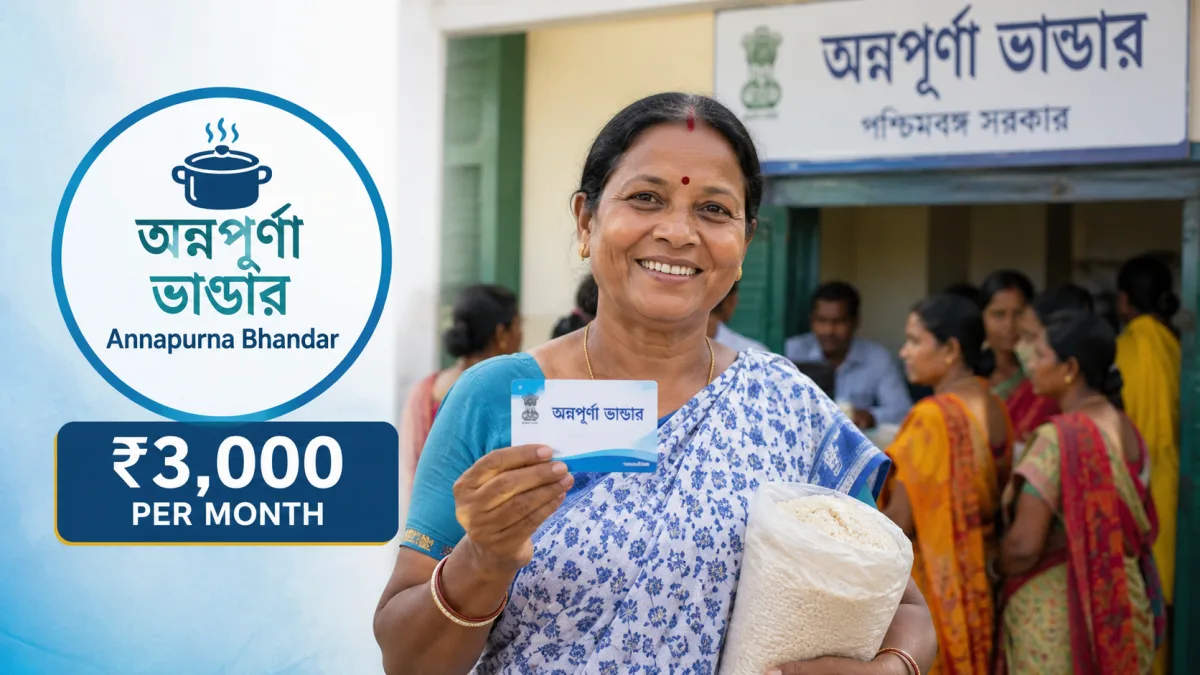
Picture this: your bhabhi gets a WhatsApp forward from a neighbour saying 'apply for Annapurna Bhandar, ₹3,000 every month straight into your account.' She has no idea if it's real, doesn't know if she qualifies, and has never touched a 10-page government form in her life. The Annapurna Bhandar Yojana is West Bengal's new monthly cash transfer scheme for women, and if you're in the state or helping someone navigate it, here's what you actually need to know.
What is Annapurna Bhandar Yojana?
Annapurna Bhandar is a state welfare scheme launched by West Bengal's BJP government. It gives ₹3,000 per month to eligible women through Direct Benefit Transfer (DBT), so the money goes straight into an Aadhaar-linked bank account. No middlemen, no ration shop queue, no local official with a ledger. The scheme officially started from June 1, 2026.
The name is a clue: 'Annapurna' is the Hindu goddess of food and nourishment, and 'Bhandar' means storehouse or treasury. Loose translation: a scheme to make sure women have money for daily needs. The ₹3,000 is unconditional cash. You don't have to prove how you spent it.
This is not a subsidised grain scheme. You're not getting rice at ₹2/kg through a ration shop. You're getting real money in your account every month. Think of it as a financial top-up for qualifying women, on top of whatever ration card entitlements your household already has. Read our explainers on how Indian government welfare schemes work if you want the bigger picture.
Who is eligible for the ₹3,000 monthly payment?
Here's where it gets complicated. The official eligibility criteria haven't been published in one clean, easy-to-find document. Based on what Economic Times and Jagran Josh have reported, the broad requirements are:
- Must be a woman resident of West Bengal
- Age typically between 18 and 60 years (exact upper age limit varies slightly across reports)
- Household income below a specified threshold
- Must have a bank account linked to Aadhaar for DBT to work
- May not be eligible if already receiving benefits from certain other central government welfare schemes
The exact income cutoff hasn't been spelled out in a single official circular that's been widely circulated. I couldn't find a definitive number published by the state government anywhere. Honestly, the online portal is your best starting point if you're unsure whether you qualify. The application process itself should flag eligibility issues.
How to apply on the Annapurna Bhandar online portal
West Bengal has a dedicated online portal for Annapurna Bhandar applications. You can access it, fill the form online, and submit your application digitally. Sounds simple enough.
But here's the part that's generating real concern: the application form is reportedly 10 pages long.
The Wire published a piece specifically flagging this. A lengthy, complex form locks out the very women this scheme is supposed to help — women in rural areas, older women not comfortable with forms, women without easy access to a computer (annoying, I know). A 10-page form is a genuine barrier, not a minor inconvenience. It's a fair complaint, and it's worth knowing going in.
Documents you'll generally need when applying:
- Aadhaar card (mandatory for DBT)
- Bank account details linked to Aadhaar
- Residence proof such as voter ID, ration card, or domicile certificate
- Income certificate, if required for your income bracket
- Passport-size photograph
You can apply through the official portal yourself or go to a Common Service Centre (CSC) near you if you need help with the online process. Search for 'Annapurna Bhandar Yojana official portal West Bengal' to get the current URL. Government portal links do shift occasionally, so a fresh search beats any link printed weeks ago.
How DBT actually puts money in your account
DBT is the plumbing that makes this work. Once your application is approved, ₹3,000 per month gets credited directly to your Aadhaar-seeded bank account. The government uses NPCI's Aadhaar Payment Bridge to route the money.
The key thing: if your Aadhaar is not linked to your bank account, the money will not reach you even if your application is approved. That's step one. You can fix this at your bank branch or through net banking. NPCI's website (npci.org.in) lets you check which bank account is currently mapped to your Aadhaar.
Also keep your registered mobile number active. OTP-based verification is standard in these processes now. If your Aadhaar-linked number is one you no longer use, update it at your nearest Aadhaar enrolment centre first. I'm not sure exactly why so many people skip this step, but it's probably the most common reason payments don't come through.
Annapurna Bhandar versus Lakshmir Bhandar: what's the difference?
If you've been following West Bengal welfare schemes, you'll know about Lakshmir Bhandar, the previous government's scheme that gave women ₹500 to ₹1,000 per month depending on category. Annapurna Bhandar at ₹3,000 is significantly higher in absolute terms.
Lakshmir Bhandar enrolled a large number of beneficiaries and was popular. The BJP government coming in with Annapurna Bhandar at three times the amount is partly political positioning. But for households, ₹3,000 is a meaningful monthly figure for food and essentials across most of West Bengal.
One question that hasn't been clearly answered in any widely available official document: can you receive both Lakshmir Bhandar and Annapurna Bhandar at the same time, or does the new scheme replace the old one for existing beneficiaries? The official notifications suggest there are DBT rules governing this, but the fine print isn't being communicated clearly. Check with your local government office or the portal directly before assuming you'll get both.
Does this affect your ration card?
No. This is a cash transfer scheme. Your ration card entitlements under the National Food Security Act (NFSA), meaning subsidised rice, wheat, and other grains at ration shops, continue completely separately. One doesn't replace the other.
West Bengal has a large population covered under NFSA. Monthly grain entitlements through ration shops run on their own track. Annapurna Bhandar sits on top of that as additional cash support. Think of them as two separate pipes: one carries subsidised grain, the other carries cash.
There's also been a separate central government move around QR tagging of FCI foodgrain bags for better traceability across the supply chain. That's a logistics and accountability measure for the PDS system, not connected to Annapurna Bhandar directly. But it shows the government is trying to plug leakage from both ends.
Practical things to do before applying
A few things worth sorting out before you or someone you know starts the application:
- Aadhaar-bank linkage: Non-negotiable. No linkage means no payment, regardless of approval status.
- Active Aadhaar-linked mobile number: If the number registered with Aadhaar is inactive, update it first.
- Do not pay any 'agent' to apply for you: The portal is free. Anyone charging you ₹200, ₹500, or any amount to 'process' your Annapurna Bhandar application is almost certainly running a scam. Read about government scheme application scams and how to spot them.
- Get your application number: Take a screenshot or printed copy. You'll need it to check status later.
- If you need help filling the form: Go to your gram panchayat office, municipality ward office, or a CSC. Do not hand your Aadhaar details to anyone you don't fully trust.
Checking your application status
The Annapurna Bhandar portal has a status check feature. You'll typically need your application number or Aadhaar number. Economic Times has reported on the portal's direct link being available, so do a fresh search for the current URL.
If you're stuck, the block development office (BDO) or municipality ward office in your area can also help trace applications. For general government scheme complaints, the state's grievance portal is another option.
The broader picture
Annapurna Bhandar is part of a clear pattern in Indian state politics right now: direct monthly cash to women voters. You've seen versions of this in Telangana, Karnataka, Maharashtra, and now West Bengal. The policy instrument is popular because cash is flexible and visible.
Whether it translates into lasting change depends on a lot of things beyond the scheme itself. But for a household earning ₹10,000-15,000 a month, an additional ₹3,000 is not nothing. That's school books, medicines, a month of cooking gas cylinders.
The concern about the 10-page application form, as flagged by The Wire, is worth taking seriously. A scheme that exists on paper but is inaccessible to the people who need it most isn't delivering its promise. If you know someone who qualifies but is struggling with the form, helping them get to a CSC or BDO office is genuinely useful. That's ₹36,000 a year sitting unclaimed if they don't apply.