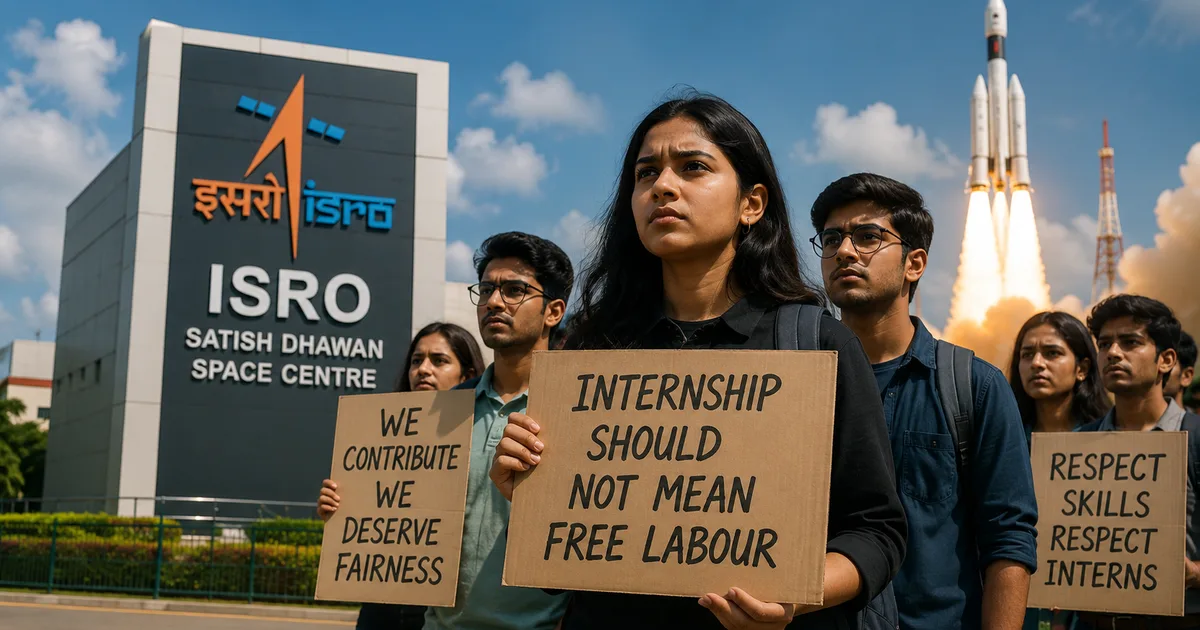
Imagine this. You've spent the last three years grinding through an engineering degree at a tier-2 college in India. You've cracked the exams, kept your CGPA high, and finally landed a summer internship at ISRO, India's premier space agency. You call your parents immediately. They distribute sweets to the neighbours. And then you read the offer letter carefully. Zero stipend. No accommodation provided. You have to figure out how to live in an expensive city like Bengaluru or Thiruvananthapuram entirely on your own dime for two to three months.
That's the reality behind the ISRO unpaid internship debate 2026. This blew up recently after a techie took to X (formerly Twitter) to point out that the math simply doesn't work for most Indian students. Honestly, this is one of the more depressing tech debates we've had this year. We talk endlessly about making India a global tech superpower. But we refuse to pay the young engineers who are supposed to build that future.
What exactly is the ISRO internship policy?
The Indian Space Research Organisation has a student internship and project trainee scheme across its centers. It's meant for undergraduate and postgraduate students in science and engineering. You apply online. You go through a selection process based on your academic merit. And if you get picked, you work alongside the scientists who launch rockets and satellites.
But the official policy document is painfully clear on compensation. It pays ₹0. Nothing. (Annoying, I know).
ISRO doesn't offer any financial help or stipend to its interns. They also don't give you a bed in their guest houses or student hostels. They don't cover travel expenses or daily food costs. You're entirely on your own. Basically, you get a certificate and the highly respected ISRO brand name on your resume. That's the transaction.
The viral post that started the 2026 debate
So the current debate kicked off when a techie posted on social media about why it's just not a viable workplace for talented engineers from average Indian middle-class backgrounds. The post pointed out that paying zero rupees to interns gatekeeps the opportunity. It means only students whose parents can easily afford to sponsor a multi-month stay in a major city can take the offer.
Think about the actual costs here. If you land an internship at ISRO headquarters or the U.R. Rao Satellite Centre in Bengaluru, you're paying for PG accommodation, three meals a day, local transport, and basic living expenses. Even a very modest setup in a shared room will cost you ₹15,000 to ₹20,000 a month in Bengaluru. Over a two-month internship, a student has to drop ₹40,000 out of pocket just to work for free.
If you get assigned to the Vikram Sarabhai Space Centre (VSSC) in Thiruvananthapuram or the Space Applications Centre (SAC) in Ahmedabad, the rent might be slightly lower. But travel costs from your hometown will likely eat up any savings. For a lower-income student who took out a heavy SBI education loan to fund their B.Tech? It's impossible. And that's exactly why engineering students are protesting online right now. They argue that talent and merit mean absolutely nothing if you can't afford the entry fee.
Why the policy is under fire now
You might be thinking it's a government organization funded by taxpayers, so maybe they just don't have the budget. But context matters heavily here. This debate is happening right when ISRO is reportedly facing its biggest manpower crunch in 25 years. I'm not sure exactly why the hiring slowed down so much, but recent news reports say there are over 5,600 vacant posts across the agency, from junior scientists to technical assistants.
When you have a massive staffing gap, alienating young talent is a mess. ISRO is competing for engineering talent against private tech giants and well-funded startups. If you're a brilliant computer science or mechanical engineering student, you could intern at a tech firm in Hyderabad or Pune. You can easily make ₹40,000 a month, plus a housing allowance. Or you could go to ISRO, work on national projects, and lose money.
I know, sounds complicated. It isn't. The math is just bad for the students. They're choosing financial stability over national pride. You really can't blame them when entry-level IT salaries haven't moved much in a decade but rent has doubled.
The defense: why doesn't ISRO pay?
To be fair, ISRO supporters fiercely defend the zero-stipend policy. They say ISRO is a government research entity, not a profit-making corporate enterprise. The internship is viewed strictly as an educational extension or a training program required by universities. It isn't an entry-level job.
They often point to the prestige factor. Getting ISRO on your resume opens doors globally. They say the long-term career benefits outweigh the short-term financial hit, especially for those applying for MS programs abroad.
Then there are budget constraints. Government funds are strictly allocated. Creating a new budget line for thousands of stipends across all ISRO centers requires parliamentary approval and Ministry of Finance clearance. It also requires massive bureaucratic wrangling.
Finally, senior scientists have to take time away from missions like Gaganyaan or Chandrayaan to mentor these interns. The agency sees this mentorship and access to world-class facilities as their contribution to the student's education.
But honestly, these arguments sound incredibly outdated in 2026. The prestige of an organization doesn't pay for your PG rent in Marathahalli. In my experience, landlords only care about cash. And if the government can fund multi-billion dollar space exploration missions, finding a basic sustenance allowance for a few hundred student interns shouldn't break the bank.
How other government internships compare
Is this normal for Indian government agencies? Yes and no. The landscape is shifting.
Many traditional government departments run unpaid internships. But there's a growing realization that this model is broken. The NITI Aayog internship is famously unpaid. Other bodies, though, are realizing they need to offer stipends to get serious talent. The government's own recently announced PM Internship Scheme proposes direct financial assistance for youth via Direct Benefit Transfer (DBT) linked to Aadhaar. Even some state government fellowships pay decent stipends of ₹15,000 to ₹25,000.
When you look at the private sector, the contrast is absurd. An average engineering intern at a decent IT company gets anywhere from ₹15,000 to ₹30,000 a month. Even early-stage startups scrape together ₹10,000 for their interns to cover basic travel. Paying zero is increasingly seen as sketchy by Gen Z workers, regardless of the brand name attached to the offer.
The real cost of unpaid internships in India
Unpaid internships create a massive class divide in the Indian workforce. When prestigious opportunities are unpaid, they become the exclusive domain of the privileged.
If you're a student from a rural background who fought hard to get into an NIT or a good state college, you probably need a paid internship to support yourself. You might even need to send some money back home to your parents. You simply can't take the ISRO offer. The student who takes that offer is likely someone from a tier-1 city whose parents can comfortably wire them ₹20,000 a month via UPI without breaking a sweat. (Which, for the record, I think is actually a good thing for that specific student, but terrible for the system as a whole).
This means our premier space agency might be missing out on some of the hungriest engineering minds in the country. And why? Simply because those students can't afford a two-month unpaid vacation pretending to be a scientist.
What are students actually demanding?
The demands from the student community aren't outrageous. Nobody is asking for corporate-level salaries for a summer project. The core demands circulating online are incredibly basic and pragmatic.
- A minimum stipend of ₹10,000 to ₹15,000 per month to cover basic food and shared accommodation.
- The ability to stay in vacant guest house rooms or dormitories for a nominal fee if a cash stipend is blocked by bureaucracy.
- Being allowed to eat at the subsidized staff canteens to drastically reduce daily food costs for interns living in expensive cities.
These are basic requests for survival, not luxury. The numbers here are a bit fuzzy, but when you consider the sheer scale of India's space budget, covering these basic amenities for a few hundred brilliant young minds seems like a rounding error. It would completely change the demographic of who gets to contribute to India's space journey.
The brain drain connection
There's another angle to this debate that people ignore. What happens to the brilliant students who reject ISRO because they can't afford it? They look elsewhere. Often, elsewhere means outside India.
Many top engineering students end up applying to universities in the US or Europe for their Master's degrees. Why? Because those universities offer Research Assistantships (RA) or Teaching Assistantships (TA) that actually pay a living wage. An Indian student might get rejected for a stipend at home. But a university in Texas or Germany will pay them to do research. We're practically handing our best technical talent over to foreign institutions because we refuse to cover their basic living expenses at home.
With 5,600 vacant posts at ISRO, this is a brain drain we literally can't afford. If we want to build sovereign AI and launch advanced communication satellites, we need the engineers. (Which makes sense, actually). And engineers need to eat.
What needs to change?
This debate shows a fundamental flaw in how India treats its young technical talent. We expect world-class innovation while offering terrible compensation.
If ISRO wants to fill those vacant posts with top-tier engineers, they have to start treating interns like prospective employees. Not just students lucky to breathe the same air as senior scientists. A basic stipend of around ₹15,000 a month wouldn't make anyone rich. But it would make the internship accessible to everyone. It would cover basic rent and mess food.
Or, if stipends are truly impossible because of rigid government rules, ISRO could provide subsidized accommodation in their guest houses. They have large campuses. Build a few more basic hostel blocks for student trainees. Something has to give. You can't run a 21st-century space program with 20th-century HR policies.
Conclusion: where do we go from here?
For now, the official policy remains completely unchanged. If you're applying for an ISRO internship this year, you need to be deeply prepared for the financial reality. Have a frank conversation with your family about the costs before you accept an offer. If you can afford it, the learning experience is genuinely unmatched. If you can't, don't feel bad about taking a paid corporate gig instead.
The techie who started this debate did the engineering community a huge favor. We need to normalize talking about compensation openly, even when dealing with revered national institutions. National pride is great. But it doesn't pay the internet bill or the rent.
If you're looking for paid opportunities or want to understand how tech hiring is changing, you might want to check out our guides on finding tech jobs. You can also read up on our explainers to upskill in areas like AI and data science. Just watch out for fake job offers asking for registration fees. We've covered plenty of those traps in our scams section.
"Talent is equally distributed across India, but opportunity is severely restricted by wealth. When a government agency prices an internship at zero rupees, they are not filtering for merit or dedication. They are simply filtering for inherited wealth."