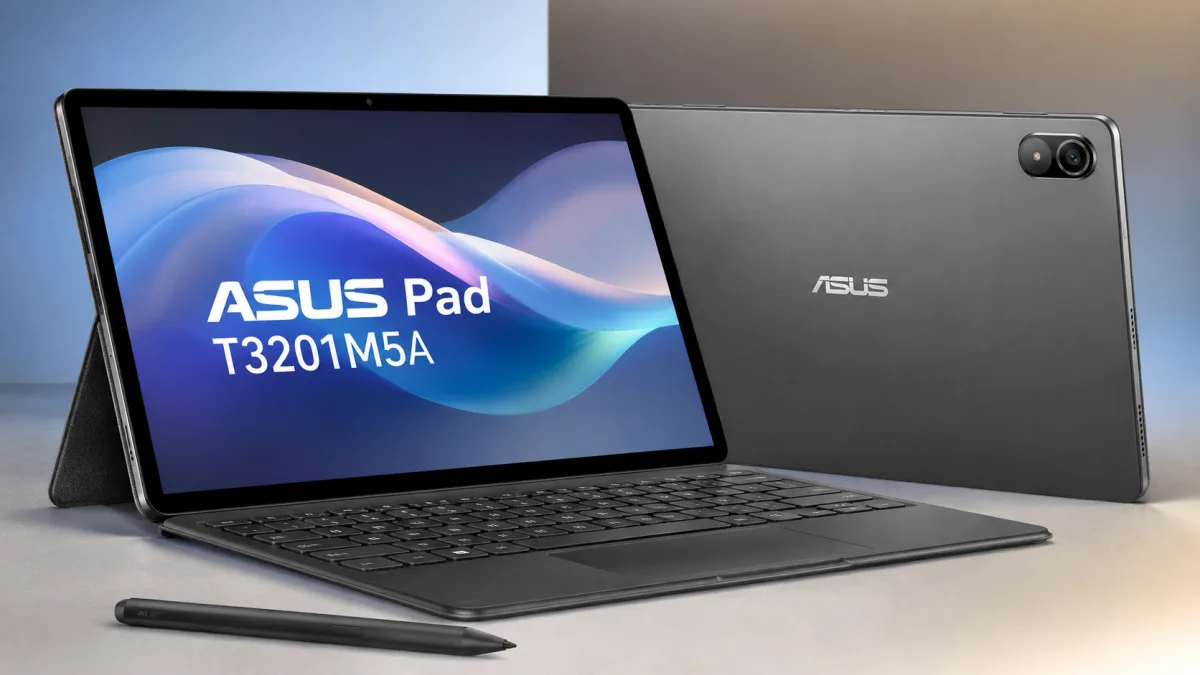
The tablet market in India has been boring for a while now. You either buy an iPad and empty your bank account, or you settle for a cheap Android tablet that stutters when you open two Chrome tabs. That's about to change. The ASUS Pad T3201M5A is officially on its way to India. Leaks and official teasers confirm some serious hardware for this upcoming device. I've spent the last few days looking at the spec sheets and comparing it with what we already have in the market.
Honestly, ASUS is taking a big swing here. They left the Indian tablet space a few years ago. Coming back with a premium device is a risky bet. But the hardware actually backs up the ambition.
What we know about the display
The screen is usually the first thing you notice on a tablet. ASUS is putting a 12.2-inch 2.8K OLED display in the T3201M5A model. That's massive. Most tablets in this price bracket stick to 11 inches. And they definitely don't have a 144Hz refresh rate with an OLED panel.
Why does this matter? Look, if you watch a lot of movies on JioCinema or Netflix, an OLED screen gives you true blacks. The colours just pop. A 144Hz refresh rate means scrolling through menus or web pages will feel incredibly smooth. It makes the tablet feel faster than it actually is. (I know, it sounds complicated but it really isn't). It just means the screen updates 144 times a second.
There's also a practical side to this. A 12.2-inch screen is big enough to use split-screen apps comfortably. You can have your class notes open on one side and a YouTube tutorial running on the other. In my experience, for students preparing for competitive exams, that extra screen space is a massive advantage.
Medical and engineering students in India carry heavy books. A 12.2-inch tablet can store the entire MBBS syllabus in PDF format. Apps like GoodNotes or Samsung Notes work beautifully on large Android screens now. With a stylus, you can highlight text or draw diagrams of the human heart. You can write down formulas too.
And when it comes to online classes on platforms like Unacademy or BYJU'S, the larger screen is a huge help. You can actually see what the teacher is writing on the digital whiteboard without squinting. Taking notes simultaneously in split-screen mode makes the studying process much faster.
Performance and processor details
Under the hood, the ASUS Pad runs on the MediaTek Dimensity 8300 processor. Some people still prefer Snapdragon chips. I get it. But MediaTek has improved a lot over the last two years. The Dimensity 8300 is a very fast processor. It handles heavy multitasking easily.
If you play games like BGMI or Call of Duty Mobile, this tablet runs them on high settings. The Dimensity 8300 is built on a 4nm process. This basically means the chip is power efficient. It doesn't drain the battery quickly while doing simple tasks.
For gamers in India, BGMI is the standard test. The Dimensity 8300 can easily run BGMI at 90fps if the developers optimize the game for this specific chip. I'm not sure exactly why it takes so long for some optimizations. But the 144Hz screen paired with 90fps gaming will give you a big advantage in close-combat situations.
We also see a lot of people playing Genshin Impact. That game always makes devices run hot. A tablet this large has plenty of surface area to dissipate heat. It should be cooler than most smartphones under heavy load.
ASUS presented several AI features at Computex 2026. Some of those will likely be in this tablet. Things like AI noise cancellation for video calls are genuinely useful. If you're taking a Zoom call with ceiling fans whirring in the background, the software should block out that noise. Edge AI processes tasks locally without sending your data to the cloud. This is great for privacy. If you're drafting a work email, the AI summarises it right on the device.
Battery life for Indian commutes
We Indians travel a lot. Whether it's a two-hour metro ride in Delhi or a long train journey across states, battery life matters. Leaks covered by FoneArena confirm a 9000mAh battery for the ASUS Pad T3201M5A.
That's a large battery. It should easily last a full day of heavy use. If you only use it for an hour of reading at night, it might last you a week. I couldn't find a clear official answer on the fast charging speeds yet (which makes sense, actually, before a launch). Some rumors point to 65W charging. If true, that's a huge benefit. Waiting three hours to charge a tablet is a mess.
The 9000mAh battery is large, but remember it has to power a very bright, very fast 12.2-inch OLED screen. OLED panels use more power when displaying white backgrounds. So if you read a lot of web articles with the white theme on, the battery will drain faster. I highly recommend using dark mode. Dark mode on an OLED screen turns off the black pixels completely. This saves a lot of battery life.
If you travel frequently on trains like the Vande Bharat or Rajdhani, you can download entire seasons of Panchayat or Mirzapur on Amazon Prime Video. A fully charged 9000mAh battery will easily last through a 10-hour train journey. Just keep the screen brightness at a moderate level.
Cameras for video calls
We rarely talk about tablet cameras because they are usually terrible. People don't use a 12-inch tablet to take photos at a wedding. But the front camera is important for video calls.
The leaks suggest a front-facing camera placed on the landscape edge. This is the correct placement. When you attach a keyboard and use the tablet like a laptop, you want the camera at the top center. Not on the side.
Whether you're attending a Microsoft Teams meeting for your IT job in Bengaluru or catching up with relatives on a WhatsApp video call, a landscape camera helps. It makes you look like you're actually looking at the person. Otherwise, you're just staring off to the side.
The expected India launch date
Reports from The Tech Outlook indicate the ASUS Pad T3201M5A will launch in India on August 6th, 2026. That's just around the corner.
The timing makes a lot of sense. It launches right before the festive season sales begin in India. We can expect heavy discounts during the big sales in October on various e-commerce platforms.
Pricing predictions and competition
ASUS hasn't announced the official price in rupees yet. Looking at the global pricing and the hardware, this is not a budget tablet. I expect it to start anywhere between INR 45,000 and INR 55,000.
If ASUS prices this above INR 60,000 without accessories, they will struggle to sell it against the iPad Air in India. Aggressive pricing is their only path to success here.
At that price point, it competes directly with the iPad Air and premium Samsung tablets. That's a tough crowd. People in India trust Apple when spending over 40,000 rupees on a tablet. If you ask me, iPads hold their resale value much better in the second-hand market in places like Gaffar Market or SP Road.
But the iPad Air has a standard 60Hz LCD screen. It looks outdated compared to a 144Hz OLED.
Then there's Samsung with the Galaxy Tab S9 series. Samsung has perfected the Android tablet experience with additions like Samsung DeX. This turns the tablet UI into a desktop layout. ASUS will need something similar to justify the premium price tag. If they just give us a stretched-out smartphone interface on a 12-inch screen, buyers will be disappointed.
ASUS will have to offer big bank discounts. We'll probably see instant discounts of around INR 3,000 to INR 5,000 on HDFC or SBI credit cards at launch.
Accessories and extra costs
A tablet is just a glass slab until you add accessories. To get the most out of the ASUS Pad T3201M5A, you'll need the magnetic keyboard cover and the active stylus.
Buying these separately can easily push the total cost past INR 65,000. I'm hoping ASUS runs a launch bundle offer. Sometimes brands sell the keyboard at a massive discount if you buy it with the tablet during the pre-booking phase. Keep an eye out for such deals when the August 6th launch happens.
If you're a digital artist using apps like Clip Studio Paint or Sketchbook on Android, the latency of the stylus is a big deal. The numbers here are a bit fuzzy, but the 144Hz screen refresh rate should make the pen feel very responsive. When you draw a line, the digital ink should follow the pen tip instantly. No noticeable delay.
Software updates and security
Android tablets have a bad reputation for software updates. A phone gets updates for four years. But a tablet is often forgotten after two.
ASUS needs to promise at least three years of major Android updates. If you buy this in 2026 with Android 14, it should get Android 15, 16, and 17. Security patches are even more important. Since you'll likely use this device for online banking via apps like YONO SBI or HDFC Bank, having the latest security patch is non-negotiable. Storing your Aadhaar card or PAN card on DigiLocker also requires a secure operating system.
One thing to consider is how this tablet fits with your existing devices. If you already use an Android phone, the file sharing process is seamless. You can use apps like Quick Share to send large PDF files or photos from your phone to the tablet in seconds. You don't need to email files to yourself anymore.
Audio experience
A big screen is only half of the media consumption equation. The audio matters just as much. Premium tablets usually come with quad speakers.
We expect the ASUS Pad T3201M5A to have four speakers tuned for high-res audio. Good speakers mean you can clearly hear dialogues in your online classes or Netflix shows even when there's background noise in your house.
What to watch for at launch
Here's a quick list of what to look out for during the launch event:
- The exact INR pricing and introductory bank offers.
- Whether the stylus is included in the box or sold separately.
- The official weight of the tablet, because 12.2 inches can get heavy.
- Details on software updates and how many years of support ASUS promises.
If you need a basic tablet just for YouTube and web browsing, this is overkill. You can find cheaper options for around INR 15,000. But if you want a premium media consumption device with a massive OLED screen, the ASUS Pad T3201M5A is worth waiting for.
The Android tablet market needs more competition. Apple has dominated the premium segment for too long. Samsung has done a decent job, but more options are always better for buyers.
I'm curious to see how ASUS markets this in India. They have a strong gaming brand with ROG. They have good laptops too. But tablets are a different product category. They need to convince buyers that an Android tablet is worth 50,000 rupees. We'll know the full details on August 6th. And honestly, even if you don't buy it, it's just cool to see companies pushing the hardware limits again.