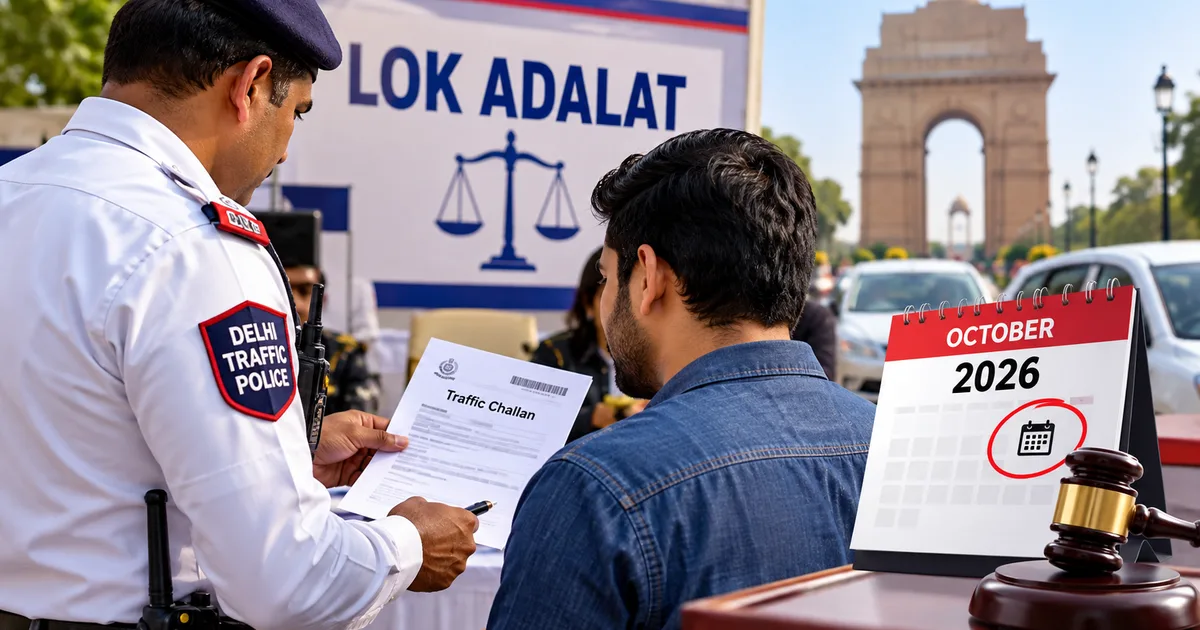
If you drive in the national capital, you know that sickening feeling when a traffic camera catches your number plate, followed days later by an SMS alert. Those ₹1,000 and ₹2,000 penalties add up fast on the Parivahan portal. Soon enough, you're sitting on five pending notices that freeze your vehicle ownership transfer or fitness certificate renewal. The upcoming Delhi Traffic Police Lok Adalat October 2026 session on Sunday, October 25, 2026, is your best opportunity to clear that backlog without draining your monthly budget.
I know how frustrating this feels. You get slapped with a fine for stopping two inches past the white line at ITO during evening rush, or your two-wheeler gets flagged by an automated speed sensor on the Barapullah corridor. Paying full price on every automated slip really hurts. Honestly, it's a mess. But that's exactly where the Lok Adalat steps in.
What the Delhi Lok Adalat actually is and why it exists
A Lok Adalat, or people's court, is an alternative dispute resolution setup established under the Legal Services Authorities Act. In simple words, it's a compromise bench headed by a sitting or retired judge alongside an advocate. Basically, the goal is straightforward. It unblocks the system by resolving minor disputes amicably instead of dragging citizens through endless court dates (which makes sense, actually). If you ask me, traffic courts would simply drown under paperwork without this release valve.
Thousands of camera challans hit Delhi vehicle owners every single week. It's relentless. Regular magistrate courts simply don't have time to hold individual trials for millions of compoundable traffic violations. So when you appear before a Lok Adalat bench, you aren't fighting a full trial. You're settling. The judge reviews your camera capture and listens to your side of the story before deciding whether to slash the fine or let you off with a caution.
The primary objective of holding traffic Lok Adalats is to provide accessible, speedy relief to commuters burdened by compounding camera notices while easing the heavy caseload resting on district traffic courts.
You can't just show up unannounced.
The entire exercise runs on a digital appointment system run jointly by the Delhi State Legal Services Authority and the traffic police. No token, no entry. If you don't have a pre-booked slip, security guards will turn you away right at the gate. It's really that strict.
Why the October 2026 session was rescheduled
You might recall seeing notices for a Lok Adalat earlier this autumn. The Delhi Traffic Police originally slated this session for mid-September. But plans changed quickly. Citywide security arrangements and VIP convoy movements for the BRICS Summit 2026 forced authorities to postpone district court hearings across the capital (and Delhi traffic during summit movements is a complete mess). Court administrations pushed back dates to avoid gridlock near central judicial complexes. I think rescheduling was their only sensible option.
Sunday, October 25, 2026, is now the confirmed date. Holding it on a Sunday makes life easier for government staff and office workers who can't take leave during the regular work week. Much like tracking the All India bank strike schedule, marking this revised Sunday on your calendar keeps you from missing the final settlement window of the season. Don't let it slip past.
Which traffic challans qualify for a discount
Not every traffic violation qualifies for relief. In my experience, this is the single biggest misconception drivers in Delhi have. A lot of motorists assume that stepping into a court automatically wipes away whatever penalty sits on their registration. That's simply not true.
Compoundable versus non-compoundable violations
Under the Motor Vehicles Act, traffic offences fall into two buckets: compoundable and non-compoundable. Only compoundable offences can be resolved at a Lok Adalat bench. Basically, a compoundable offence is a minor slip-up where the law lets you settle by paying a fee rather than facing jail time or a drawn-out prosecution (which is a relief for most everyday commuters).
Eligible compoundable violations include:
- Red-light jumping and stop-line violations captured by intersection surveillance cameras.
- Exceeding speed limits detected through laser speed guns or overhead highway sensors.
- Riding a two-wheeler without a helmet or carrying a pillion passenger without headgear.
- Driving a car without fastening your seatbelt.
- Improper parking that disrupts road traffic.
- Expired Pollution Under Control certificates and minor paperwork lapses.
- Using mobile phones while driving, provided it caused no collision.
Non-compoundable offences can't be touched by a Lok Adalat bench. If your challan involves drunk driving under Section 185, street racing, reckless driving that caused injury, or driving without any license at all, the magistrate can't settle it. No chance. Those serious offences remain tied to a regular traffic court where formal trials and statutory penalties apply.
Thing is, if you already contested a challan and transferred it to regular court where charges were framed, you can't pull it back to Lok Adalat. So look at your Parivahan slip first. If the status says pending or sent to virtual court, you're good to proceed.
How to book your Lok Adalat token online step by step
Securing a token is easily the trickiest part of this process. Honestly, grabbing a slot feels like booking Tatkal train tickets on IRCTC during festival rush. Thousands click the exact second slots open, and gateway errors pop up everywhere. The server capacity numbers here are a bit fuzzy, but slots vanish in minutes. If you want to see how public platforms handle spikes like this, our plain-English tech explainers break down similar queuing tools on Indian platforms.
Here is the exact step-by-step workflow you must follow when the token booking window goes live:
- Open the official Delhi Traffic Police portal on your browser and locate the dedicated Lok Adalat banner on the home screen.
- Enter your vehicle registration number or your specific challan notice number into the lookup box.
- Submit your registered mobile number to receive an authentication code via SMS.
- Review your list of pending notices displayed on the screen and select the challans you want to settle.
- Choose your preferred district court complex from the drop-down menu based on where your violations happened or your home address.
- Select an available time slot and submit your details to generate your appointment slip.
- Download the generated PDF document immediately and save copies on your phone and computer.
The system limits how many challans you can attach to one token (annoying, I know). Most sessions cap your booking at two or three notices per vehicle, with a hard ceiling of two tokens per user account. So if you're sitting on six or seven pending slips, pick the highest penalties first. That gives you the biggest rupee discount right away.
Dealing with website crashes on booking morning
The registration window usually opens at 10:00 AM two or three days before the court date. By 10:02 AM, the portal crawls. Sudden traffic surges cause frequent timeouts, much like the network congestion during Delhi NCR earthquake alerts when thousands of devices ping networks simultaneously. In my experience, if you aren't already on the page at ten sharp, you're fighting an uphill battle.
Don't smash the refresh button if the screen freezes while waiting for your OTP. That kills your queue position and kicks you straight to the end of the line. Instead, open the portal early, keep your vehicle registration copied on your clipboard, and stick to a reliable home Wi-Fi connection. The whole scramble reminds me of the process in our Delhi Laxmi Yojana registration guide, where solid preparation makes all the difference.
Documents you must carry to the court complex
Once you've got your token, don't think you can walk in with only a smartphone. Delhi court security is strict about physical paperwork. If you flash a PDF on your screen, guards will send you straight to the crowded photocopy stalls outside the gate (which, for the record, is the last place you want to wait on a Sunday morning). In my experience, those gate queues are pure chaos.
Before heading out on October 25, assemble a folder containing these items:
- Two clear physical printouts of your downloaded Lok Adalat challan slip showing your assigned courtroom and serial number.
- Printed copies of each individual pending challan listed on your token.
- Original vehicle registration certificate alongside a printed copy or verified DigiLocker export.
- Your original driving license and one self-attested photocopy.
- A valid government identity card such as your Aadhaar card or voter ID.
- Adequate physical cash in small notes alongside your active UPI payment apps.
Why carry cash when UPI is everywhere? It's simple. Mobile reception inside court basements is notoriously sketchy, and payment gateways routinely drop when hundreds of people try scanning QR codes at the same desk. Carrying ₹1,000 in physical currency means you won't get stuck waiting for a failed transaction to reverse.
What happens inside the courtroom on October 25
Seven district court complexes host benches across Delhi: Tis Hazari, Patiala House, Karkardooma, Rohini, Dwarka, Saket, and Rouse Avenue. Arrive early. Getting there thirty minutes ahead of your slot gives you enough breathing room to navigate security. Guards will inspect your physical paper slip before letting you past the main gate.
Once inside, track down your assigned courtroom. Court staff call out token numbers in batches. When your turn arrives, simply step up to the bench. The magistrate checks the camera image on the screen and asks you a quick question or two about the violation.
Be polite. If an automated camera caught you speeding while rushing someone for urgent medical care, explain it calmly. Magistrates have broad discretion. I'm not sure exactly why some benches are more lenient than others, but judges routinely cut ₹2,000 fines down to ₹300 or ₹500 for first violations. For minor slips like crossing a stop-line, they often waive the penalty entirely with a simple warning. If you ask me, being respectful before the bench goes a long way.
After the judge decides the settled penalty, the court clerk stamps your slip with the formal disposal order. You carry this stamped paper over to the payment counter to pay the fine and collect your official receipt. Guard that receipt like gold. It's your legal proof of discharge.
Common mistakes that get motorists turned away
Every session sees hundreds of drivers leave empty-handed over simple procedural mistakes. We cover these hurdles in our practical citizen tech guides because administrative rules catch people off guard constantly. In my experience, five minutes of prep work saves you hours of frustration.
First, never send a relative or friend to represent you without a signed authorization letter and copies of your government ID. If your car or scooter is registered in your spouse's or father's name, showing up without that letter will get you turned away instantly. It's a non-negotiable rule.
Second, don't bring out-of-state challans to Delhi benches. If a camera caught you speeding on the Yamuna Expressway in Uttar Pradesh or the Kundli-Manesar-Palwal Expressway in Haryana, Delhi magistrates have zero jurisdiction over those offences. Those notices belong to their respective state courts (and bringing them here won't help you at all).
Finally, check your Parivahan app two or three days after the session wraps up. The traffic police database usually takes forty-eight to seventy-two hours to update and mark your notices as disposed. But if an old fine still lingers as pending after seven working days, head down to the Delhi Traffic Police headquarters at Todapur with your stamped court receipt so they can clear your digital record by hand.