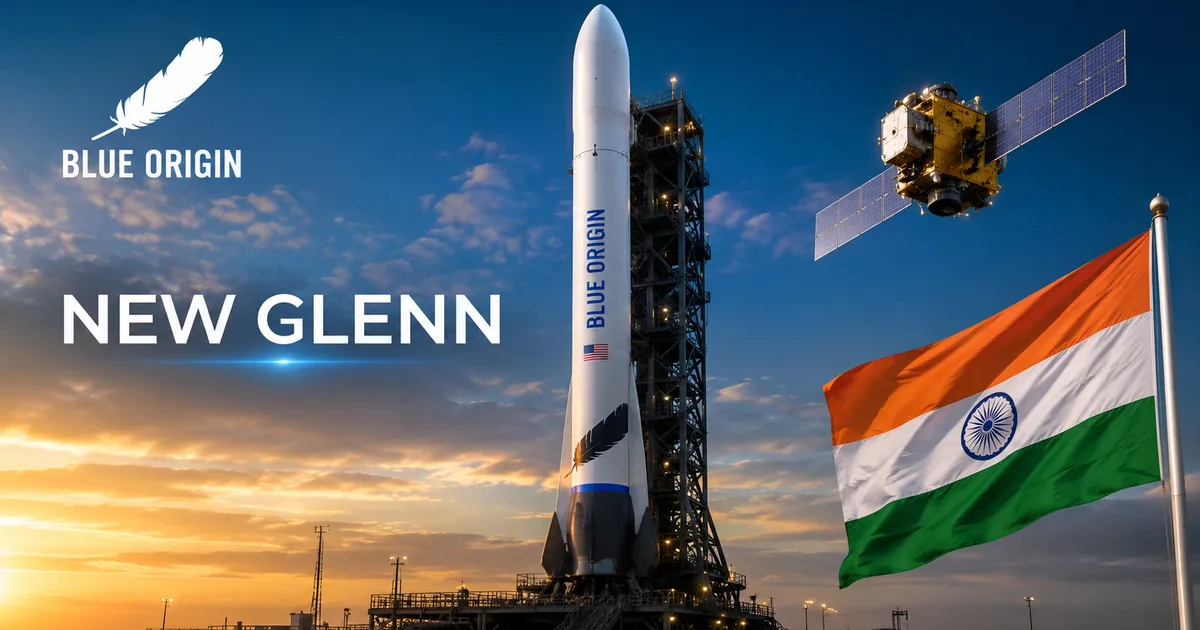
If you've been following space news lately, Blue Origin's New Glenn rocket keeps showing up in headlines for all sorts of reasons, most of them dramatic. Earlier in 2026, it successfully reused its booster at sea for the first time. Then it put a satellite into the wrong orbit. And on May 29, 2026, it blew up on the launch pad during a hotfire test at Cape Canaveral in Florida. No injuries, fortunately, but the explosion was big enough to shake nearby homes and briefly paint the sky orange.
So, what exactly is New Glenn? And why should someone in India care about a rocket owned by Jeff Bezos's space company?
Turns out there are a few genuinely interesting reasons, including a Lucknow-based manufacturer that is literally making parts for this rocket right now.
What New Glenn actually is
New Glenn is Blue Origin's flagship orbital rocket. "Orbital" matters here. Blue Origin's older rocket, New Shepard, just goes up and comes back down, taking tourists to the edge of space. New Glenn gets payloads into orbit around Earth, which is where the real commercial action is. Think of it this way: if New Shepard is a local bus, New Glenn is a cargo flight between cities.
The rocket is about 98 metres tall, roughly the height of a 30-storey building. It can carry up to 45 tonnes to low Earth orbit (LEO) and around 13 tonnes to geostationary transfer orbit (GTO). That puts it in the same league as SpaceX's Falcon Heavy, which has become the dominant vehicle for large commercial payloads.
New Glenn is named after John Glenn, the first American to orbit Earth in 1962. It runs on seven BE-4 engines on its first stage. The BE-4 burns liquid oxygen and liquefied natural gas, which is cleaner than older kerosene-based engines. These same engines also power United Launch Alliance's Vulcan Centaur rocket, which tells you Blue Origin has actual external customers for the BE-4 beyond its own programme.
Reusability and the launch economics argument
The commercial logic behind New Glenn is reusability. SpaceX cracked this with Falcon 9 and it fundamentally changed the economics of getting things to space. Before reusable rockets, once a launch vehicle flew, that was it. You'd spend hundreds of millions building a rocket you used exactly once. SpaceX proved you could land the first stage and fly it again, dozens of times over.
Blue Origin is attempting the same thing with New Glenn. On its third flight, it successfully landed the first stage on a ship in the ocean, the first time a New Glenn booster had been reused. That's a real achievement, honestly. Landing a massive rocket on a moving ship in open ocean is hard in ways that are difficult to overstate. Blue Origin has been pricing New Glenn launches at reportedly around $60-70 million, comparable to a SpaceX Falcon 9. That pricing only makes commercial sense if the booster gets reused consistently, which is exactly what the company still needs to prove.
The bad news: that same third flight put the payload, AST SpaceMobile's BlueBird 7 satellite, into the wrong orbit. The FAA officially called it a "mishap." BlueBird 7 was effectively lost. And then, as if the year hadn't been dramatic enough, the next New Glenn (designated LN-01) exploded on the launch pad during a hotfire engine test on May 29. Jeff Bezos's response: "we'll rebuild."
Which, honestly, is the only response available to him.
India's unexpected role in the New Glenn programme
Here is the part Indian readers might not have seen in the main headlines. PTC Industries' Aerolloy Technologies, an Indian aerospace manufacturing company, won an order from Blue Origin to supply components for the BE-4 engine that powers New Glenn.
Aerolloy Technologies is the aerospace division of PTC Industries, a company listed on Indian stock exchanges. BE-4 engine components need precision casting and machining to tight aerospace tolerances (annoying, I know, but that's the nature of rocket parts). The fact that an Indian company won this contract says something about where Indian aerospace manufacturing has quietly reached over the past decade.
This matters beyond the stock story. India has been building aerospace manufacturing capabilities for years, partly through ISRO's supply chain and partly through private investment. Companies like Aerolloy are now plugging into global commercial space supply chains. That feeds into India's broader goal of becoming a commercial space manufacturing hub, something the government has been pushing through the IN-SPACe framework since 2020. For more on India's growing private space sector, take a look at our space industry guides.
How New Glenn compares to ISRO's rockets
ISRO's LVM3 (formerly GSLV Mk III) is India's heaviest operational rocket, capable of carrying about 8 tonnes to LEO or around 4 tonnes to GTO. It launched Chandrayaan-3 and has been ISRO's commercial workhorse for large payloads. ISRO's commercial arm, NewSpace India Limited (NSIL), also sells launch slots internationally and has been quietly building a customer base.
New Glenn, with 45 tonnes to LEO, is significantly bigger. But size isn't really the comparison point here. New Glenn is American and private, and Indian satellite operators sometimes need to launch internationally when ISRO's schedule is full or when a payload spec doesn't match Indian rockets cleanly.
Could Indian satellite operators use New Glenn? Theoretically, yes. Right now, though, two major incidents in quick succession mean Blue Origin is grounded while the FAA investigates. That process takes months, at minimum. Any Indian company that had New Glenn in its 2026 or early 2027 launch plans is now dealing with real schedule uncertainty. You can read more about how India's satellite sector works in our tech explainers section.
What this means for India's commercial satellite sector
India's commercial satellite sector has been growing steadily. Companies tied to OneWeb (where Bharti Airtel holds a stake), newer Indian space startups, and government entities like NSIL all need reliable launch options. More launch providers globally means better pricing, more schedule flexibility, and less dependence on any single provider.
SpaceX Falcon 9 currently dominates commercial launches. New Glenn was supposed to provide real competition. A setback for New Glenn doesn't immediately change SpaceX's pricing, but it delays the diversification of options that would benefit customers, including Indian ones, over the next few years.
There's also the regulatory overhang. The FAA is already treating the wrong-orbit incident as a formal mishap requiring investigation. An explosion during a ground test is a separate incident on top of that. Two significant failures close together will mean stricter scrutiny on New Glenn's certification before it flies again.
For Indian satellite operators, the practical message is simple: don't make New Glenn your only launch option for 2026-27. Keep ISRO's PSLV and LVM3, NSIL's slots, and SpaceX Falcon 9 in the mix. Commercial space is competitive precisely because no single provider is perfectly reliable. Keep an eye on the latest developments in our space and tech news section.
Will New Glenn recover from this?
SpaceX had multiple failures before Falcon 9 became the workhorse it is today. ISRO had GSLV failures that set the programme back years. Rocket development has always been iterative and expensive, and Blue Origin has the financial backing to keep going. Bezos has been funding Blue Origin directly for years, and the company now has a supply chain that includes Indian manufacturers. That suggests the programme has real industrial depth.
The May 29 explosion destroyed one vehicle and set back the timeline by some months. "We'll rebuild" is probably accurate. The real question is how long recovery takes and whether launch customers hold on or move to alternatives in the meantime. I'm not sure exactly how long the FAA review will drag on, but a few months is the optimistic read.
For India, the story worth watching is less about whether New Glenn eventually launches Indian satellites and more about whether Indian manufacturers like Aerolloy Technologies keep winning supply chain contracts as the programme matures. That's the more durable opportunity, regardless of how long New Glenn's current grounding lasts.