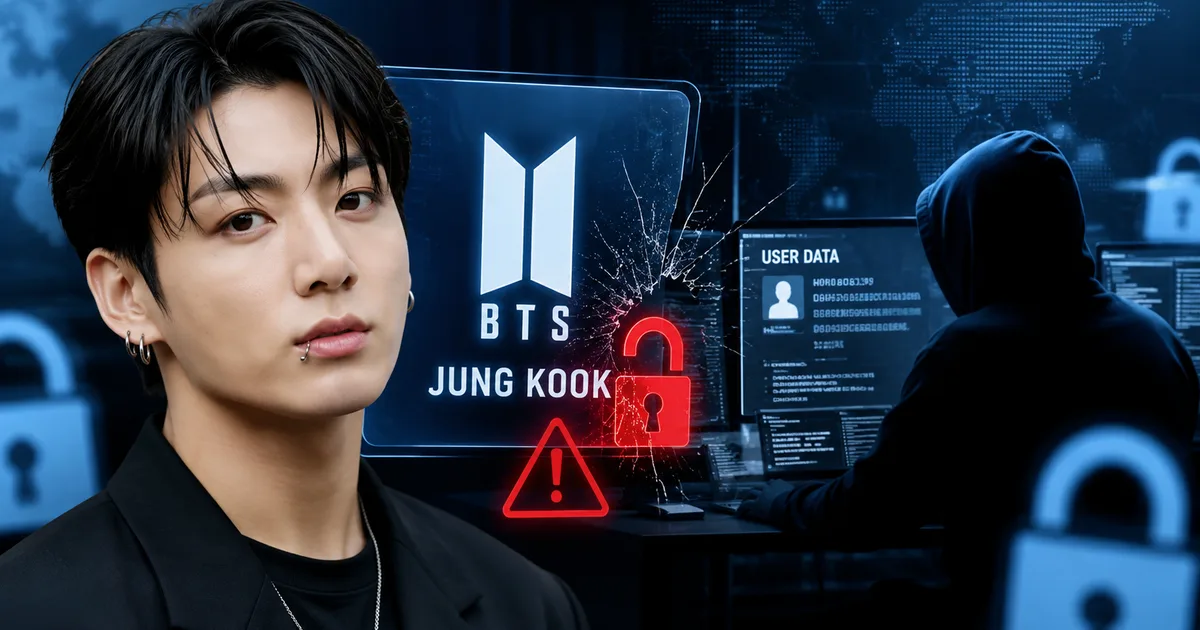
So the news is out about the BTS Jung Kook hacking case 2026 and the details are honestly terrifying. A Chinese national just got hit with a 20-year prison sentence in Seoul for trying to steal roughly 224 crore rupees in a massive cyber fraud scheme. A big chunk of that involved targeting the HYBE shares owned by BTS superstar Jung Kook.
I read through the court documents and South Korean news reports today. The scale of this operation is wild. Basically, the ringleader was pulling the strings from Thailand before getting extradited to face justice. They managed to target 8.4 billion won (around 53 crore rupees) just in Jung Kook's stock options, which is a mess.
This goes way beyond K-pop royalty getting targeted. This kind of financial fraud is happening right here in India too. I know it sounds distant. But the tactics are identical.
How the BTS hacker pulled off a 224 crore fraud
This hacking group wasn't just guessing passwords. They ran a highly organized criminal operation. The Chinese ringleader showed "no sincere remorse" in court. And they coordinated a whole network to bypass two-factor authentication to get into secure financial accounts.
They specifically targeted HYBE shares. HYBE is the parent company of BigHit Music and the agency behind BTS. High-net-worth people holding millions in company stock are walking targets. The hackers used advanced phishing to compromise the accounts (annoying, I know).
They didn't act alone. This was a syndicate operating across borders. They hid in Thailand. They probably assumed local police wouldn't catch them. But international police cooperation actually worked this time, which is surprising. They caught the ringleader and extradited them to South Korea. A Seoul court gave them a 20-year sentence. That's a massive amount of prison time for a cybercrime. The fraud was on a $25.5 million (roughly 224 crore rupees) scale, so the judges clearly wanted to send a message.
In my experience, it really makes you think about our own digital security. We might not have 53 crore rupees in HYBE shares sitting around. But the tactics used by these hackers are the exact same ones hitting ordinary people in Mumbai and Bengaluru every single day.
Why hackers target K-pop idols like Jung Kook
You might wonder why a hacking ring would go after a pop star instead of a bank directly. It's simple math. The K-pop industry generates billions of dollars. Idols like Jung Kook get massive stock options as part of their contract renewals, so their personal accounts are incredibly valuable.
Celebrities often have vulnerable personal security. They travel constantly and use public Wi-Fi in hotels. They get thousands of emails a day. All it takes is one assistant clicking a sketchy link in an email claiming to be a brand deal, and the hackers are in.
Once they get into an email account, they don't immediately steal the money. They just sit there. They read the emails to learn the communication style of the financial advisor. I'm not sure exactly why they wait so long sometimes, but they figure out when the stock options vest and how to authorize a transfer. Sophisticated hackers will stay hidden for months just gathering intelligence.
Then they strike.
What this means for everyday Indian internet users
Look, you probably don't have international hackers tracking your stock portfolio. But the underlying mechanics of this hack matter for anyone with a smartphone and a bank account in India.
The scammers who tried to drain Jung Kook's accounts used the same basic principles as the guys calling you about a blocked SBI credit card or sending fake electricity bill alerts on WhatsApp. They find a target. They gather personal information. Then they exploit a weak point in the security chain.
In India, our lives are completely tied to our phones. Your Aadhaar is linked to your PAN, which is linked to your bank account, which is linked to your UPI app. If a hacker gets access to your primary Gmail account or clones your SIM card, they have full access to your financial life.
I think the craziest part is how fast it happens. I see so many cases where someone loses their life savings because they clicked a malicious APK file pretending to be a courier delivery update. It takes five minutes. The hackers drain the accounts, convert the rupees to crypto, and the money is gone forever.
The BTS case is just a highly publicized version of this. The numbers are bigger, and the targets are famous.
The WhatsApp stock trading scams hitting India right now
This case perfectly mirrors the massive wave of stock market fraud happening right now in India. You've probably seen the ads on Instagram or received a random WhatsApp message inviting you to a VIP trading group.
The scammers pretend to be well-known Indian investors or representatives from legitimate brokerage firms. They share fake screenshots of massive profits. And they convince you to download a custom trading app that isn't on the official app stores.
You transfer your rupees into this app. At first, the app shows your investments doubling. You get excited and invest more. But the app is completely fake (which makes sense, actually). The numbers on the screen are just pixels. When you try to withdraw your money, they ask for a tax fee. Eventually, the group gets deleted and your money is gone.
These Indian trading scams are run by similar syndicates operating out of Southeast Asia. They use the exact same psychological tricks that the Chinese hacker used to target Jung Kook's HYBE shares. They prey on the desire for quick money and the assumption that our digital systems are secure.
If you're investing through Indian platforms, you need to be incredibly careful. Never take stock tips from WhatsApp groups. Never install third-party trading apps. Stick to verified platforms and enable every security feature they offer.
How these financial hacking rings operate
Honestly, the way these international hacking rings operate is terrifying. They run like regular corporations. They have HR departments and performance targets. They have specialized teams for different tasks.
A typical high-level financial hack works like this.
- They buy leaked databases from the dark web to find your phone number and email address.
- They send a highly personalized phishing message that looks like an urgent notice from the Income Tax Department or a legitimate business contact.
- They bypass security using SIM swapping or malware to read your text messages, getting around your password entirely.
- Once they are in, they move fast to add themselves as a beneficiary on your bank app or transfer funds directly via UPI.
Traditional security advice is failing. Telling people to just use a strong password doesn't work when the hackers can bypass your password entirely.
Protecting your money in 2026
You can't unplug from the internet. You need to use digital payments and manage your investments online.
But you can make yourself a harder target. Hackers are lazy. They want easy money. If your accounts are slightly harder to crack than the next person's, they'll usually move on.
The single best thing you can do today is stop using SMS for two-factor authentication whenever possible. Use an authenticator app instead.
You should take these practical steps right now.
Lock down your telecom security
SIM swapping is a huge risk in India right now. Contact your telecom provider and ask them to add a PIN or password to your account. This means nobody can request a duplicate SIM card without knowing that specific code. Pay attention to your network signal. If your phone suddenly loses network completely and doesn't recover for hours, someone might have swapped your SIM. Call your bank immediately.
Stop downloading random apps
I see this all the time. Someone gets a WhatsApp message with a link to download an app for a free government scheme. They install the APK file. That app is just malware. It sits on your phone, reads your OTPs, and sends them to the hackers. Only install apps from the official Google Play Store or Apple App Store. Check our latest updates regularly to stay informed about new malware targeting Indian users.
Use a hardware security key
If you handle sensitive data, you need to step up your security game. Forget SMS OTPs. Buy a hardware security key. You plug it into your phone or laptop when you need to log in. Even if a hacker has your password and your phone number, they can't get in without the physical key. It costs around 4000 rupees and is the best investment you can make for your digital security.
What to do if you get hacked in India
We always think it won't happen to us. If you ask me, that's the biggest mistake people make. If you wake up one day and find your bank account empty, you need to act incredibly fast.
First, call your bank's emergency hotline and freeze your accounts immediately. Don't wait. Don't send an email. Just call them.
Second, call the national cybercrime helpline at 1930. The Indian government set this up specifically to handle financial cyber fraud. If you report the transaction within the first few hours, there's a decent chance they can freeze the funds in the scammer's receiving account before they convert it to cryptocurrency.
Third, file a formal complaint on the official government portal at cybercrime.gov.in. You'll need the transaction details and your bank statements. Keep screenshots of everything.
It's a stressful process. Frankly, the banks aren't always helpful. But you have to push them. The RBI rules are very clear about unauthorized transactions. If you report it immediately, the liability is on the bank, not you. You just have to fight for it.
The reality of modern cybercrime
The BTS Jung Kook hacking case 2026 is a massive wake-up call. When a Chinese national can coordinate a 224 crore heist targeting South Korean celebrities from a base in Thailand, the game has changed entirely.
These hackers aren't kids in basements anymore. They run multinational criminal enterprises. The numbers here are a bit fuzzy, but they have massive resources and infinite patience.
We need to stop victim-blaming people who get scammed. The systems we use every day have serious security flaws. That includes your bank and your telecom network. The companies building these systems need to take more responsibility. Until they do, we're all on our own.
Take a few minutes today to check your security settings. Enable app-based two-factor authentication. Delete those sketchy apps from your phone. And maybe think twice before clicking on that text message about your income tax refund. You can read more about securing your devices in our comprehensive security walkthroughs. It might take an hour of your time, but it could save you a massive headache down the line.