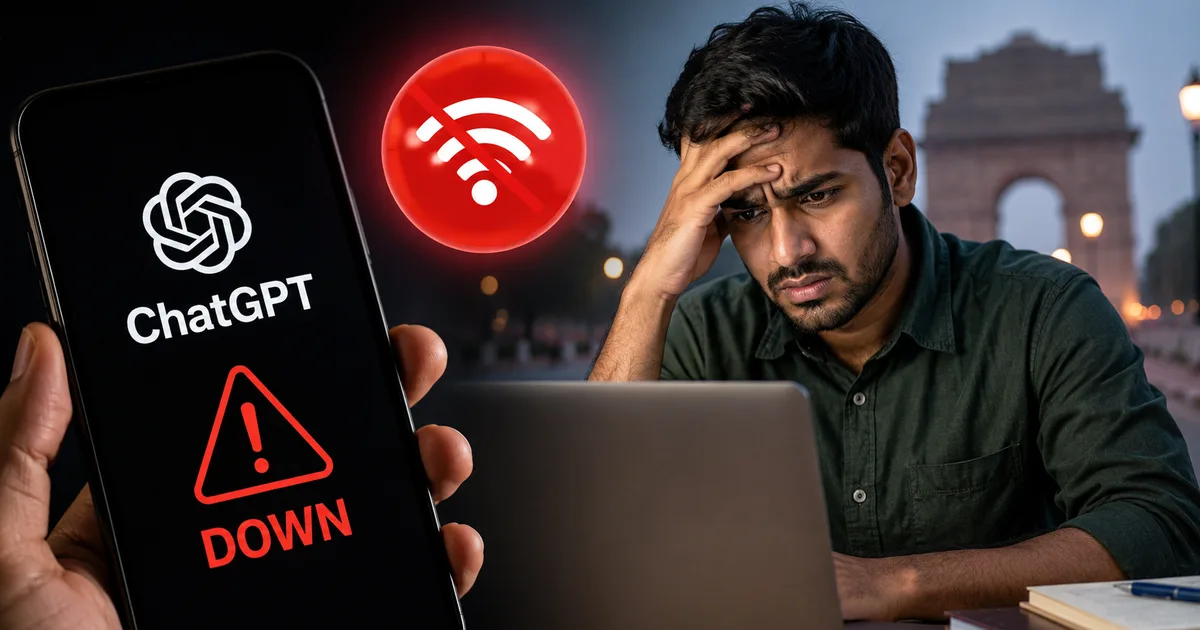
It was a Friday morning when thousands of Indian users opened ChatGPT and got nothing. Spinning loaders. Error messages. Past chat histories gone. If you were one of them, you weren't alone, and you definitely weren't imagining it. On May 29, 2026, OpenAI experienced one of its more significant outages, taking down ChatGPT, DALL-E, Sora, Codex, the developer API, and even the login system all at once.
This wasn't a small blip. According to Digit.in, more than 4,300 users in the US alone filed reports on Downdetector within hours of the disruption starting. India's numbers were harder to pin down officially, but social media lit up with complaints from Mumbai to Bengaluru to Hyderabad. Students mid-assignment. Developers whose Codex tools had gone silent. Small business owners whose AI-assisted workflows just stopped.
What actually went down during the OpenAI outage
The scope is what made this one unusual. Most service disruptions hit one part of a platform. This one hit everything at the same time.
- ChatGPT refused to load new queries. More annoyingly, past chat history disappeared from the sidebar completely.
- Codex stopped responding and wasn't updating its own status page either, leaving developers genuinely confused about whether the problem was on their end or OpenAI's.
- DALL-E image generation went offline entirely.
- Sora, OpenAI's video generation tool, went dark.
- The developer API showed elevated error rates, specifically on GPT-4o-mini, per OpenAI's own status page at status.openai.com.
- The login system itself failed for some users, making it impossible to even confirm what was wrong.
OpenAI's status page did eventually acknowledge the issues, though it took a while to catch up with what users were already seeing in real time. In my experience, official status pages during live incidents are almost always a few steps behind what users are actually reporting. The GPT-4o-mini API errors were confirmed by OpenAI, who said a fix was being applied. How long full restoration took varied by service.
Why Indian users felt this more than most
Here's the thing about India's relationship with ChatGPT. It's not casual anymore.
Over the past two years, ChatGPT has embedded itself into how a huge number of Indian professionals actually work. Law students draft case summaries with it. Software developers at mid-size companies use the API for automation. Freelancers writing English-language content for international clients use it constantly. Teachers build lesson plans with it. Customer support teams use GPT-4o to handle first-level queries before a human steps in.
So when it goes down at 9am on a Friday, the disruption lands hard. And there's a timing problem specific to India: IST is UTC+5:30. That means Indian users hit this outage right in the middle of peak morning work hours while large parts of the US were still asleep. There's no coordinated maintenance window that works cleanly across that time gap.
Codex being down was particularly painful for developers. Many Indian IT teams had integrated Codex into code review workflows or CI/CD pipelines. Bengaluru and Hyderabad, especially. When Codex stopped responding and didn't update its own status page, teams spent hours guessing whether the problem was on their end or OpenAI's. That ambiguity alone costs real time.
On May 29, 2026, OpenAI's outage simultaneously affected ChatGPT, Codex, DALL-E, Sora, the developer API, and the login system. More than 4,300 US users reported issues on Downdetector within hours, and Indian users across major cities reported widespread disruption during peak morning work hours.
Why do these outages happen at all?
This is worth understanding, because it's easy to assume that a company worth hundreds of billions of dollars just shouldn't have downtime. That's not how any of this works.
OpenAI's infrastructure runs on Microsoft Azure globally. ChatGPT alone serves hundreds of millions of users. The volume of compute required is staggering. When something goes wrong at that scale, a bad deployment or a cascading database failure, it can ripple across everything very fast.
The fact that so many services went down simultaneously suggests this wasn't a single-service bug, though I'm not sure exactly where the failure originated. It points toward something at the authentication or central infrastructure layer. When the login system fails at the same time as Codex, DALL-E, the API, and Sora, that's usually not five separate problems. That's one central problem causing everything else to fall over.
And no, this isn't unique to OpenAI. Cloudflare had its own global outage in 2026 that took down huge chunks of the internet at once. TikTok had a notable disruption too. Large-scale distributed systems fail. The question is how quickly they recover and how transparently they communicate during the incident.
Honestly, the bigger issue here isn't that outages happen. It's that users often don't know what's happening or for how long. When Codex goes down and its own status page doesn't update, that's a transparency failure on top of a technical one.
What you can actually do when ChatGPT goes down
First, check status.openai.com before spending 20 minutes restarting your router and reinstalling the app. Seriously. This is step one and most people skip it entirely.
Beyond that, it helps to have alternatives ready. Not because ChatGPT is bad, but because depending on a single external service for anything time-sensitive is just bad planning. (I've made this mistake. Spent an entire afternoon waiting for a service to come back up when I could have just switched tools and finished the work.)
Some options that were working during this outage:
- Google Gemini at gemini.google.com, also available inside Gmail, Docs, and Google Meet for Workspace users in India
- Microsoft Copilot, built into Windows and Edge, which runs on OpenAI models but through its own infrastructure layer that can stay up even when OpenAI's direct services are struggling
- Perplexity AI, good for research-heavy queries and with a mobile app that works well on Indian connections
- Claude by Anthropic at claude.ai, increasingly used by Indian developers as a Codex alternative for code review and generation tasks
For developers specifically: if you're using the OpenAI API in production, you should have a fallback model configured. Most serious teams build in a secondary provider call if the primary returns errors above a threshold. A 30-minute integration now can save you from a production fire the next time this happens. This outage was a clean reminder of that.
The bigger picture: India's AI dependency problem
There's a broader question this outage surfaces. India is now one of the largest user bases for AI tools globally. ChatGPT, Gemini, Microsoft Copilot, and a dozen others like them: all US-hosted, US-company services. When they go down, Indian users have no recourse. No government SLA. No consumer protection that applies. No equivalent of what TRAI does for telecom services when those fail.
The Indian government has been pushing for domestic AI infrastructure through IndiaAI Mission and projects like Hanooman. But those are still early-stage, if you ask me. The practical reality in 2026 is that most Indian knowledge workers depend on foreign-hosted AI for significant parts of their daily workflows, and those services can go dark without warning or timeline.
This isn't a reason to panic or avoid using these tools. They're genuinely useful and the uptime is good most of the time. But it is a reason to not build single points of failure into your work. Keep offline copies of important prompts and templates. Know your alternatives before you need them. Don't set a time-sensitive client deliverable to require an AI step with a 10-minute buffer and no backup.
If you want to understand more about how AI services actually work at scale, including why they're prone to outages and what cloud dependencies these tools carry, it's worth reading up on how large language model inference works.
How to check if ChatGPT is down
Three places, in order of reliability:
- Check status.openai.com first. OpenAI's official status page. Not always real-time during fast-moving incidents, but authoritative once it does update.
- Go to downdetector.in for crowd-sourced reports. A real outage shows a sharp spike in filings within minutes of the problem starting.
- Search 'ChatGPT down' on X sorted by latest. Social media picks up widespread outages almost immediately, often before any official acknowledgement.
Also check your own internet before concluding it's OpenAI's fault. Something as simple as JioFiber acting up or a VPN glitch can look identical to 'ChatGPT is broken' when the problem is actually local to your connection. (I've seen this trip people up more times than I'd expect.) Our tools section has a quick connectivity diagnostic if you need to rule that out fast.
The May 2026 outage was real and it was wide. But not every ChatGPT loading failure is an OpenAI problem. Worth checking both ends before assuming the worst.
One last thing. If your work now seriously depends on ChatGPT or any AI tool, spend an hour building a backup plan. Not because outages are frequent, they're not, but because when one hits at the wrong moment, having an alternative ready makes the difference between a 10-minute inconvenience and a blown deadline. Our guide to building a reliable AI toolkit for Indian professionals covers this in more detail.