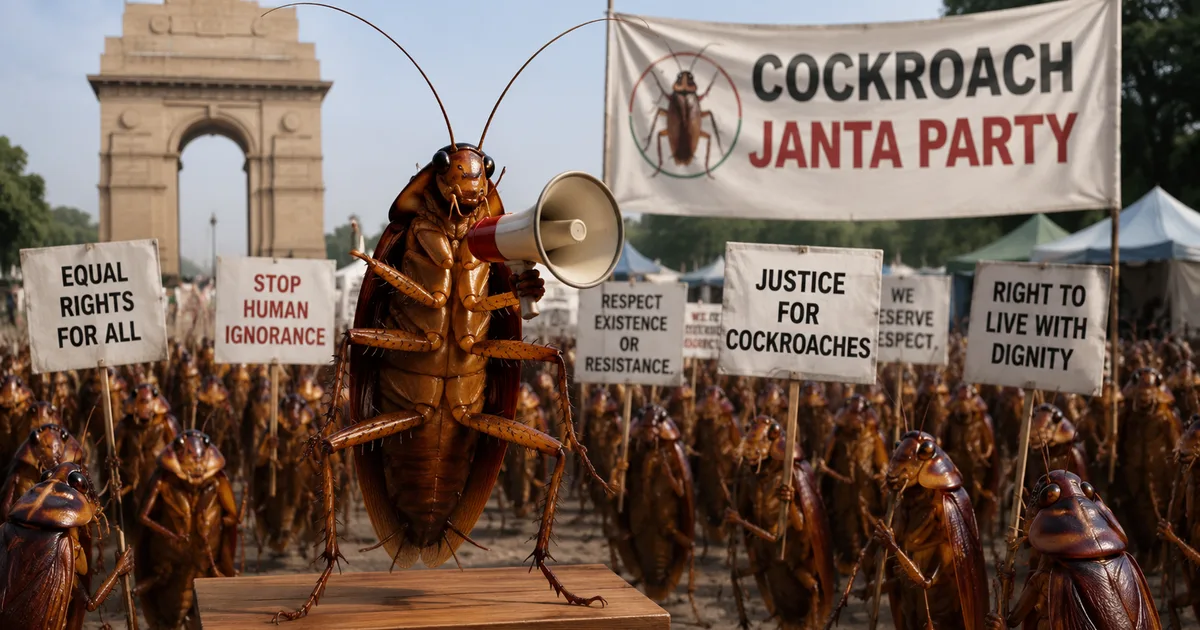
You've probably seen the WhatsApp forwards by now. Or maybe you noticed the endless trending hashtags on X over the last month. The Cockroach Janta Party (CJP) Jantar Mantar protest 2026 has been virtually impossible to ignore if you're on the Indian internet.
But let's be honest for a minute.
Most of the news coverage is a chaotic mess. You have screaming TV anchors and totally conflicting reports. I spent the last few days digging through what actually happened and how a spontaneous student movement forced a Union Minister out of office. Honestly, the whole thing is wild.
We need to break it down properly. No political spin. Just the facts about why thousands of students were camping out in the brutal Delhi heat.
What exactly is the Cockroach Janta Party?
Look, it's not a registered political party. You won't find them on an EVM anytime soon. They don't have a party symbol registered with the Election Commission.
The CJP is a digital movement (which makes sense, actually, given how teenagers organise today). Think of it as a massive Reddit thread that just spilled over into real life. Abhijeet Dipke and a few others founded it because they were fed up with competitive exams in India. Specifically, they were furious about the NEET-UG paper leaks.
I mean, think about it. You study for two years. Your parents spend lakhs on coaching institutes in Kota or Hyderabad. Sometimes they take out loans just to afford the hostel fees. You skip family functions and ruin your sleep schedule. Then some guy buys the paper on Telegram for ₹50,000 using UPI. It's absolutely infuriating.
I think that anger just needed a place to go. For a long time, it lived in YouTube comment sections. Eventually, the frustration boiled over.
The courtroom remark that lit the match
Things really blew up on July 25. That's when the infamous cockroach comment happened during a court hearing about the exam leaks.
Thing is, I won't repeat the whole exhausting context. Basically, someone compared protesting students to cockroaches that keep multiplying and causing a nuisance. Obviously, that didn't go down well with teenagers whose futures are hanging in the balance.
But instead of getting demoralised, the students owned it. They made it their brand.
Within hours, the Cockroach Janta Party was born online. People changed their profile pictures to cockroach images. Sarcastic memes flooded Instagram reels. It's classic Indian internet behaviour. They took a boomer insult and turned it into a weapon.
By leaning into the joke, they stripped the insult of its power. I think this was their smartest move. They created a shareable identity that even people who didn't care about NEET could get behind.
The 37-day standoff at Jantar Mantar
By early June, the digital outrage moved offline. Students arrived at Jantar Mantar in Delhi from all over the country. They stayed there for 37 exhausting days.
I tracked the live streams on YouTube. The organisation was pretty impressive for a leaderless movement. In my experience, you don't see that kind of coordination often. They didn't have seasoned politicians telling them what to do. They had QR codes for donations and Google Sheets for tracking food supplies. They also used encrypted WhatsApp groups to avoid police crackdowns (and honestly, who can blame them?). They essentially ran a startup out of a protest camp.
But it wasn't all peaceful sit-ins. Things got ugly fast.
- Mass detentions of students by Delhi police became a regular occurrence. At one point, six main organisers were picked up in a single night and shoved into police vans.
- Internet restrictions in the immediate area made it hard to coordinate. They had to rely on SMS and offline mesh networks.
- Midnight talks with government officials dragged on for weeks and went absolutely nowhere. It looked like a deliberate stalling tactic.
And then there were the rumours. A viral video tried to claim that volunteer Mohammad Junaid was splitting from the group to start his own faction. He put out a statement immediately calling them fake rumours. The CJP officially backed him up and provided legal support. The misinformation machinery was in full swing to fracture the leadership.
Why Dharmendra Pradhan had to resign
This is the part that surprised a lot of people. The Union Education Minister actually stepped down.
Usually, politicians weather these storms. They issue a generic apology or set up a committee. They suspend a few low-level bureaucrats. Then they wait for the news cycle to move on to a cricket match. This time was different.
The pressure just kept building. And the students refused to pack up.
The CJP dominated the narrative entirely. Every time the ministry put out a press release, it was ratioed into oblivion within minutes on X. The NEET-UG leak is a massive headache for the government. The stubbornness of the Jantar Mantar crowd kept the leak in the headlines day after day. It embarrassed the administration globally.
Finally, the dam broke. On July 25, Dharmendra Pradhan resigned.
"No protester will be left alone until our core demands are met. The resignation is just step one. We want systemic change, not just a change of face."
In my experience, student protests rarely claim a cabinet minister here. It showed that the government realised the political cost of ignoring the youth vote is getting too high.
What did the government actually agree to?
The protest didn't end just because the minister quit. They stayed at Jantar Mantar until the Centre agreed to their core demands. The movement called off the agitation once they got concrete assurances. They secured the following:
- Compensation for NEET victims families: The government agreed to provide financial support for students who lost years of preparation and money due to the compromised exams.
- A complete overhaul of the testing agency: They demanded, and supposedly received promises for, structural changes to how these massive entrance exams are conducted and secured.
- Withdrawal of police cases: The government agreed to drop the charges against the students detained during the 37-day agitation. This ensured their future careers wouldn't be ruined by a police record.
They called off the strike after these were accepted. Founder Abhijeet Dipke pointed out the irony immediately. He noted that the government spent way more time tracking the organisation's social media than actually fixing the leaks. If you ask me, that irony is pretty rich.
The digital playbook behind the protest
If you're reading our explainers regularly, you know I love looking at how tech shapes these events. The CJP protest is a masterclass in modern digital mobilisation.
Some news reports tried to paint this as a global playbook funded by offshore networks. You know the narrative. They compared it to the Arab Spring or implied foreign funding was paying for the tents and biryani. But talk to the actual students in Kolkata or Delhi. They'll tell you a completely different story. They just used the tools they use every single day.
How they bypassed the noise
When the TV channels ignored them or called them anti-national, they bypassed them entirely. They used Telegram channels to broadcast unedited footage of the police action so nobody could twist the narrative. And they used X spaces to hold nightly town halls. They answered questions directly from worried parents.
It's the exact same way people share deals or tech tips online. They just repurposed it for a massive political movement. Honestly, they didn't need an expensive PR agency. They had thousands of angry 19-year-olds with smartphones and cheap Jio data.
It makes you wonder how future protests will evolve. If the government shuts down WhatsApp during the next big agitation, what's the fallback? We might start seeing more adoption of decentralised apps or offline Bluetooth mesh networks like Bridgefy. The numbers here are a bit fuzzy, but the tech is real. It's definitely something to watch out for.
The Kolkata connection and the wider impact
Delhi was the epicenter, but you can't ignore how this resonated across the country. Students in Kolkata and Pune weren't just watching passively. Chennai students held solidarity marches too. They also ran parallel digital campaigns to keep the pressure on.
I spoke to a few engineering students who helped amplify the messages. They weren't even medical aspirants. They saw the NEET leak as a symptom of a completely broken system. For them, it was about basic constitutional rights and fighting against political interference in education.
I'm not sure exactly why this specific issue blew up so big, but they managed to take a highly specific issue and turn it into a broader conversation about how India treats its youth. When you have terrible unemployment numbers, and then you tell kids that the system is rigged against them even if they study 16 hours a day, you're lighting a powder keg.
The government defused it this time by giving in to the demands. But the playbook is out there now. The next time a government agency messes up a major exam, they won't just deal with angry letters to the editor. They'll be dealing with a highly coordinated digital army that knows exactly how to set up camp in the capital and wait them out.
And if you ask me, that's a change we desperately needed.
Watch out for the scams
Because this is India, scammers immediately tried to cash in on the chaos. I've seen at least three different WhatsApp forwards claiming to offer priority NEET re-exam slots. Or they share fake CJP legal defense fund donation links that actually just steal your banking details. It's super sketchy.
Here's the deal. The official CJP movement at Jantar Mantar is over for now. They aren't asking for money randomly on WhatsApp. If you see a link asking for UPI payments to support arrested students, ignore it immediately. It's a scam.
If you actually want to know how these UPI scams operate, check out our deep dive on protecting yourself from digital fraud. I think they just change the wrapper to fit whatever is trending in the news cycle today.
Always verify the UPI ID before sending money (annoying, I know, but you have to do it). Remember that no legitimate student group is going to ask for your Aadhaar details via a random Telegram bot. Keep your money safe. If you do fall for one of these scams, report it to cybercrime.gov.in or call the 1930 helpline.
What happens next for the students?
The tents at Jantar Mantar are gone. The students have taken the trains back home. The trending hashtags have died down. They are replaced by whatever the new controversy of the week is.
But the underlying issues haven't vanished. The NEET exams and the competitive coaching industry are still an anxiety-inducing mess. Millions of students are still terrified that their hard work will be undone by a leaked PDF file in a shady WhatsApp group.
The CJP proved that young people can force accountability. They organised smartly and used technology to their advantage. They refused to back down when intimidated. They used the internet to exert real political pressure on the people in charge. They didn't stop at complaining into the void. Every political party in this country is going to study this closely before the next general election.
I think we'll see if the government actually follows through on their promises. Knowing how bureaucracy works in this country, I wouldn't hold my breath. They love forming committees that take three years to publish a report nobody reads. The students get to claim a massive victory against a system that usually crushes them.