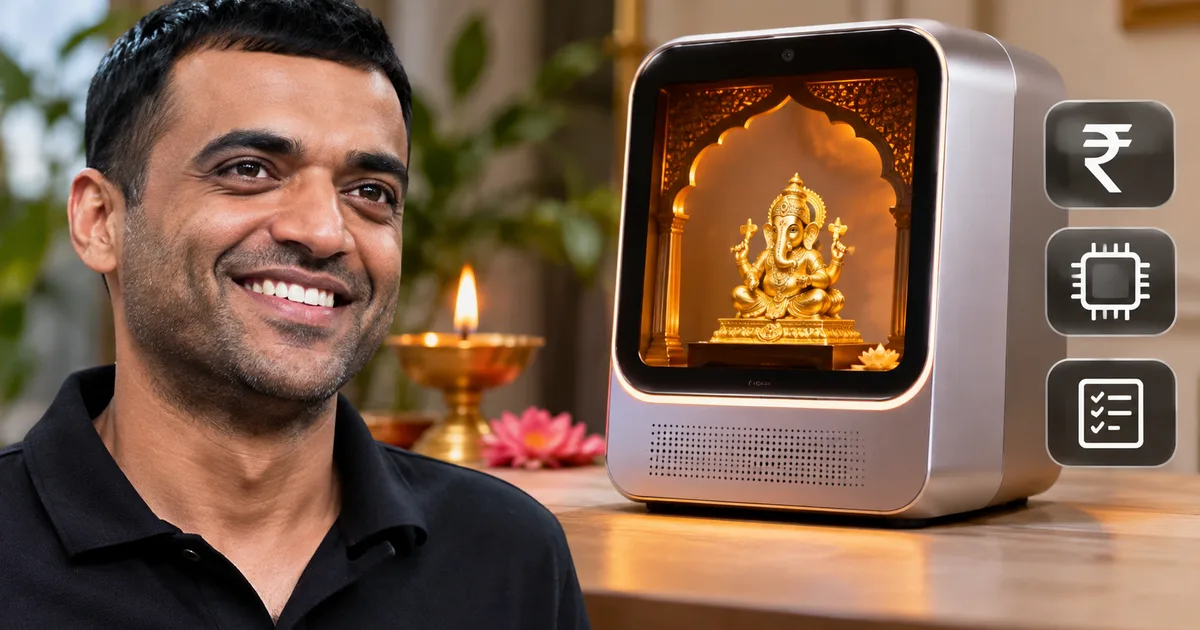
Zomato founder Deepinder Goyal has jumped straight into high-end hardware, and his latest bet is turning heads across the country. The Deepinder Goyal Temple device is a head-worn wellness gadget priced at ₹85,000, designed to sit against your forehead and track what's happening inside your skull. When pre-orders opened on November 1, 2026, eager buyers overwhelmed the checkout servers within minutes. Goyal took to social media to acknowledge the chaos, calling the server crash a classic beginner blunder. It's an ambitious piece of kit with a steep price tag, and it shows that Indian hardware makers are getting bold.
The site crashed fast.
If you follow our coverage of the latest tech news, you know Indian founders don't usually gamble on unproven consumer hardware. Most stick to safe bets like quick commerce or enterprise SaaS. Goyal is taking a very different path here. Temple isn't a Zomato product at all. It's his own personal health-tech venture backed with private money. The goal is pretty simple: build a gadget that tracks your brain state way better than a smartwatch on your wrist.
If you ask me, whether ordinary folks actually need brain tracking is another conversation entirely. (I know, spending eighty-five thousand rupees on a headband sounds bananas to most people, and honestly, it probably is.) Still, the tech packed inside this frame is worth checking out.
The ₹85,000 reality: Temple device price in India and booking rush
Here's the deal: buying a Temple unit will set you back ₹85,000. That's a lot of money. For context, it puts the device right in the price bracket of a flagship phone or a MacBook Air. In my experience, when most fitness bands in India sell for under ₹3,000, getting buyers to pay that kind of cash for an untested headband is a wild gamble.
Yet, when bookings opened at noon on November 1, the servers gave out almost right away. People with carts ready got stuck on blank screens. Goyal hopped onto X right away to address the mess:
"Underestimated the traffic by quite a bit. Rookie mistake. Fixing things right now," Goyal admitted shortly after the pre-order portal went down.
So who's buying it? Mostly biohackers, tech executives, early adopters, and fitness buffs with deep pockets. On the checkout page, you've got payment options for debit cards, net banking, credit cards, and UPI, though plenty of buyers chose no-cost EMI plans. Honestly, the numbers here are a bit fuzzy because the company hasn't said how many units were up for grabs in this batch. But the crash shows people are curious. You just don't see homegrown consumer hardware cause this kind of rush every day.
How BrainFlow tech tracks cerebral blood flow
Most fitness trackers rely on photoplethysmography (PPG) sensors pressed against your wrist skin. They shoot tiny green or red LED lights into your tissue. That's how they check pulse rates and blood oxygen. It works fine for step counts or checking your resting pulse while you sleep. But Goyal's team argues wrist measurements tell you almost nothing about your actual mental state.
The Temple band has proprietary BrainFlow technology to monitor cerebral blood flow across your forehead and temples. Instead of tracking peripheral blood vessels in your arm, the device puts optical and hemodynamic sensors right over the prefrontal cortex. That's the control center. It's the region of your brain responsible for focus, decision making, working memory, and emotional control.
When a specific brain area works harder, your vascular system pumps more oxygenated blood to those neurons. In neuroscience, that's called neurovascular coupling, and it happens within seconds of switching tasks. Temple reads those tiny blood flow shifts through your scalp and skull. I think it's fair to say the exact hardware under the hood is still somewhat hush-hush, mostly because the company hasn't published peer-reviewed papers yet. But the underlying concept is functional near-infrared spectroscopy (fNIRS), which scientists have used in labs for decades.
Basically, Temple wants to bring lab-grade brain scanning right to your desk.
The science of optical neuroimaging: fNIRS explained
To understand why this is different, you've got to see how consumer brain tech usually works. For decades, gadgets in this space relied on electroencephalography (EEG). EEG headsets measure the electrical signals produced by firing brain cells. And while EEG is great in a clinic, in my experience, it's notoriously fussy at home. You need sticky gel and clean skin contact just to stop the signal from dropping out whenever you blink.
Optical tracking with near-infrared light skips most of that mess. Bone and skin tissue are surprisingly translucent to near-infrared light in the 700 to 900 nanometer range. Oxygen-rich blood and oxygen-poor blood absorb this light at different rates. So by sending out specific wavelengths and reading what bounces back, the sensors calculate blood oxygen shifts inside your brain tissue in real time.
And that's why placement is everything. Dense hair blocks near-infrared light completely (which makes sense, actually). Because the sensors sit strictly across your forehead and the bare skin around your temples, the device gets clean contact without sticky goop or clumsy rubber caps. It's a sensible engineering trade-off that makes daily use doable at your desk.
Core Temple wearable features and the Entropy score
So what do you actually get once you strap this band onto your head? There's no display screen. You won't be reading WhatsApp messages or checking delivery updates while walking down the road. Instead, Temple connects over Bluetooth to a companion smartphone app.
The main metric inside the app is the Entropy score. In physics, entropy measures disorder. Temple applies that same idea directly to your state of mind. If your Entropy reading is high, it means your mental energy is scattered or fatigued. When the reading is low and steady, you're in a state of calm focus.
Look, distilling brain blood flow into a single number is great marketing, but if you ask me, it gives people genuinely useful feedback during work. You can see when your focus peaks during deep work sessions, or see how back-to-back Zoom calls tank your mental stamina. That kind of instant feedback is hard to get anywhere else.
Here are the primary hardware and software features included in the package:
- Non-invasive optical sensors positioned directly across your frontal lobes to record hemodynamic responses.
- Continuous real-time calculation of mental strain, focus duration, and recovery indexes.
- Lightweight ergonomic chassis available in multiple muted color finishes designed for extended desk work.
- Companion smartphone application providing daily cognitive trend charts, sleep correlation, and guided breathing exercises.
- Magnetic quick-charging dock that powers the band for a full workday of intermittent focus tracking.
We've seen ambitious luxury experiments like this before, much like how the Dyson Toothbrush 2026 dental tech aims to introduce advanced diagnostics to everyday grooming routines. Whether everyday consumers want that kind of complexity at home is another question entirely.
Headband versus smartwatch: can it beat the Apple Watch?
Deepinder Goyal raised some eyebrows when he claimed that Temple gives you far better physiological data than an Apple Watch. It sounds like classic founder talk. But looking at basic anatomy, I think he has a fair point.
Your wrist is noisy. Every time you type on a keyboard or carry groceries, wrist sensors pick up motion artifacts. To make matters worse, peripheral blood vessels shrink when you're cold or stressed, which messes up heart rate variability scores. Your head stays far calmer while you sit at a desk. And because brain blood vessels get steady blood flow from the carotid arteries, the biological signal is much cleaner.
Does that make Temple an Apple Watch killer? Not even close.
Your Apple Watch handles phone calls, pinging notifications, GPS maps, and workout badges for your evening run. Temple does none of those things. It's built strictly for brain state tracking, making it an entirely different category of gear. You'll probably put Temple on while working at your desk or doing morning breathwork, then swap back to your regular watch before stepping out. If you want a closer breakdown of dedicated versus multi-use devices, our detailed tech explainers show how specialized sensors compare to mainstream wearables.
Delivery timelines, data privacy, and Indian regulations
If you managed to snag a pre-order during the November 1 drop, don't expect a package on your doorstep anytime soon (annoying, I know). The company says initial shipments will take around three months. That puts first deliveries somewhere in February 2027.
Building consumer hardware is brutal. That's doubly true for a brand-new Indian startup dealing with sensitive optical components. Supply chain hold-ups and sensor calibration bugs could push things back without much warning. In my experience, Indian hardware projects often stumble on initial delivery timelines, so three months feels a bit generous.
Then there's user privacy under India's Digital Personal Data Protection (DPDP) Act. When a wearable tracks blood flow and cognitive fatigue, you're looking at deeply sensitive personal health data. The Temple app has to store and handle that biometric information with real care. Indian buyers will want absolute proof that their brain data won't be monetized or handed over to advertisers later on.
Is Temple worth ₹85,000 for regular users?
Let's be real here. For 99% of Indian computer users, spending ₹85,000 on a brain headband makes zero financial sense. You could buy a top-tier phone like the upcoming Motorola Signature 27 launch and still keep plenty of cash in your pocket for a proper ergonomic chair.
Temple isn't built for ordinary buyers right now. It's built for founders and tech enthusiasts who treat personal productivity like an obsession. If you ask me, unless knowing your exact neural fatigue score directly helps you run your company or close deals, you don't need this on your forehead.
For everyone else, the smart move is simple: sit back and wait. Let the first batch of buyers test the band in daily life, and let outside neuroscientists see if the numbers actually hold up. Right now, there's zero rush to be Goyal's guinea pig.