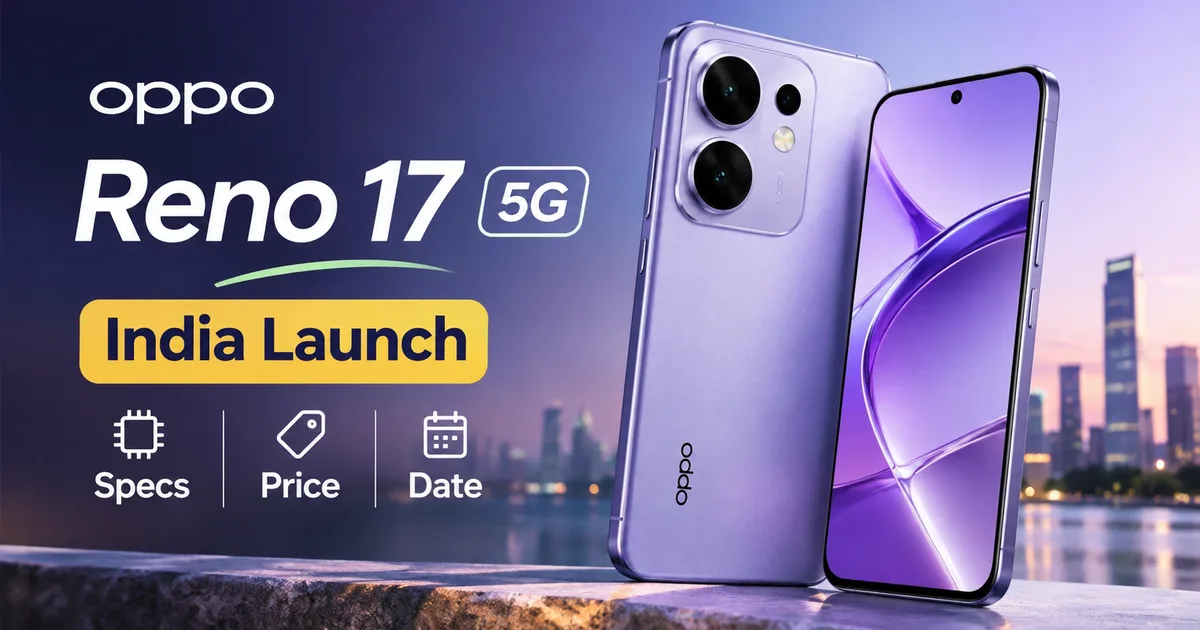
If you feel like Oppo just released a new Reno phone yesterday, you aren't imagining things. The company refreshes this lineup every five to six months in India, and the next cycle is already rolling in. Leaks around the Oppo Reno 17 5G have picked up speed over the past few weeks, thanks to fresh listings spotted on regulatory databases like Thailand's NBTC and chatter from tipsters across supply chains.
Oppo treats the Reno family as its main breadwinner across Indian offline retail. Walk into any local phone shop around Karol Bagh in Delhi or T Nagar in Chennai, and you'll spot massive Reno posters greeting you before you even talk to a salesperson. They're everywhere. But the mid-range market in India has changed drastically over the last year, if you ask me. Buyers are skeptical about paying premium money just for slim designs and portrait filters. People want reliable batteries and processors that won't choke during summer heat.
So what does this upcoming release bring to the table? Not a total reinvention, that's for sure. Based on leaked regulatory filings and reporting from publications like 91mobiles, the incoming generation brings some welcome practical tweaks (which makes sense, actually), along with a strategy shift that could surprise regular Reno fans.
Oppo Reno 17 5G price in India and variant expectations
Money dictates everything in this segment. The exact launch numbers here are a bit fuzzy, but industry sources track the base variant of the phone to land around Rs 38,000 in India for an 8GB RAM and 256GB storage configuration. A higher-spec 12GB RAM version will likely push closer to Rs 42,000 (standard markup for extra storage, basically).
That puts the phone squarely in territory where Indian buyers start demanding flagship-grade performance. It's steep.
In my experience, that kind of price tag makes people hesitate immediately. Thing is, Oppo rarely expects customers to pay sticker price upfront. The brand leans heavily on launch schemes. You can expect standard bank card instant discounts of roughly Rs 3,000 with HDFC or ICICI cards, alongside no-cost EMI plans spanning up to nine months. If you trade in your old handset through exchange portals on Flipkart or at an offline retail counter like Reliance Digital, the realistic checkout price will probably settle near Rs 34,000.
Here's how the pricing structure shapes up compared to the previous release:
- Base model with 8GB RAM and 256GB storage expected between Rs 37,999 and Rs 39,999
- Higher tier with 12GB RAM and 256GB storage expected around Rs 41,999
- Offline introductory bundles expected to include screen protection plans or discounted earbuds for early buyers
Is that competitive? It depends on what you value. If you want raw benchmark scores for competitive mobile gaming, phones like the performance-heavy iQOO Neo 12 5G give you significantly more compute per rupee. But Oppo knows who buys these phones. In my experience, the Reno line is really for people who care about a slim in-hand feel and hassle-free walk-in service support in tier-2 or tier-3 towns across India.
Oppo Reno 17 5G specifications and hardware upgrades
Every Reno refresh typically tweaks two things: the back panel finish and the camera setup. That's the formula. This time around, leaked spec sheets suggest Oppo is actually listening to user complaints about battery endurance and display smoothness. I think it's about time, too.
Display and everyday handling
On the front, leaks indicate a 6.7-inch curved AMOLED display. Oppo seems ready to jump from the conventional 120Hz panel up to a 144Hz refresh rate on this model. Does 144Hz matter over 120Hz for scrolling Instagram or checking WhatsApp? Honestly, you won't notice much difference in everyday app switching. It's barely perceptible. Where it actually helps is touch response during quick gestures and supported games.
Peak brightness is rumored to cross 1,600 nits in high brightness mode. That matters under harsh Indian sunlight. If you've ever tried reading Google Maps while walking outside during a scorching afternoon in Ahmedabad or Hyderabad (annoying, I know), you understand how frustrating reflective screens can be. The panel also has high-frequency PWM dimming. That's a welcome touch, especially because it cuts down on eye fatigue during late-night reading in pitch-dark bedrooms.
Camera hardware and the missing telephoto debate
Camera hardware is always the main marketing pitch for any Reno launch. Tipped specifications point to a triple rear camera cluster centered around a 50MP primary sensor with optical image stabilization.
The secondary cameras present an interesting picture. Some early Chinese leaks mentioned a high-resolution 200MP sensor, but recent listings analyzed by 91mobiles point to a much more grounded setup for global units. We're looking at a 50MP main camera paired with an 8MP ultra-wide lens, plus that usual 2MP depth sensor.
And this is where I get frustrated with brand decisions. Seriously. Putting a 2MP auxiliary sensor on a phone that costs nearly Rs 40,000 in 2026 is frankly insulting. Buyers at this price point deserve a dedicated telephoto lens for portraits (or at least a usable zoom). If you look back at the older Oppo Reno 15 Pro, that device had dedicated optical zoom that made portrait shots genuinely flattering. Cutting optical zoom on the standard model forces digital cropping. It looks grainy once the lights dim inside Indian banquet halls or family restaurants.
On the flip side, the front camera is still a major priority for Oppo. The leaks point to a 50MP selfie shooter with autofocus. For vloggers and selfie lovers, Oppo's skin tone tuning and front-facing edge detection are still some of the most reliable in this price bracket.
Battery capacity and charging speeds
This is the one area where the leaks show genuine progress. Multiple certification filings point toward a massive 6,500mAh battery, with some reports even suggesting capacity reaching up to 6,700mAh through newer silicon-carbon cell technology (huge if accurate).
If that holds true for the retail Indian unit, it's a huge win for daily usability.
Indian smartphone owners put heavy demands on battery life. In my experience, between nonstop UPI payments and daily office commutes in brutal heat, standard 5,000mAh packs often run dry before dinner. Continuous 5G background sync doesn't help either. It's frustrating. A 6,500mAh cell gives you genuine two-day endurance on moderate usage.
Charging is tipped at 80W SuperVOOC wired charging. Oppo used to push 100W on older releases, so stepping down to 80W might look like a downgrade on paper. I'm not sure exactly why they dialed it back, but in practice, the difference between 80W and 100W is only about six minutes of total plug-in time. More importantly, 80W generates less heat, which helps battery health survive brutal Indian summer months.
Why the Pro model might skip India entirely
Perhaps the most intriguing detail from recent supply chain leaks is the fate of the Reno 17 Pro. Tipsters tracking Indian certification batches suggest Oppo might skip the Pro model for the initial Indian rollout. Instead, the company looks set to bring only the standard model alongside a cheaper Reno 17c or Reno 17F variant.
According to reporting from 91mobiles, certification records and tipster leaks indicate that only the standard model and a regional c-variant are currently lined up for the Indian market, leaving the Pro version exclusive to China for now.
Why would Oppo drop the Pro variant in India? Look at how the premium mid-range market here has shifted over the past twelve months.
Basically, when a phone crosses Rs 45,000 in India, customer expectations change overnight. Buyers stop caring about slim camera rings and start comparing raw processing power against rivals running genuine flagship chips. The older Reno Pro models struggled to justify their Rs 48,000 price tags against aggressive competition, if you ask me. By skipping the Pro and focusing energy on the standard model near Rs 38,000, Oppo avoids an awkward pricing mess and concentrates on its strongest retail sweet spot.
Expected release date and Indian retail availability
The timeline follows Oppo's familiar release playbook. Launch events in China are scheduled for November 2026, where the full phone lineup will make its first official appearance.
For Indian consumers, retail availability usually follows within four to six weeks (give or take a week). That puts the realistic Indian launch window in late December 2026 or early January 2027. Regulatory certification through Indian agencies typically surfaces three weeks before an official announcement, so watch for Bureau of Indian Standards listings to confirm the exact date.
When the device does arrive, distribution will be extensive:
- Major ecommerce availability across Flipkart and the official Oppo India online store
- Demo units at Croma, Reliance Digital, and Vijay Sales outlets
- Broad stocking across local neighborhood stores with localized dealer financing options
Having wide offline availability is Oppo's greatest structural advantage. In my experience, that store presence sells more phones than any online marketing blitz. While online-only rivals often sell out in flash sales, an everyday buyer in Jaipur or Patna can simply walk into a physical showroom and hold the phone in their own hands. They can even set up zero-down-payment financing on the spot.
How the phone stacks up against mid-range rivals
The Indian sub-Rs 40,000 segment is currently a bloodbath. It really is. If you plan to buy around December or January, you'll face tough alternatives.
The upcoming Vivo V80 5G launch is the most direct competitor. Vivo and Oppo fight for the exact same retail counter space and buyer demographic. Vivo usually counters with aggressive portrait algorithms and ZEISS branding partnerships. That offline rivalry is always fierce.
Meanwhile, if you follow our coverage in the latest Indian tech news hub, you know brands are shifting toward durable silicon-carbon batteries and longer software support commitments. Oppo needs to promise at least three major Android OS updates for this phone to stay competitive against Samsung and Google in this price bracket. I think two years of updates just won't cut it anymore. You can browse our practical smartphone buying guides to see how mid-range choices compare across different budgets.
Final thoughts for prospective buyers
Should you wait for this phone? Look, if you currently own a handset from the Reno 14 or Reno 15 family, there's no urgent reason to spend your hard-earned savings. None at all. Your phone still handles daily social media apps and UPI transactions with zero fuss.
But if you're nursing an aging three-year-old mid-ranger with a degraded battery that dies by 3 PM, the jump to a 6,500mAh cell alongside a bright 144Hz screen makes this upcoming handset worth keeping on your radar. Just keep an eye on official confirmation about the camera sensor lineup before putting your money down.