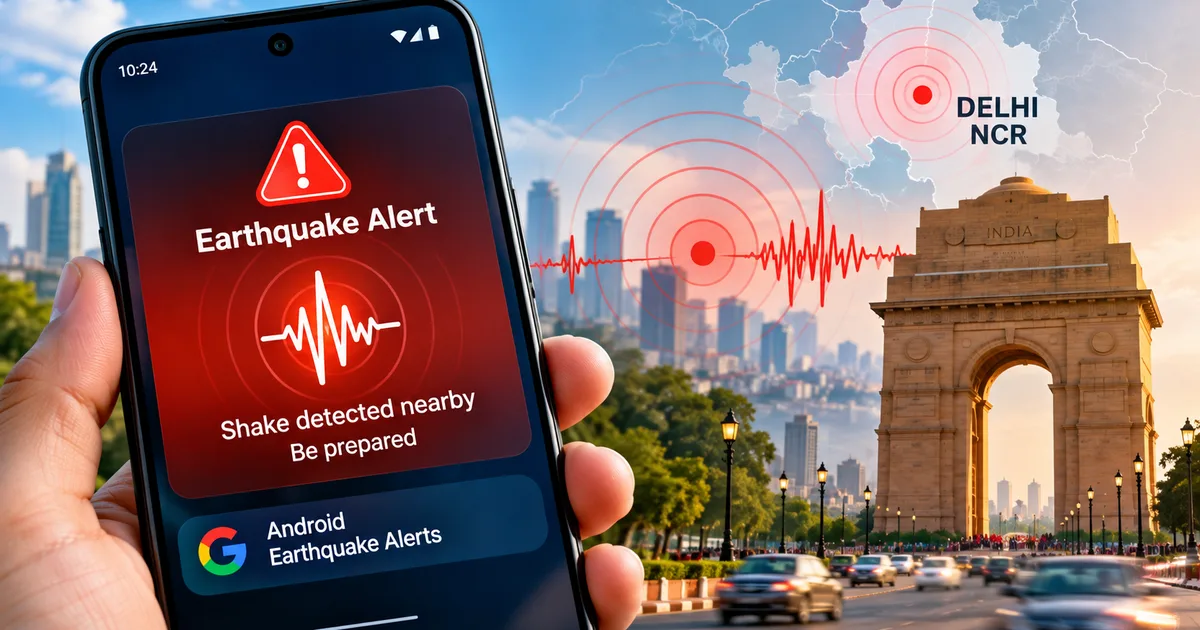
So, you're sitting in your Gurgaon apartment, sipping your evening chai, and suddenly your phone starts blaring a strange, loud alarm. A few seconds later, the ceiling fan starts swaying. The windows rattle. And you realise what's happening. You've just experienced the magic, and the terrifying reality, of the Android Earthquake Alerts 2026 update in action. With the recent Delhi NCR tremors shaking everyone up yet again, Google's Early Warning System has suddenly become the most talked-about feature on our smartphones.
Honestly, it feels like science fiction. One second you're doomscrolling Instagram or arguing in a family WhatsApp group. The next, your ₹15,000 Redmi phone predicts a natural disaster before the ground even moves. But it's not magic. It's just a lot of clever engineering combined with the massive scale of the Android ecosystem (which makes sense, actually). There are around a billion Android phones active in India right now. And Google is basically using all of them.
I think understanding how this tech works, why it successfully saved lives in Venezuela, and why it sometimes fails here in North India requires looking under the hood.
How your phone became a mini seismometer
Every modern smartphone has a tiny piece of hardware inside called an accelerometer. It's the same little chip that tells your phone to rotate the screen when you turn it sideways for a YouTube video. It's also what counts your steps in those fitness apps you download in January and ignore by February.
But a few years ago, some very smart engineers at Google realised something fascinating.
In my experience, engineers love solving problems like this. These accelerometers are sensitive enough to feel the specific vibrations of an earthquake. Not just any vibration, mind you. They can distinguish between you dropping your phone on the floor, and the deep rumble of tectonic plates shifting under the earth's crust.
Earthquakes basically send out two types of waves.
First come the P-waves or Primary waves. These travel extremely fast through the ground. They are relatively harmless. You might not even feel them. Then come the S-waves or Secondary waves. These are slower, but they pack a punch. S-waves are the ones that cause serious damage like collapsing buildings or breaking roads.
When an earthquake starts, the fast P-waves hit the surface first. Your Android phone feels that specific P-wave vibration. And because it's connected to the internet, it instantly sends a tiny packet of data to Google's servers. It says, "Hey, I felt a P-wave at this exact location."
The power of the crowd
One phone feeling a bump means absolutely nothing. You might have just slammed your fist on the table because the Indian Railways Kavach 4.0 Rollout 2026 got delayed again. Or maybe your Swiggy order was cancelled. But what happens when ten thousand phones in the exact same pincode send that exact same signal to Google's servers at the exact same millisecond?
Google knows it's a real earthquake. The servers instantly calculate the epicenter and the estimated magnitude based on the rapid spread of those signals. Then, they bounce a warning back to all the phones in the surrounding areas about to get hit by the damaging S-waves.
Thing is, internet signals travel at the speed of light. S-waves travel through rock much slower. So the math works in our favor. You get the alert a few seconds before the heavy shaking starts. It's a brilliant application of technology. It's basically a crowd-sourced early warning network built on devices we already own.
The Venezuela success story: proof that it works
Look, we have to talk about what happened in Venezuela recently. It proved this system actually works in the chaotic real world, not just in a California testing lab.
When a 6.2 magnitude earthquake struck the northern coast of Venezuela, it caused severe damage in Caracas and several coastal towns. But millions of people got a blaring warning on their phones before they felt a single tremor. Social media was flooded with screenshots of the Google notification. People had those few precious seconds to dive under a sturdy table or step away from windows.
"A Google official confirmed that the company's Android Earthquake Alerts System detected the initial seismic activity in Venezuela and sent warning notifications to users seconds before the shaking was felt."
That is a massive achievement. Traditionally, building a national early warning system requires governments to spend hundreds of crores. They have to install massive, expensive seismometers deep underground all over the country. Japan has a legendary system. Mexico has one. But most developing countries simply can't afford that kind of infrastructure.
Google basically looked at that problem and asked why we should build an entirely new network of physical sensors. Everyone already carries a connected sensor in their pocket. If you ask me, this is the best part of the whole setup. If you want to read more about how tech is bypassing traditional infrastructure to fix real-world problems, you should check out our Tech Explainers section.
The Indian context: collaboration with NDMA
You might be wondering if this is something Google just forced onto our phones without asking. Actually, the rollout in India was a coordinated effort. Google worked directly with the National Disaster Management Authority and the National Seismology Centre to bring this feature to Indian users.
I think this is extremely relevant because India's geography is a mess. We have the Himalayas in the north, which are highly active. And we have a massive plateau in the south. Working with local authorities means the alerts are integrated with the official systems. So, when the NDMA detects a major quake using their traditional massive seismometers, they can also trigger the Android alert system to push warnings to users.
It's a two-pronged approach.
The phones act as millions of micro-sensors. The government's official sensors provide the heavy-duty verification. It's a great example of public-private partnership. But as we saw recently, even this combined effort has blind spots.
Why did the system fail during the North India tremors?
If the system is so great, and if it worked in South America, why did it totally fail during the recent tremors that shook Delhi NCR, Punjab, and Haryana? I was sitting in my living room. The couch started shaking violently. And my phone was dead silent. No warning. No loud alarm.
The truth is, the system is far from perfect. India presents some very unique geographical and infrastructural challenges for it.
First, the system requires extreme density at the source. It needs a lot of phones in the exact area where the earthquake starts to detect those initial P-waves clearly. Many earthquakes that shake Delhi actually originate deep in the Hindu Kush mountains of Afghanistan or the rugged regions of Nepal. In these mountainous areas, mobile network coverage is sketchy at best. Fewer people live there. I'm not sure exactly why Google hasn't found a workaround for this yet. If Google's servers don't get enough data fast enough from the epicenter, they can't confirm the quake and send the alert to Delhi in time.
Second, there is the unavoidable issue of server processing and transmission time. Even computing at light speed takes a fraction of a second. If the epicenter is too close to your city, the damaging S-waves will reach you before the internet signal can make the round trip. From the epicenter, to Google's servers, and back to your phone. You are essentially caught in the blind zone. You will feel the shake before the notification pings.
Third, your specific phone needs to be connected to the internet and have location services turned on continuously. If you are underground in the Delhi Metro with no signal, you won't get the warning. Or if you turned off your location tracking to save your daily Jio data limit, you won't get it either. The server doesn't know where you are.
It's frustrating. People feel this when big tech companies promise the moon but underdeliver on the ground. Think about the recent hype around Google's September 2026 Android Feature Drop: India Rollout. Half the marketed features didn't even work properly on the mid-range phones most Indians actually use.
How to make sure you're protected (and what to do)
You absolutely need to have this feature turned on. Even a two-second warning is enough time to grab your sleeping child or step away from a tall bookshelf. It's completely free. It doesn't drain your battery in any noticeable way. And it could save your life in the right circumstances.
Checking if the alert system is active on your phone only takes a few taps:
- Open your phone's settings app.
- Scroll down and tap on safety and emergency. On some older Android versions, it might be hidden under location then advanced.
- Tap on earthquake alerts.
- Make sure the toggle switch at the top is turned on.
I highly recommend tapping the "See a demo" button on that screen. That way you know exactly what the alarm sounds like. Spoiler alert: it is incredibly loud and grating. It bypasses your Do Not Disturb settings entirely. This is exactly what you want when a building is about to shake (annoying, I know).
What to do when the alert actually sounds
Getting the alert on your screen is only half the battle. You need to know instinctively what to do in those three to five seconds before the heavy shaking hits. Freezing in panic defeats the whole purpose of having an early warning.
- The universal golden rule of earthquake safety is to drop, cover, and hold on. Drop to the ground immediately, get under a sturdy desk or heavy dining table, and hold onto a leg so the furniture doesn't shift away from you during the violent shaking.
- You must stay away from glass. Windows shatter easily and violently during quakes. Move to an inner, load-bearing wall if you can't find a table.
- Do not run outside under any circumstances. If you're sitting in a tenth-floor apartment in Noida, running for the stairs is the absolute worst thing you can do. Most severe injuries and fatalities happen from falling debris like glass, air conditioners, and facade tiles while people are trying to exit buildings. Stay put and find cover inside.
- If you happen to be driving, pull over safely to the side of the road, away from overpasses, bridges, or massive power lines, put the parking brake on, and stay inside your car with your seatbelt fastened until the shaking stops.
It's basic safety stuff. But when the adrenaline hits and the ground moves, people forget the basics. That's why practicing and reading up matters. We cover a lot of these practical, everyday safety guides over in our How-to Tech Guides hub. Because knowing how to safely interact with the physical world using your tech is just as important as buying the latest gadget.
The bottom line on Android quake alerts
Google figuring out how to turn our idle smartphones into a massive network of interconnected earthquake detectors is cool. It's a genuinely helpful, life-saving use of technology.
But we have to be realistic about its limitations. In my experience, relying too much on tech is dangerous. It failed during the recent North India tremors because basic physics and remote network infrastructure got in the way. It is not a perfect silver bullet.
You have to treat the Android Earthquake Alerts system as a backup plan. It's an extra layer of security, not a guarantee. Turn it on, and keep your phone charged. But don't assume it will save you every single time the earth decides to move. Honestly, you should probably spend a weekend making sure that heavy bookshelf in your living room is actually bolted to the wall. Tech can only do so much.