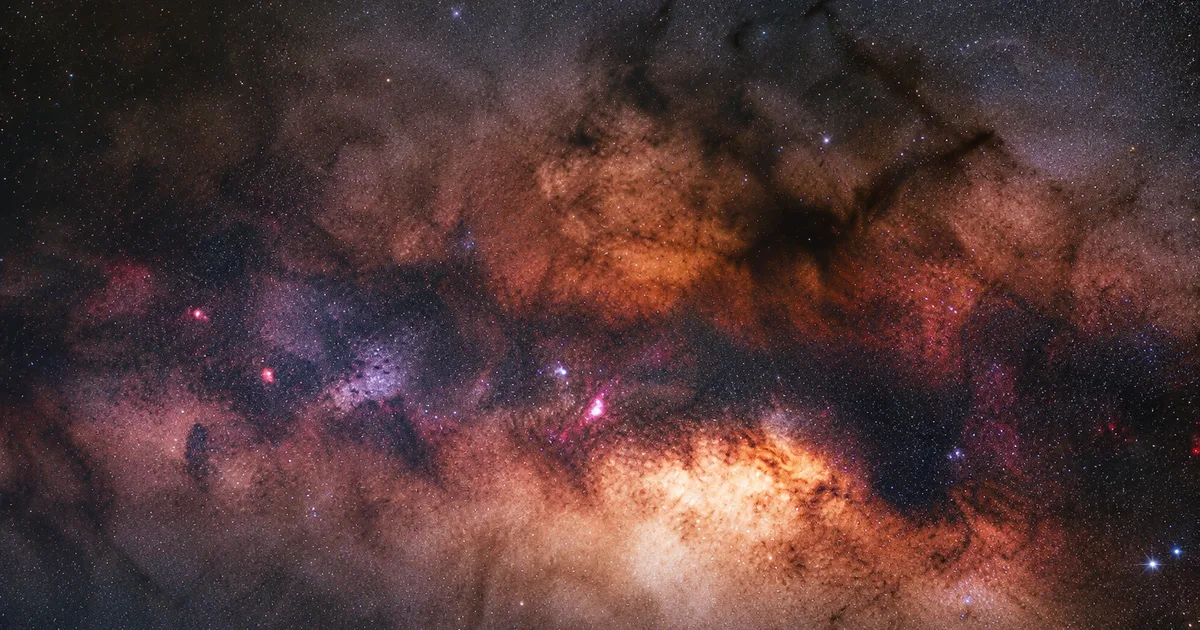
Think about the largest digital photo you've ever taken on your phone. Maybe it's a 108-megapixel shot of a sunset in Manali that takes up half your storage. Now multiply that by sixty. The European Space Agency recently released the new ESA Euclid Telescope Milky Way Image, and it's a monster. We're talking about a massive 6-gigapixel galactic center mosaic that captures the crowded, dusty heart of our galaxy. It contains over 60 million stars in a single frame. It's like trying to count every grain of sand on a Goa beach, but in outer space.
Honestly, this image is a big deal. For years, astronomers had a tough time getting a clear look at the galactic center. Why? Dust. A thick, dusty wall blocks the view, it's like trying to peer through that heavy Delhi smog in November. But this telescope uses advanced infrared cameras that cut right through all that haze. If you ask me, the results are wild because we're seeing details that weren't visible before. And if you want to check out other space explainers, you can visit our space explainers section for similar guides.
Why the 6-gigapixel galactic center mosaic is a big deal
Scale here is just hard to wrap your head around.
One gigapixel is a billion pixels. This monster has six billion. Think about that. If you wanted to view the whole thing at full resolution, you'd need hundreds of standard 4K TV screens lined up side-by-side. The file's so big that downloading it would swallow your daily 1.5 GB data pack on Jio or Airtel in a split second. Honestly, I think you'd need a high-speed fiber connection just to load the raw file without your laptop freezing up (I'm not completely sure of the exact size in gigabytes, but it's huge).
The sheer size is cool, sure, but what's actually inside those pixels is what matters. The telescope looked right at the galactic bulge. That's the crowded middle part of our Milky Way. Before this, scientists could only guess how many stars were packed in there because they couldn't see them clearly. Now, we can see them. They're packed together like commuters in a Mumbai local train during rush hour, except these commuters are giant balls of burning gas separated by light-years of empty space.
Here's the deal. This map is just one piece of a much larger project. The European Space Agency is building a massive cosmic atlas because they want to understand how the whole universe is structured. By mapping millions of stars, astronomers can easily trace the history of our galaxy. It's basically like using Aadhaar cards to run a census on the entire population, but for stars.
What the Milky Way bulge survey reveals to astronomers
The main goal of this is the Milky Way bulge survey. It studies the oldest stars in our galaxy.
And these old stars hold some massive secrets.
By looking at their colors and brightness, researchers can figure out how old they are and what they're made of. Astronomers at Leiden University are already analyzing the dataset. I think they're hoping to find rare objects that are usually invisible. These include brown dwarfs, which are failed stars that don't have enough mass to start nuclear fusion. They also want to spot free-floating planets. These are lonely worlds that got kicked out of their solar systems and now drift through the dark alone. And since they don't emit much light, finding them is a massive pain (which makes sense, really).
"We're looking for the needle in the cosmic haystack. With sixty million stars captured in such high detail, we finally have the statistical power to find these rare objects."
This quote from the Leiden team shows how huge this data is. It's a goldmine. Astronomers will spend decades studying this single image. They'll compare it with older data from telescopes like Hubble or James Webb. But there's a catch. While Webb focuses on tiny, deep spots of the sky, Euclid looks at massive areas. That's the main difference here. Basically, Euclid is a surveyor that maps the forest, while Webb looks closely at individual leaves.
How the space camera sees through cosmic dust
So, how does Euclid actually manage this?
It comes down to wavelengths. Space is full of tiny dust grains. And these grains are great at scattering visible light. That's why the galactic center looks like a dark, sketchy cloud to our eyes. But infrared light has longer wavelengths. It just slips past the dust without getting scattered.
Euclid has two main instruments. One camera captures visible light, while the other's built for near-infrared wavelengths. That infrared instrument is what makes the galactic center visible. It's like a pair of night-vision goggles. It turns the dark, dusty void into a glowing field of millions of stars. And the detail is so sharp that astronomers can pick out individual stars, even in the most crowded parts of the bulge.
Look, this isn't cheap technology. The Euclid mission cost the European Space Agency around 1.4 billion Euros. In Indian currency, that's about 12,500 crore rupees. That's a massive amount of money. To put that in perspective, ISRO built the Chandrayaan-3 lunar mission for about 615 crore rupees. So Euclid is about twenty times more expensive than India's moon lander. But the science you get is huge. If you ask me, it's a long-term investment in our understanding of physics and cosmology.
The Indian connection to space mapping
You might wonder if India has a role in this kind of research. While ISRO isn't a direct partner, Indian scientists still analyze this data. Researchers at institutes like the Indian Institute of Astrophysics in Bengaluru use these public datasets for their own work. They study stellar dynamics and dark matter. When ESA releases these images, they also release the raw data. Honestly, if you've got a decent internet connection and a good computer, you can just download it and start doing science yourself.
Also, India has plans for its own space observatories. We've already launched Aditya-L1 to study the Sun, and now scientists are proposing new telescopes to study cosmic rays and ultraviolet light. Which is pretty exciting, if you ask me. The success of missions like Euclid helps Indian researchers design better instruments for future domestic missions. It's a collaborative world and space science doesn't stop at national borders.
How you can explore the image yourself
You don't need a PhD to appreciate this map. The European Space Agency put up zoomable versions of the mosaic online, and they're easy to access. You can start with a view of the whole galaxy and zoom in until you see individual pinpricks of light. It's wild. You scroll past thousands of stars and realize you're looking at a tiny corner.
If you want to explore the image, here's what you need to know:
- Use a desktop computer or a laptop. Phones will struggle to load the zoomable web interface because of memory limits.
- Make sure you have stable broadband. A standard mobile connection is probably going to lag a lot.
- Look for the darker lanes of dust cutting through the stars. These areas have dust that's too thick even for infrared light.
- Search for clusters. These are groups of stars that formed together and stay held together by gravity.
Personally, I spent an hour zooming into random sections of the map. It makes you feel tiny. Every single dot in that image is a sun. And since many of those suns probably have planets, there's a good chance some of them have liquid water. The scale is just mind-blowing. If you're interested in stargazing from home, check out our list of mobile tools that help you map the night sky. Also, if you want to keep up with developments in space and technology, we regularly cover these topics in our science news section.
Astronomers are going to release more data as the mission goes on. Right now, Euclid is still early in its six-year survey. It'll map a third of the sky eventually. By the time it finishes, we'll have a three-dimensional map of billions of galaxies. And this first look at our own galactic heart is just a sample of what's coming.