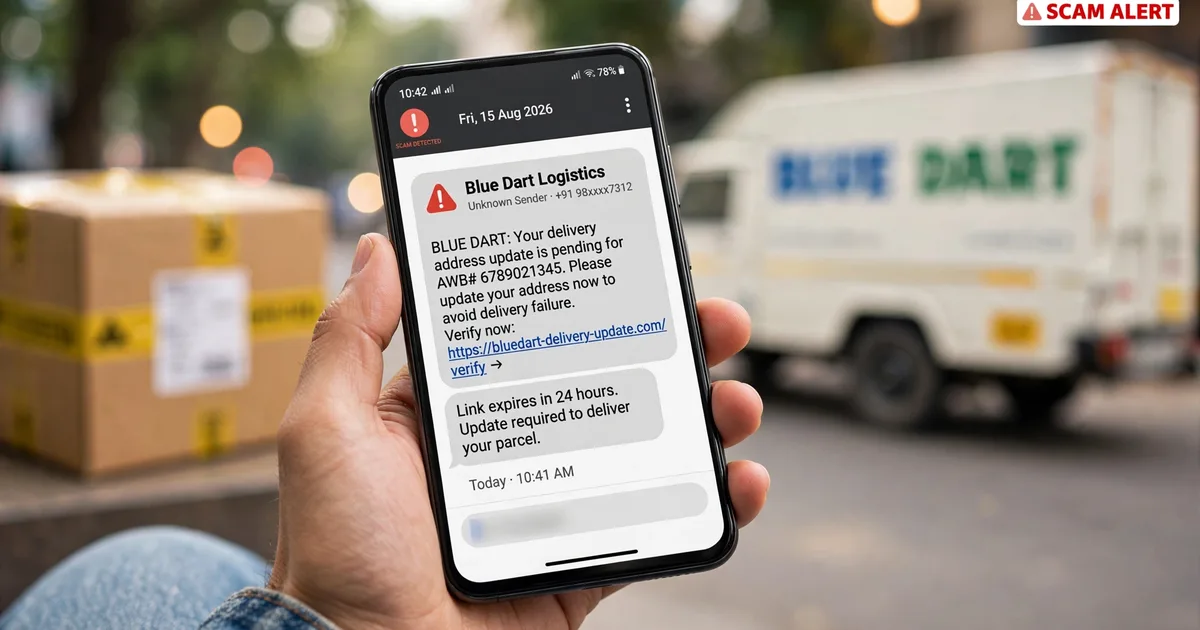
You're sitting at your desk on a regular Tuesday afternoon when your phone buzzes with a message. The text looks official. It warns you that Blue Dart attempted to deliver a parcel this morning, but couldn't find your house number. And it tells you that your package goes straight back to the sender if you don't update records within twelve hours. If you tap that link, you walk straight into the fake Blue Dart delivery address update SMS scam 2026, a calculated fraud sweeping across Indian cities right now.
Thing is, almost everyone is expecting a parcel these days (annoying how hooked we are on online shopping, I know). Maybe you ordered a phone charger on Amazon, or you're just waiting for a new bank passbook. In my experience, that expectation is what scammers exploit. They cast a wide net across thousands of random Indian phone numbers. And they know a lot of people will react out of instinct rather than caution.
It works because people panic.
What the fake Blue Dart delivery address update scam actually is
This fraud is a modern variation of smishing, which is just phishing over SMS. Criminal gangs blast out bulk messages pretending to be Blue Dart Express, one of India's biggest courier networks. The message claims your delivery failed because your house address is incomplete or missing a landmark. To fix things, it urges you to tap a link and reschedule.
Here's where the trap snaps shut. The link takes you to a cloned page that copies Blue Dart's authentic tracking portal, right down to the corporate blue and white colors. It asks you to verify your full name and residential address. Then comes the real hook. The site demands a tiny re-delivery fee, usually Rs 5 or Rs 10.
Most people let their guard down here because five rupees feels completely harmless. Nobody thinks a scammer wants pocket change. But that token payment isn't about five rupees at all. When you type your card details or net banking password on that fake portal, the scammers grab everything in real time. Within minutes, they run unauthorized charges on your account while stealing the one-time passwords sent to your phone.
If you ask me, it's the exact same script we keep seeing. We've tracked this pattern before across our scam alerts and consumer warnings, especially during rush shopping festivals. In fact, it mirrors the tactics used in the India Post parcel delivery scam that hit millions of India Post customers with nearly identical address alerts.
How the fake courier delivery SMS fraud operates
The operation runs with scary precision. Criminal networks don't operate as lone hackers in basements anymore. In my experience, they run organized syndicates with spoofed SMS gateways and mule bank accounts spread across multiple Indian states. To stay safe, you have to understand how their playbook works.
The urgent text message
It all starts with fake urgency. The SMS usually arrives from an ordinary ten-digit mobile number or a sketchy sender ID, rather than an official header like AX-BLUEDT or VK-BLUEDT. The text warns that delivery failed because your street name was missing. And it threatens to cancel the whole booking if you don't respond right this second.
Look, I've noticed these texts often have weird little mistakes. Sometimes 'Address' is spelled as 'Adres' (I'm not sure why they still make typos like that, honestly). The link in the message is always a dead giveaway. Instead of taking you to bluedart.com, it points to sketchy domains like bluedart-update-parcel.in or bluedart-kyc-service.top that were registered barely days ago.
The clone tracking portal and token payment
Once you tap that link, the page looks surprisingly real on a phone. It displays a fake tracking number with an alert: 'Shipment on hold at local hub due to incomplete address.'
You type in your street address and PIN code. Then the page sends you to collect that tiny Rs 5 fee. When you submit your card details or UPI ID, the scammer's server captures every character. Behind the scenes, someone in a scam call center grabs those stolen numbers and tries a huge transfer, maybe Rs 25,000 or Rs 50,000, on a shopping site or an overseas merchant.
Next, the fake portal prompts you for the OTP that just hit your phone. You think the OTP is for the Rs 5 charge. In reality, that OTP approves the massive debit that empties your bank account.
It all happens in seconds.
The malicious APK and call forwarding trick
Phishing sites aren't the only weapon here. In some nasty cases, attackers push things even further. When people click the SMS link, the site asks them to install a so-called 'Blue Dart Support' app.
That download is actually a malicious APK file packed with remote spyware. Once it's on an Android device, the rogue app asks for deep permissions to read incoming SMS texts and mirror your phone screen. A retired Army officer in India recently lost over Rs 12 lakh after installing a fake courier app like this, which gave criminals total control over his banking apps and OTP messages.
Another dirty trick uses call forwarding strings. Sometimes a fake support agent calls you directly, offering to help locate your parcel. They tell you to type a specific code into your phone dialer, usually *21* followed by a ten-digit mobile number.
I think this is the sneakiest trick of the bunch. That code is a standard telecom call forwarding code supported by networks like Airtel and Jio, alongside Vodafone Idea. Dialing it quietly routes your incoming calls and verification texts straight to the scammer's handset (which is terrifying if you think about it). It leaves your bank accounts wide open while you wonder why your phone went silent. Just recently, a Mumbai woman trying to track an online parcel lost Rs 68,000 after scammers tricked her into running these unauthorized steps.
Warning signs in a Blue Dart address update phishing link
Spotting these fake delivery notices isn't hard once you know what real couriers never do. Keep an eye out for these red flags:
- The SMS originates from an ordinary ten-digit mobile number or strange country code instead of an official TRAI-registered enterprise header.
- The link leads to an unverified web domain rather than the official bluedart.com address.
- The webpage demands an online payment of Rs 5 or Rs 10 to reschedule or update your delivery address.
- The text creates intense panic by claiming your parcel will be destroyed or permanently returned within a few hours.
- The site asks you to download an Android APK package outside the official Google Play Store.
- A caller instructs you to dial short numeric codes or install screen-sharing software like AnyDesk or TeamViewer.
CERT-In and Indian cyber police repeatedly advise citizens: Blue Dart and other logistics firms never charge fees to update address details, nor do they request OTPs over the phone. Any demand for online payment to release a standard parcel is fraudulent.
Honestly, real delivery companies already have your tracking ID synced with the store where you bought the item. If a delivery driver can't find your building, he calls you directly from his route, or the shopping app pings you inside your account. They don't send messy text messages asking for debit card details.
Plain and simple.
How to protect your bank account and phone
If you get a sketchy text like this, the safest move is dead simple. Don't tap the link, and delete the message right away.
Here's what you should do instead:
- Track your order exclusively through the app or website where you made the purchase, whether that is Amazon, Flipkart, or a direct brand store.
- Verify tracking numbers by navigating directly to the official Blue Dart website at bluedart.com rather than following links inside unverified messages.
- Remember that you should never pay nominal re-delivery fees under any circumstances because real couriers reattempt deliveries free of cost.
- Disable app installations from unknown sources in your Android security settings to prevent accidental malware downloads.
- Check your call forwarding status by dialing *#21# on your phone dialer to verify that no unauthorized forwarding is active on your SIM card.
- Set daily UPI transaction limits and disable international debit card usage inside your mobile banking app to minimize potential losses.
In my experience, these traps spike heavily during festival sales. Scammers love piggybacking on big promotional sales, which we covered in our breakdown of festival delivery phishing tricks. And if you want a complete guide on securing your phone, check out our practical digital safety guides for step-by-step settings on Android and iOS.
Where to report parcel delivery fraud in India
When cyber fraud hits, speed is everything. Cyber cops call the first two hours after a scam transaction the golden hour. If you move fast enough, officials can often freeze the stolen money in the scammer's account before they pull it out at an ATM or swap it into crypto.
Take these steps right away if you typed your details or lost money:
- Contact your bank's emergency fraud line immediately to block your debit cards, freeze your net banking account, and pause UPI access.
- Dial the National Cyber Crime Helpline at helpline 1930 right away to register an incident ticket with the Indian Cyber Crime Coordination Centre (I4C).
- File a formal complaint on the official national portal at cybercrime.gov.in with full transaction details, SMS screenshots, and bank statements.
- Notify your local state cyber crime police station with copies of your complaint acknowledgment number.
- If you installed any unknown application, perform a complete factory reset on your mobile device to wipe hidden malware.
Honestly, staying skeptical about random text messages doesn't cost you a single rupee. Taking half a minute to check a tracking ID on an actual app can save an entire month's salary. Make sure you warn your parents, since older folks get targeted the most.