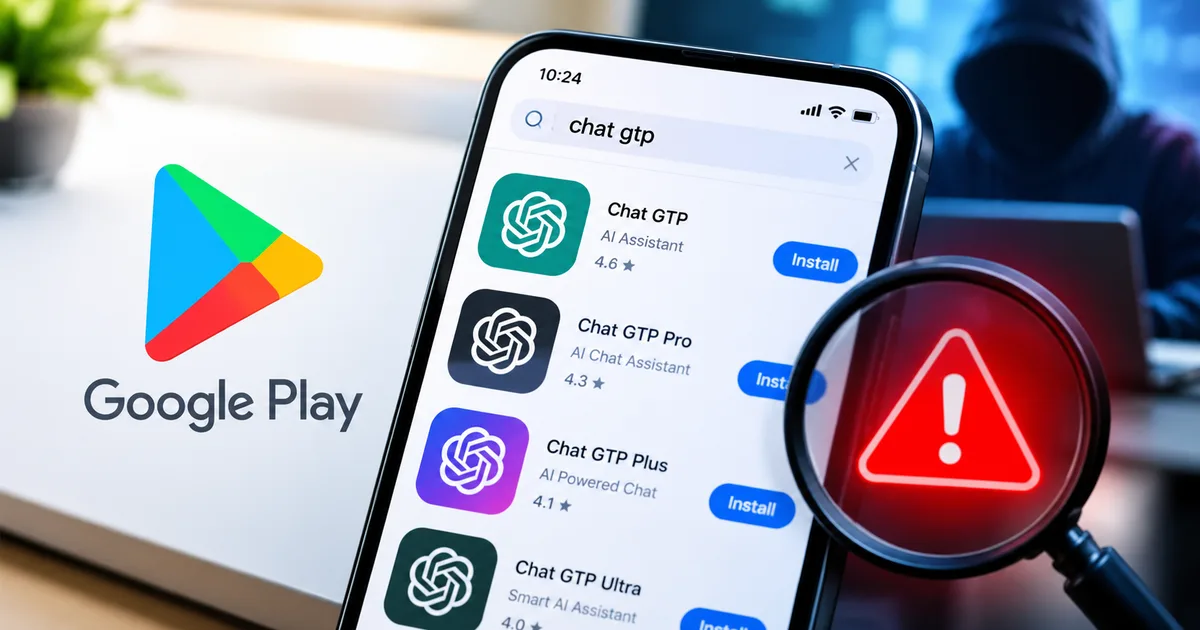
I got a call from my uncle in Pune last Tuesday. He was furious. He told me he'd downloaded ChatGPT, asked it to write a simple email, and the app demanded ₹899 through UPI before giving him the answer. I knew immediately what happened. He fell for one of the hundreds of fake 'Chat GTP' apps on Play Store that are flooding Android phones in India right now.
Honestly, this is a massive mess. Everyone wants to try artificial intelligence because they hear about it on the news constantly. So they open their phones and search for the app. But they misspell things, typing "Chat GTP" instead of ChatGPT. Scammers know this. They build apps that look exactly like the real thing and buy fake reviews. Then they wait for unsuspecting Indian users to get tricked and hit download.
How the typo-squatting scam actually works
Typo-squatting is an old trick. Scammers register names that are very close to popular brands. And if you're typing fast on a small phone screen, you just won't notice the letters are swapped.
Look, you open the Play Store and type Chat GTP. The top result has a slick logo. So you install it. Once that app is on your phone, a few different things can happen. In my experience, the best scenario is getting a useless app packed with unskippable video ads for gambling sites. The worst scenario is much darker.
Hackers use these fake apps to deploy serious malware. Security researchers at Group-IB recently identified a new malware combination called WindRelay that drives a growing fraud scheme. Basically, these malicious apps sit on your phone and quietly steal your data. They read your SMS messages to intercept bank OTPs, and they scrape your contact list.
In another recent incident, CyberSecurityNews reported that hackers attacked Android users with fake ChatGPT invites. They sent WhatsApp messages with a sketchy APK file. Install it, and the app drops hidden malware that hijacks your device. We saw similar tactics in the recent fake Aadhaar loan scams outbreak earlier this year (which was a total disaster).
How bad apps bypass Google security
You might assume any app on the official Play Store is safe. That's a bad assumption. Google uses automated systems to scan for malware. But scammers are clever.
They upload a clean version of the app first, which usually passes the security checks without any issues. Once it's approved and available for download, they push an update. That update contains the malicious code.
Sometimes the app itself doesn't have traditional malware. It just works as a thin wrapper around a web browser that loads a website mimicking an AI chat interface. Because the sketchy activity happens on the website and not in the app code, it bypasses security scanners completely. I think this is why we see so many of them.
The hidden financial costs
Most of these fake apps just want your money directly.
The real ChatGPT has a very capable free tier. You can use it without paying a single rupee.
Fake apps operate differently. They let you ask three questions. Then a pop-up blocks the screen and demands a weekly subscription of ₹499 or ₹899. They integrate seamlessly with Indian payment systems. You get a prompt to pay via Google Pay or PhonePe.
Many people pay it because they think this is just how the official app works. I know it sounds obviously fake to tech people. But regular users don't really have a reason to doubt it.
The criminals behind these scams study Indian consumer behavior. They know a one-time charge might trigger an alert, so they rely on auto-renewing subscriptions instead. They set up e-mandates on your UPI app. You authorize it once because you think it's a one-time verification fee, and the app drains money from your account every week. I'm not sure exactly why banks don't catch this faster. But it takes most people a month to realize where their balance went.
We're also seeing massive privacy violations. Microsoft recently caught malicious AI assistant extensions harvesting chat histories from hundreds of thousands of users. Think about it. If you use a fake app to draft sensitive work emails or summarize personal documents, the scammers read all of it. Your private data goes straight to servers controlled by cybercriminals.
Warning signs of a scam app
You need to know how to spot these scams. The Play Store tries to clean them up, but new ones appear every single day. Here is what you should look for.
- Check the developer name before downloading. The only company that makes the official ChatGPT is OpenAI, so any other name is a massive red flag.
- Read the written comments instead of just looking at the star rating. Scammers buy fake five-star reviews, but angry users will leave one-star warnings about hidden charges.
- Review the permission requests carefully. An AI chatbot does not need access to your SMS messages, device location, or phone dialer.
If an AI app asks to read your texts, it's likely trying to steal OTPs.
How to get the real ChatGPT on your phone
Getting the official app is straightforward if you know what to look for.
Open the Google Play Store or Apple App Store. Search exactly for "ChatGPT". Then look for the app developed by "OpenAI".
The official logo is a geometric flower shape. It's usually white on a black background, or black on a white background. It's never green. Look at the download count too. The real app has hundreds of millions of downloads. Basically, if the app you're looking at only has ten thousand downloads, you're in the wrong place.
The official app lets you log in with your Google or Apple account. It won't ask for credit card details or UPI IDs just to start chatting. There is a paid version called ChatGPT Plus. But the free version works perfectly well for most everyday tasks. If you prefer using AI on your computer, read our ChatGPT desktop download guide for detailed instructions.
The dangerous mix of AI apps and deepfakes
The scams are getting more sophisticated. We're seeing a dangerous overlap between fake AI apps and deepfake technology.
Some of these fake apps ask for voice samples. They claim it's for a voice recognition setup process, but in reality, they're collecting audio data to clone your voice. Then they use this cloned voice to call your family members. They pretend you're in an emergency and need money urgently. This is a growing problem across India (which makes sense, actually, given how cheap the tech is now).
We've seen similar tactics used in financial fraud involving deepfake investment app scams. The common thread is always deception. They use something shiny and new, like an AI chatbot or a celebrity endorsement, to bypass your natural skepticism. They know people are curious about these tools. If you ask me, they exploit that curiosity mercilessly.
Indian regulators taking action
The Indian government is taking steps to address this scam. The cyber police in Gurgaon recently reached out to tech giants to remove fake apps and web links created by online fraudsters.
"Days after the cyber police reached out to tech giants, urging them to remove fake apps and web links created by online fraudsters, Google has taken down two apps."
Google took down multiple apps after the police notice. But it's a constant battle. For every app they remove, three new ones pop up under different names.
The Reserve Bank of India has tightened rules around digital payments to protect consumers. If you authorize a UPI payment yourself, getting a refund is incredibly difficult. The bank will argue that you entered your UPI PIN voluntarily. Thing is, prevention is your only real defense.
Alternatives to standalone apps
If you're worried about downloading the wrong app, you don't have to use an app at all.
You can use the web browser on your phone. Open Chrome or Safari and go directly to chatgpt.com. You get the exact same experience without any risk of downloading hidden malware.
You can also use AI features built into apps you already trust. Microsoft integrated its Copilot AI directly into the Windows search bar. Google has Gemini integrated into Android. You really don't need a random third-party app to experience artificial intelligence.
What to do if your phone is compromised
If you realize you have a fake AI app on your phone, you must act quickly. First, uninstall the app immediately. Just go to your phone settings and remove it from the apps list.
Second, check your bank accounts (annoying, I know). Open your banking app and look for any unauthorized UPI mandates or card deductions. Scammers often set up recurring auto-payments. You might be losing ₹500 every week without noticing. Cancel any suspicious mandates immediately.
Third, change your passwords. If you used the same password on the fake app that you use for your email, your accounts are at risk.
If you lost money, report it. The Indian government has a dedicated cybercrime portal. Call the 1930 national helpline. You can also file a complaint at cybercrime.gov.in. Just be prepared to provide transaction IDs and screenshots of the app.
You should also alert your contacts. Since many of these malicious apps scrape your address book, your friends and family might start receiving WhatsApp messages that appear to come from you. Tell them you installed a bad app. Warn them not to click any links sent from your number.
We cover many similar threats in our scam alerts and safety section. The digital world is full of traps. Scammers follow the trends. When everyone wants AI, they build fake AI apps. You just have to stay slightly more informed than they are.